Define the positive mass collision stopping power as Scol/ρ=−(1/ρ)dT/dx. For a projectile of charge ze, mass M≫me, speed v=βc and Lorentz factor Γ=(1−β2)−1/2, the Bethe stopping formula can be writtenHere Z is the absorber atomic number, A its molar mass, I its mean excitation energy, re=e2/(4πϵ0mec2), and NA the Avogadro constant. AlsoThe optional δ and C/Z represent density and shell corrections. For a very heavy projectile Tmax≃2mec2β2Γ2, and the bracket reduces to ln(2mec2β2Γ2/I)−β2 when those corrections are neglected. If T denotes remaining projectile kinetic energy, the printed dT/(ρdx) is negative; the conventional positive stopping power has the minus sign above.[ref]
ρScol=4πNAre2mec2AZβ2z2[21ln(I22mec2β2Γ2Tmax)−β2−2δ−ZC].
Tmax=1+2Γme/M+(me/M)22mec2β2Γ2.
PSTAR and ASTAR database methods by NIST. Section 3.5, use of Bethe theory at high energies and measured low-energy stopping powers
Start with a fast massive projectile following an approximately straight path. Its time-dependent electric field perturbs bound absorber electrons. At large impact parameter, treating the perturbation to first order and summing excitation and ionization transition probabilities gives an energy transfer weighted by the absorber's oscillator strengths. The oscillator-strength sum rule reduces the leading coefficient to the number of target electrons, while their logarithmically weighted excitation energies define I.
The classical impulse picture explains the logarithm: a transverse impulse scales as 1/(bv), so transferred energy scales as 1/(b2v2); multiplying by the number of encountered electrons in 2πbdbdx gives db/b. Quantum scattering replaces ad hoc short- and long-distance cutoffs by recoil kinematics and bound-state excitation. Relativistic projectile kinematics supplies Tmax and the −β2 term. Summation over many independent encounters gives the mean stopping power, rather than the energy-loss straggling of individual tracks.
The leading approximation assumes M≫me, a sufficiently fast projectile for perturbation theory, a largely fixed projectile charge, and weak correlations between collisions. At low velocity, electron binding, charge exchange and nuclear stopping become important; at high velocity, polarization screens distant interactions and gives the density correction. The projectile's bremsstrahlung is suppressed by its large mass and is excluded from the collision stopping power.
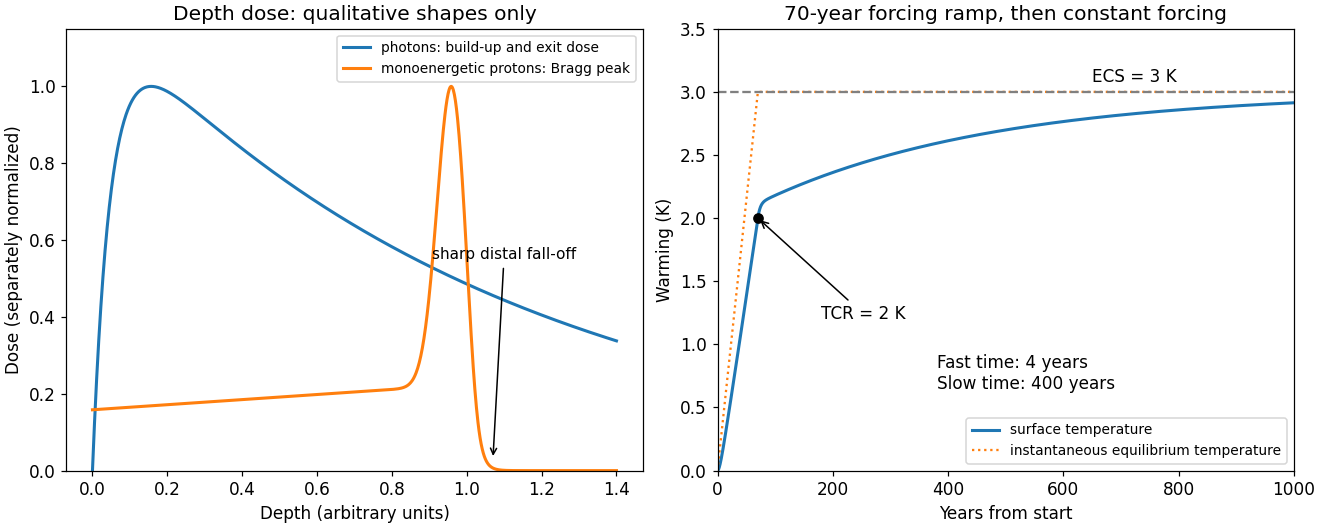
The dominant z2/β2 factor raises the energy loss as a charged projectile slows, while the logarithm moderates that rise. This produces a Bragg peak close to the end of its particle range. At still lower velocity, changing effective charge, shell effects and nuclear stopping invalidate extrapolation of the elementary Bethe stopping formula to zero energy. A finite initial energy gives a finite continuous-slowing-down range,A higher initial energy increases the particle range; greater electron density increases stopping power per unit length. Absorber Z/A and I also affect the depth. Multiple Coulomb scattering, energy-loss straggling, nuclear reactions and the incident energy spread broaden the measured peak and distal fall-off; nuclear secondaries can produce a small tail. Superposing many incident energies makes a spread-out Bragg peak for an extended target. The schematic curve below illustrates shapes only and is not patient radiation dosimetry.
RCSDA=∫0T0S(T)dT.

Ancestors (10)
- S10
- 2019
- Past exam of the short options paper shared by Parts A and B of the physics course of the University of Oxford
- Short options paper shared by Parts A and B of the physics course of the University of Oxford
- Physics course of the University of Oxford
- Undergraduate course of the University of Oxford
- Course of the University of Oxford
- University of Oxford
- List of universities
- Home
Discussion (0)
New discussionThere are no discussions about this article yet.
Articles by others on the same topic (0)
There are currently no matching articles.