After injection, the radiopharmaceutical circulates and accumulates according to its biological targeting and clearance. Technetium-99m undergoes an isomeric nuclear transition, producing approximately 140keV gamma rays; its roughly six-hour half-life permits useful counting with limited persistence. Some photons undergo absorption or Compton scattering in the patient. A lead collimator in the gamma camera accepts a narrow range of directions so the accepted event retains positional information.
An accepted gamma ray deposits energy, commonly in a NaI(Tl) scintillator, by photoelectric effect or Compton scattering. The resulting visible particle scintillation light is collected by photomultipliers. Their relative pulse sizes determine an event position and their summed pulse estimates its energy. A pulse-height analyser accepts an energy window around the photopeak to reject many scattered events. Position and uniformity corrections are applied; accepted events increment a two-dimensional pixel histogram. After acquisition the computer displays this count map as a planar projection of tracer activity. Finite counting statistics, attenuation, scattering and the collimator limit the image's quantitative accuracy and spatial resolution.[ref]
A diagnostic example is technetium-99m methylene diphosphonate, which accumulates at sites of bone turnover for bone scintigraphy. A therapeutic example is sodium iodide iodine-131, taken up by thyroid tissue and used for selected thyroid disease including differentiated thyroid cancer.
For diagnosis, an escaping gamma ray or a Positron followed by annihilation photons allows external detection, with an appropriate short half-life and limited deposited energy. For molecular radiotherapy, short-range charged emissions such as beta particles, alpha particles or Auger electrons deposit substantial local energy in the targeted tissue. Iodine-131 emits therapeutic beta particles as well as imageable gamma rays, so these categories are functional rather than mutually exclusive isotope classes.
Single-photon emission computed tomography detects individual gamma rays from a tracer. Mechanically collimated gamma cameras acquire projections from multiple angles for tomography. The collimator discards most emitted photons, creating a strong sensitivity–spatial resolution trade-off.
Positron emission tomography uses a Positron-emitting tracer. The emitted Positron travels a short distance before electron-positron annihilation produces an approximately back-to-back photon pair. Coincident detection in a detector ring defines a line of response, giving electronic collimation and greater detection efficiency; time-of-flight PET further constrains position along that line. The positron range, non-collinearity, detector size, scatter and accidental coincidences limit spatial resolution and quantification. In both hybrids, computed tomography supplies anatomy and an attenuation correction map, with attention to registration and respiratory motion.[ref]
Nuclear medicine by NIBIB. Sections describing SPECT, PET and hybrid CT imaging
After thermalization, approximate the electron and Positron as initially at rest in their centre-of-momentum frame. Their total energy is 2mec2 and total momentum is zero. Two photons must therefore have equal energies and opposite momenta, since ∣pγ∣=Eγ/c. Conservation of energy givesResidual pair momentum and electron binding cause small departures from exact collinearity and exact photon energy; the standard PET calculation neglects them.
2Eγ=2mec2,Eγ=mec2=511keV.
Define the positive mass collision stopping power as Scol/ρ=−(1/ρ)dT/dx. For a projectile of charge ze, mass M≫me, speed v=βc and Lorentz factor Γ=(1−β2)−1/2, the Bethe stopping formula can be writtenHere Z is the absorber atomic number, A its molar mass, I its mean excitation energy, re=e2/(4πϵ0mec2), and NA the Avogadro constant. AlsoThe optional δ and C/Z represent density and shell corrections. For a very heavy projectile Tmax≃2mec2β2Γ2, and the bracket reduces to ln(2mec2β2Γ2/I)−β2 when those corrections are neglected. If T denotes remaining projectile kinetic energy, the printed dT/(ρdx) is negative; the conventional positive stopping power has the minus sign above.[ref]
ρScol=4πNAre2mec2AZβ2z2[21ln(I22mec2β2Γ2Tmax)−β2−2δ−ZC].
Tmax=1+2Γme/M+(me/M)22mec2β2Γ2.
PSTAR and ASTAR database methods by NIST. Section 3.5, use of Bethe theory at high energies and measured low-energy stopping powers
Start with a fast massive projectile following an approximately straight path. Its time-dependent electric field perturbs bound absorber electrons. At large impact parameter, treating the perturbation to first order and summing excitation and ionization transition probabilities gives an energy transfer weighted by the absorber's oscillator strengths. The oscillator-strength sum rule reduces the leading coefficient to the number of target electrons, while their logarithmically weighted excitation energies define I.
The classical impulse picture explains the logarithm: a transverse impulse scales as 1/(bv), so transferred energy scales as 1/(b2v2); multiplying by the number of encountered electrons in 2πbdbdx gives db/b. Quantum scattering replaces ad hoc short- and long-distance cutoffs by recoil kinematics and bound-state excitation. Relativistic projectile kinematics supplies Tmax and the −β2 term. Summation over many independent encounters gives the mean stopping power, rather than the energy-loss straggling of individual tracks.
The leading approximation assumes M≫me, a sufficiently fast projectile for perturbation theory, a largely fixed projectile charge, and weak correlations between collisions. At low velocity, electron binding, charge exchange and nuclear stopping become important; at high velocity, polarization screens distant interactions and gives the density correction. The projectile's bremsstrahlung is suppressed by its large mass and is excluded from the collision stopping power.
The dominant z2/β2 factor raises the energy loss as a charged projectile slows, while the logarithm moderates that rise. This produces a Bragg peak close to the end of its particle range. At still lower velocity, changing effective charge, shell effects and nuclear stopping invalidate extrapolation of the elementary Bethe stopping formula to zero energy. A finite initial energy gives a finite continuous-slowing-down range,A higher initial energy increases the particle range; greater electron density increases stopping power per unit length. Absorber Z/A and I also affect the depth. Multiple Coulomb scattering, energy-loss straggling, nuclear reactions and the incident energy spread broaden the measured peak and distal fall-off; nuclear secondaries can produce a small tail. Superposing many incident energies makes a spread-out Bragg peak for an extended target. The schematic curve below illustrates shapes only and is not patient radiation dosimetry.
RCSDA=∫0T0S(T)dT.
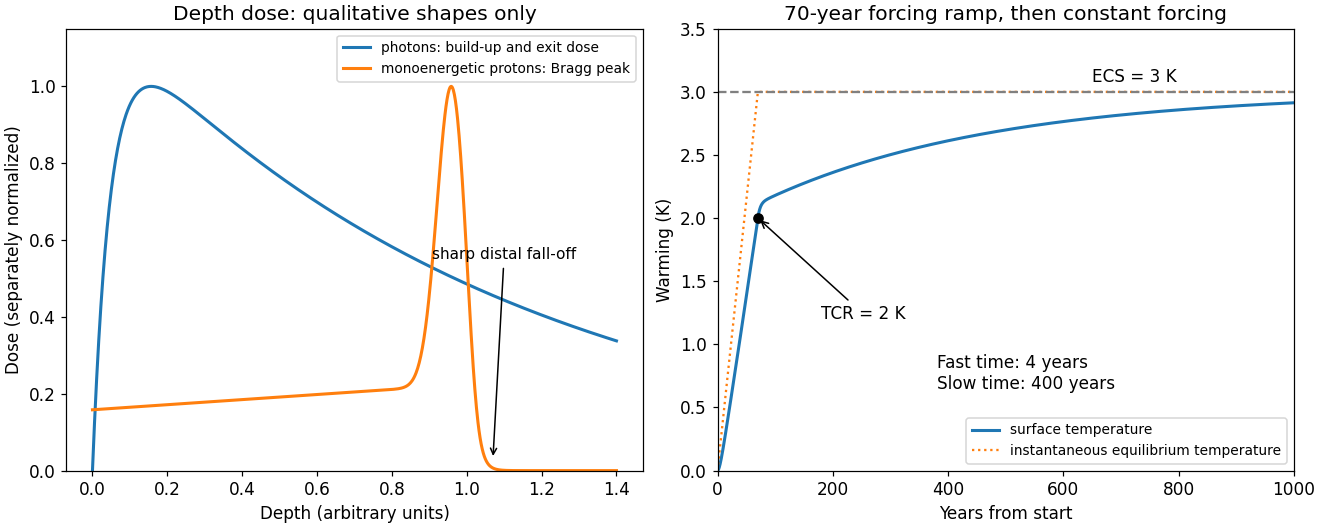

Photon radiotherapy uses indirectly ionizing photons. Their Compton scattering, photoelectric effect and, at higher energy, pair production create charged particles that deposit energy. A megavoltage beam has a dose-build-up region followed by a gradual decline and substantial exit dose. Multiple shaped beams or intensity-modulated radiotherapy distribute this dose around a target.
Proton therapy uses directly ionizing charged particles with a finite particle range and a Bragg peak. Tuning beam energy controls depth and scanning controls lateral delivery; multiple energies cover a finite target thickness. Reduced distal and integral normal-tissue dose is a potential advantage. Limitations include range uncertainty, Multiple Coulomb scattering, nuclear secondary production, motion-dependent delivery, and a variable relative biological effectiveness, particularly near the distal edge. A physical dose advantage must be assessed against target coverage and clinically relevant toxicity; it does not by itself establish superior tumour control.
A localized paediatric intracranial tumour is a representative indication where proton therapy can reduce unnecessary absorbed dose to the developing brain and other normal tissue. The finite particle range can reduce exit and integral dose compared with many photon radiotherapy plans, which may reduce late effects and secondary cancer risk over a long expected survival. It remains necessary to maintain target coverage, account for changing anatomy and keep uncertain distal-edge relative biological effectiveness away from sensitive structures. Travel, cost and daily positioning are practical disadvantages. The relevant comparison is a robust individual treatment plan and clinical endpoint, rather than the label “proton” alone.[ref]
ACR-ARS practice parameter for proton beam therapy. Paediatric treatment considerations and sparing of developing normal tissues
A strongly moving lung target is a relative contraindication to a particular proton therapy plan if respiratory motion and changing air–tissue paths make robust target coverage and normal-tissue constraints unattainable. A changing water-equivalent path changes the particle range; pencil-beam scanning can also interact with respiratory motion. A photon radiotherapy plan may then offer more reliable coverage despite its greater exit dose. This is a conditional planning contraindication, not a blanket claim that lung cancer cannot be treated with protons: gating, breath-hold, rescanning and adaptive planning can change the decision. If a robust comparative plan shows no meaningful benefit, the additional cost and access burden also weigh against the proton plan.[ref]
Respiratory motion management for particle therapy by AAPM. Report 290, dose uncertainty from respiratory motion and need for site-specific planning studies
A valid comparison needs comparable disease stage, risk, systemic treatments and dose prescriptions; otherwise selection bias and confounding can masquerade as treatment benefit. Referral to specialist centres can select younger, wealthier or more complex patients. Randomized controlled trials reduce such biases but can face limited recruitment, patient preference, crossover and lack of clinical equipoise.
Both arms need expert contemporary planning and comparable quality assurance. Centre experience, changing delivery technology and an obsolete comparison arm can distort results. The chosen endpoint must match the proposed benefit: equal tumour control with lower late toxicity may be valuable even without a survival difference. Statistical power, competing mortality, multiple comparisons and long follow-up are crucial for rare late effects, particularly second cancers. Blinding of treatment delivery is difficult, so independent endpoint adjudication and predefined analyses help. Economic analyses must state their perspective and include access and follow-up costs.
Ancestors (9)
- 2019
- Past exam of the short options paper shared by Parts A and B of the physics course of the University of Oxford
- Short options paper shared by Parts A and B of the physics course of the University of Oxford
- Physics course of the University of Oxford
- Undergraduate course of the University of Oxford
- Course of the University of Oxford
- University of Oxford
- List of universities
- Home
Discussion (0)
New discussionThere are no discussions about this article yet.
Articles by others on the same topic (0)
There are currently no matching articles.