Kepler's third law for two point masses in a Newtonian gravitational field isHere a is the semimajor axis of their relative orbit, P the orbital period and G the gravitational constant. Equivalently (P/yr)2=(a/AU)3/[(M1+M2)/M⊙], to the accuracy with which these astronomical units normalize the solar mass.
P2=G(M1+M2)4π2a3.
Assume a circular orbit and an orbital inclination i≃90∘, as appropriate for a simple eclipsing binary estimate. At quadrature the two radial velocities are opposite and equal to the orbital speeds. The more massive component has the smaller amplitude. With the centre of mass as origin,Thus a1=0.1103AU, a2=0.2206AU and Kepler's third law givesThe orbital plane contains the observer's line of sight; at quadrature the two velocities point towards and away from that observer, as labelled in the original schematic below. For an elliptic orbit, the measured amplitudes instead give asini=P(K1+K2)1−e2/(2π); the numerical answer requires the circular assumption.
a1=2πK1P,a2=2πK2P,a=a1+a2,M2M1=K1K2=2.
a=0.3309AU,M1=8.06M⊙,M2=4.03M⊙.
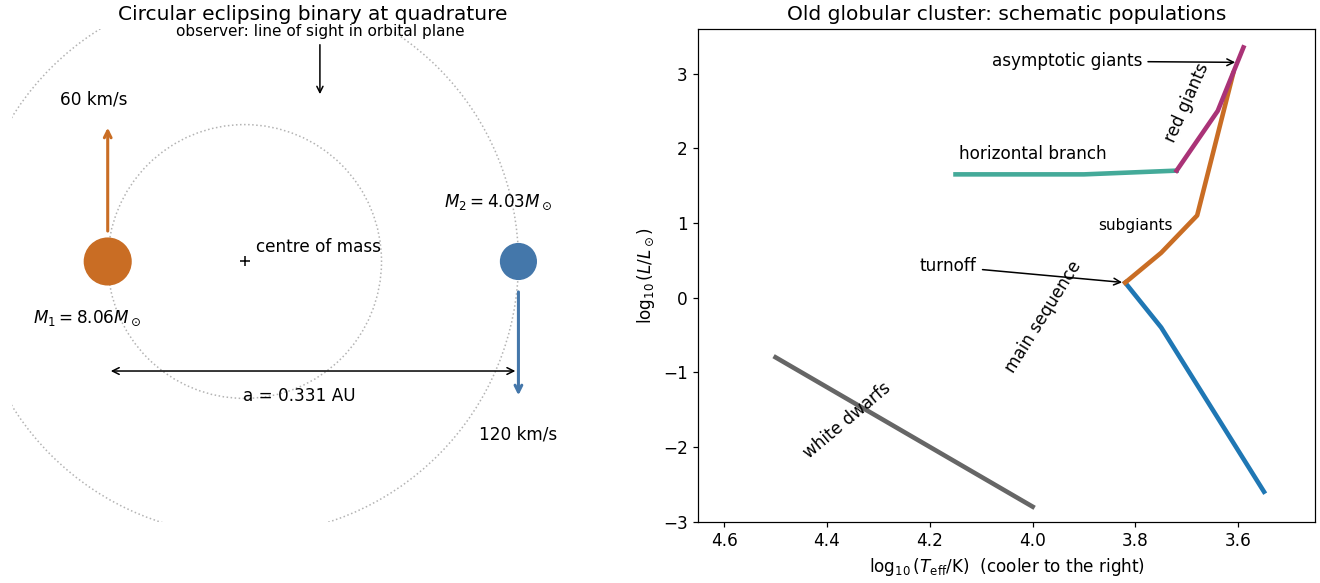

Adopt the approximate mass-luminosity relation L/L⊙≃(M/M⊙)3 and equal available fuel fractions. The main-sequence lifetime then scales as M/L, givingUsing an exponent 3.5 instead gives about 5.4×10⁷ and 3.1×10⁸ years; these are model-dependent estimates. At r=3rs=6GM/c2 the Newtonian gravitational potential energy released from infinity is GMm/r=mc2/6. Half remains as kinetic energy in a circular orbit, so the radiatable binding energy is GMm/(2r):Using the whole potential energy loss would give 1/6, which does not subtract the final kinetic energy. A fully relativistic calculation for a nonrotating black hole gives 1−8/9≃5.7%. When the surviving star exhausts hydrogen burning, it expands off the main sequence and can fill its Roche lobe. Binary mass transfer to the black hole can form an accretion disk and an X-ray binary; unstable binary mass transfer may instead produce a common envelope. This is conditional on the binary star remaining bound after the first remnant forms. The supplied black hole endpoint is an assumption, not a universal outcome for an isolated 8M⊙ star.
t1≃1.54×10⁸yr,t2≃6.16×10⁸yr.
ηNewtonian=121≃8.3%.
Ancestors (10)
- S2
- 2019
- Past exam of the short options paper shared by Parts A and B of the physics course of the University of Oxford
- Short options paper shared by Parts A and B of the physics course of the University of Oxford
- Physics course of the University of Oxford
- Undergraduate course of the University of Oxford
- Course of the University of Oxford
- University of Oxford
- List of universities
- Home
Discussion (0)
New discussionThere are no discussions about this article yet.
Articles by others on the same topic (0)
There are currently no matching articles.