Kepler's third law for two point masses in a Newtonian gravitational field isHere a is the semimajor axis of their relative orbit, P the orbital period and G the gravitational constant. Equivalently (P/yr)2=(a/AU)3/[(M1+M2)/M⊙], to the accuracy with which these astronomical units normalize the solar mass.
P2=G(M1+M2)4π2a3.
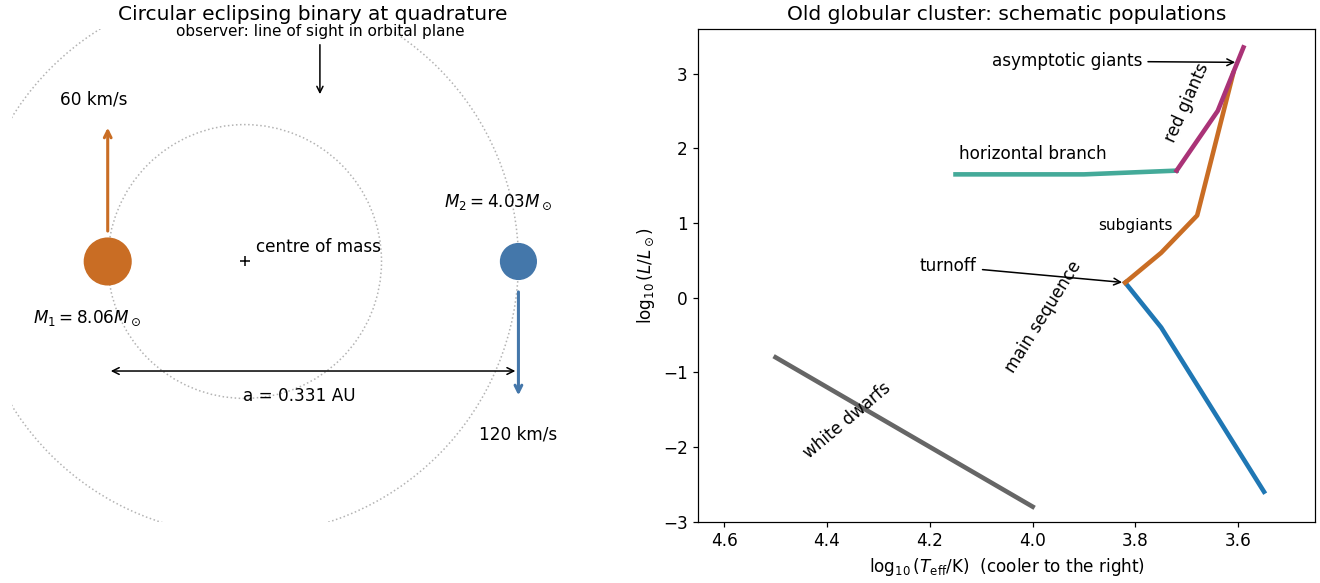
Assume a circular orbit and an orbital inclination i≃90∘, as appropriate for a simple eclipsing binary estimate. At quadrature the two radial velocities are opposite and equal to the orbital speeds. The more massive component has the smaller amplitude. With the centre of mass as origin,Thus a1=0.1103AU, a2=0.2206AU and Kepler's third law givesThe orbital plane contains the observer's line of sight; at quadrature the two velocities point towards and away from that observer, as labelled in the original schematic below. For an elliptic orbit, the measured amplitudes instead give asini=P(K1+K2)1−e2/(2π); the numerical answer requires the circular assumption.
a1=2πK1P,a2=2πK2P,a=a1+a2,M2M1=K1K2=2.
a=0.3309AU,M1=8.06M⊙,M2=4.03M⊙.

Adopt the approximate mass-luminosity relation L/L⊙≃(M/M⊙)3 and equal available fuel fractions. The main-sequence lifetime then scales as M/L, givingUsing an exponent 3.5 instead gives about 5.4×10⁷ and 3.1×10⁸ years; these are model-dependent estimates. At r=3rs=6GM/c2 the Newtonian gravitational potential energy released from infinity is GMm/r=mc2/6. Half remains as kinetic energy in a circular orbit, so the radiatable binding energy is GMm/(2r):Using the whole potential energy loss would give 1/6, which does not subtract the final kinetic energy. A fully relativistic calculation for a nonrotating black hole gives 1−8/9≃5.7%. When the surviving star exhausts hydrogen burning, it expands off the main sequence and can fill its Roche lobe. Binary mass transfer to the black hole can form an accretion disk and an X-ray binary; unstable binary mass transfer may instead produce a common envelope. This is conditional on the binary star remaining bound after the first remnant forms. The supplied black hole endpoint is an assumption, not a universal outcome for an isolated 8M⊙ star.
t1≃1.54×10⁸yr,t2≃6.16×10⁸yr.
ηNewtonian=121≃8.3%.
A thin spherical shell has outward pressure force −4πr2(dP/dr)dr and inward gravitational force GM(r)4πr2ρ(r)dr/r2. Hydrostatic equilibrium requiresA uniform-density solar model gives M(r)=M⊙(r/R⊙)3, ρˉ=3M⊙/(4πR⊙3), and after integration from R⊙ to zero,Thus the appropriate orders of magnitude are 1014–1016Pa and 107K. The uniform-density approximation underestimates the actual central pressure because the Sun is centrally concentrated. Radiation pressure is neglected in applying the ideal gas law.
drdP=−r2GM(r)ρ(r),drdM=4πr2ρ(r).
Pc=8πR⊙43GM⊙2=1.34×10¹⁴Pa,Tc=ρˉkBPcμmp=6.9×10⁶K(μ=0.6).
A free-fall timescale estimate follows from R/t2∼GM/R2:Falling to a central point mass gives the more precise factor π/(22), or 1.77×10³s; a distributed star changes an order-one coefficient. For any spherical mass distribution with radius R,The inequality is strict for an extended star; equality is approached by a thin shell at R. For an monatomic gas the virial theorem is 2U+Ω=0, so half the gravitational potential energy released by contraction heats the star and half can be radiated. The Kelvin-Helmholtz cooling time is therefore of orderA uniform-density model gives 3GM2/(10RL)≃9.4×106yr. The given bound fixes a scale, rather than an exact contraction history; both estimates are far shorter than the Sun's main-sequence lifetime.
tdyn∼GM⊙R⊙3≃1.6×10³s.
∣Ω∣=∫0Mr(m)Gmdm≥RG∫0Mmdm=2RGM2.
tKH∼2R⊙L⊙GM⊙2≃1.6×10⁷yr.
The right panel of the figure in solution has luminosity increasing upwards and effective temperature decreasing to the right. An old globular cluster contains a low-mass main sequence, a main-sequence turnoff, subgiants, a red giant branch, a horizontal branch, an Asymptotic giant branch and a faint hot white dwarf sequence. Its high-mass main sequence is absent because those stars have evolved.
If a fraction fc=0.1 of the star participates in hydrogen burning, with initial hydrogen mass fraction X=0.7, the available nuclear binding energy is 0.007fcXMc2. Assuming a roughly constant luminosity and coeval stars,Taking the quoted core fraction as hydrogen fuel itself, fcX=0.1, gives 1.98×10¹⁰yr. Stating the fuel convention matters: burning the whole stellar mass overestimates the age by about an order of magnitude. Evolving luminosity and detailed stellar structure are needed for an accurate age.
t≃1.6×1026W0.007fcX(0.8M⊙)c2≃1.39×10¹⁰yr.
The Milky Way has a thin stellar galactic disk, radius roughly 15–20kpc and scale height about 0.3kpc, containing gas, dust, young and old stars, spiral arms and most current star formation. Its stellar mass is a few 1010M⊙. A thicker, older galactic disk has scale height around 1kpc and stellar mass of order 1010M⊙, with little cold gas.
The central galactic bulge and bar extend a few thousand parsecs and contain about 1010M⊙, largely older stars. The central supermassive black hole has mass about 4×10⁶M⊙ and is negligible in the total galactic budget. A diffuse old metal-poor stellar halo, extending tens to over 100kpc, contains globular clusters and roughly 109M⊙ in stars. An extended dark matter halo reaches roughly 200kpc and dominates the total mass, of order 1012M⊙. These are approximate component scales; the gaseous galactic halo also extends beyond the stellar galactic disk.
Treat the gravitational field as approximately spherical. The circular orbit condition givesIf every star had a representative mass m and obeyed L/L⊙=(m/M⊙)3, its mass-to-light ratio would be (m/M⊙)−2, giving m≃0.47M⊙. This is a one-mass estimate, not an actual average inferred uniquely from the data: a galactic stellar mass function, stellar remnants, dust and nonstellar mass alter the relation. The flattening of the galactic disk also changes the spherical conversion by an order-one factor.
M(<8kpc)=Gvc2r=9.0×10¹⁰M⊙,Υ=L/L⊙M/M⊙=4.50.
Assume an isotropic, stationary spherical galaxy cluster. Its three-dimensional velocity dispersion obeys ⟨v2⟩=3σlos2. For a uniform sphere, the virial theorem gives 3Mσlos2=3GM2/(5R), henceA different density profile changes the coefficient, so 1015M⊙ is the meaningful scale. For isothermal X-ray gas in hydrostatic equilibrium,Using μ=0.6 and a representative slope −dlnρg/dlnr=2–3 at 1Mpc gives MX≃(1.3–1.9)×1015M⊙. The temperature and extent alone cannot fix this coefficient without a density profile. The total luminosity is 5×10¹²L⊙, so the previously inferred mass-to-light ratio gives
Mdyn≃G5Rσlos2=9.4×10¹⁴M⊙.
M(r)=−GμmpkBTrdlnrdlnρg.
M⋆≃4.50(5×10¹²)M⊙=2.25×10¹³M⊙.
Three physically distinct contributions are unseen dark matter, hot diffuse intracluster gas omitted from the summed stellar mass, and faint stars or stellar remnants missed by transferring the Milky Way mass-to-light ratio to the cluster. The first two are actual additional components; the third changes the inferred stellar budget. Departures from virial equilibrium, velocity anisotropy or extra nonthermal pressure can also bias the dynamical or X-ray estimates, although they need not remove the discrepancy.
Ancestors (9)
- 2019
- Past exam of the short options paper shared by Parts A and B of the physics course of the University of Oxford
- Short options paper shared by Parts A and B of the physics course of the University of Oxford
- Physics course of the University of Oxford
- Undergraduate course of the University of Oxford
- Course of the University of Oxford
- University of Oxford
- List of universities
- Home
Discussion (0)
New discussionThere are no discussions about this article yet.
Articles by others on the same topic (0)
There are currently no matching articles.