Thermal interstellar dust produces a bright galactic foreground concentrated toward the Milky Way plane, with additional cloud structure. Its emission spectrum differs from the approximately 2.73K blackbody spectrum of the cosmic microwave background, so comparisons across frequencies help separate it. In the sketch below this is the bright equatorial band.
Observer motion produces the cosmic microwave background dipole: to first order in β=v/c,The direction of motion is hotter and the opposite direction cooler. Its full-sky pattern has one broad positive hemisphere and one broad negative hemisphere; it is not concentrated in the galactic plane.
T0ΔT(θ)=βcosθ.
After subtracting the mean, the motion-induced dipole and galactic foregrounds, intrinsic Cosmic microwave background anisotropy appears as angular hot and cold patches, typically at the 10−5 fractional scale. These spatial temperature fluctuations encode early density and velocity structure. The displayed patch pattern is illustrative, with no claim to reproduce an observed sky map.
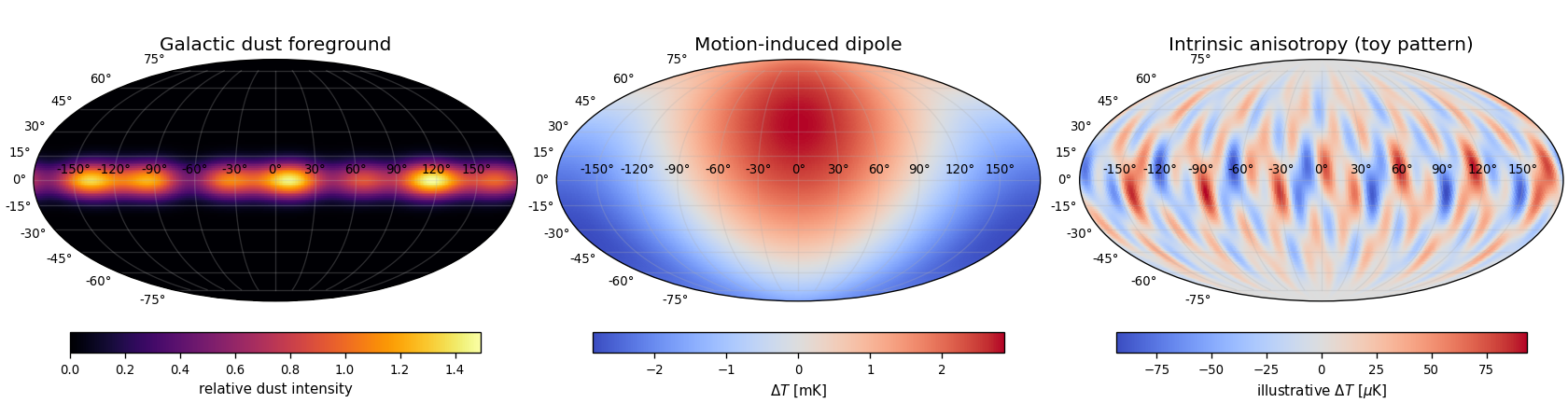
Schematic microwave components: Galactic dust, a kinematic dipole and intrinsic anisotropy, using separate colour scales
. Details. 
Measure the absolute spectral radiance over a range of frequencies and fit the Planck spectrumFor example, the COBE FIRAS blackbody spectrum experiment used a differential Michelson interferometer to compare the sky with an internal blackbody; an external calibrated blackbody could cover the sky entrance. Cold bolometers measured the difference spectrum, and foreground separation distinguished Milky Way emission from the nearly isotropic background. The fitted background temperature is approximately T0=2.73K.[ref]
Bν(T)=c22hν3ehν/(kBT)−11.
The COBE Far Infrared Absolute Spectrophotometer by NASA LAMBDA. Instrument overview: differential internal reference, external calibrator and absolute CMB temperature
The result relies on an absolute spectral comparison, rather than merely measuring a map's hot-to-cold contrast.The stated one-sided temperature contrast is β=0.00105, so the Doppler dipole givesThe motion is toward the hotter region. The contrast already gives one side relative to the mean; the hot-to-cold difference would be twice as large.
v=0.00105c≃3.15×10⁵ms−1=315kms−1.
Adiabatic expansion preserves the blackbody form while each photon's energy redshifts as a−1. Thus the cosmic microwave background temperature obeys T(z)=T0(1+z), giving
T(z=3)=4T0≃10.9K.
Convert both inputs to energy density. The matter contribution, including rest energy, is uM,0=ρM,0c2=2.25×10⁻¹⁰Jm−3. The given photon value is uγ,0=5×10⁵(1.602×10⁻¹⁹)=8.01×10⁻¹⁴Jm−3. HenceMatter energy density scales as (1+z)3, whereas the cosmic microwave background scales as (1+z)4. The photon-only matter-radiation equality condition is thereforeThis uses the supplied CMB photon density. Additional relativistic species change equality for total radiation.
uγ,0uM,0≃2.80×10³.
1+zeq=uγ,0uM,0,zeq≃2.8×10³.
Ancestors (10)
- S2
- 2012
- Past exam of the short options paper shared by Prelims and Parts A and B of the physics course of the University of Oxford
- Short options paper shared by Prelims and Parts A and B of the physics course of the University of Oxford
- Physics course of the University of Oxford
- Undergraduate course of the University of Oxford
- Course of the University of Oxford
- University of Oxford
- List of universities
- Home
Discussion (0)
New discussionThere are no discussions about this article yet.
Articles by others on the same topic (0)
There are currently no matching articles.