Write as the numerical sea-level Celsius temperature in degrees Celsius, and use the same degree increments for . The model's top temperature is . For positive its intended cold-ice branch has , so the positive melt-loss magnitude and snow gain are
The model is singular at and is not a physical melting law across that boundary. On the relevant interval , decreases hyperbolically and decreases linearly. Assume a fixed area and positive ice density, so increasing mass increases : stability has the same sign as .
The equilibrium equation is
with roots
Two distinct physical equilibria, one stable, exist provided
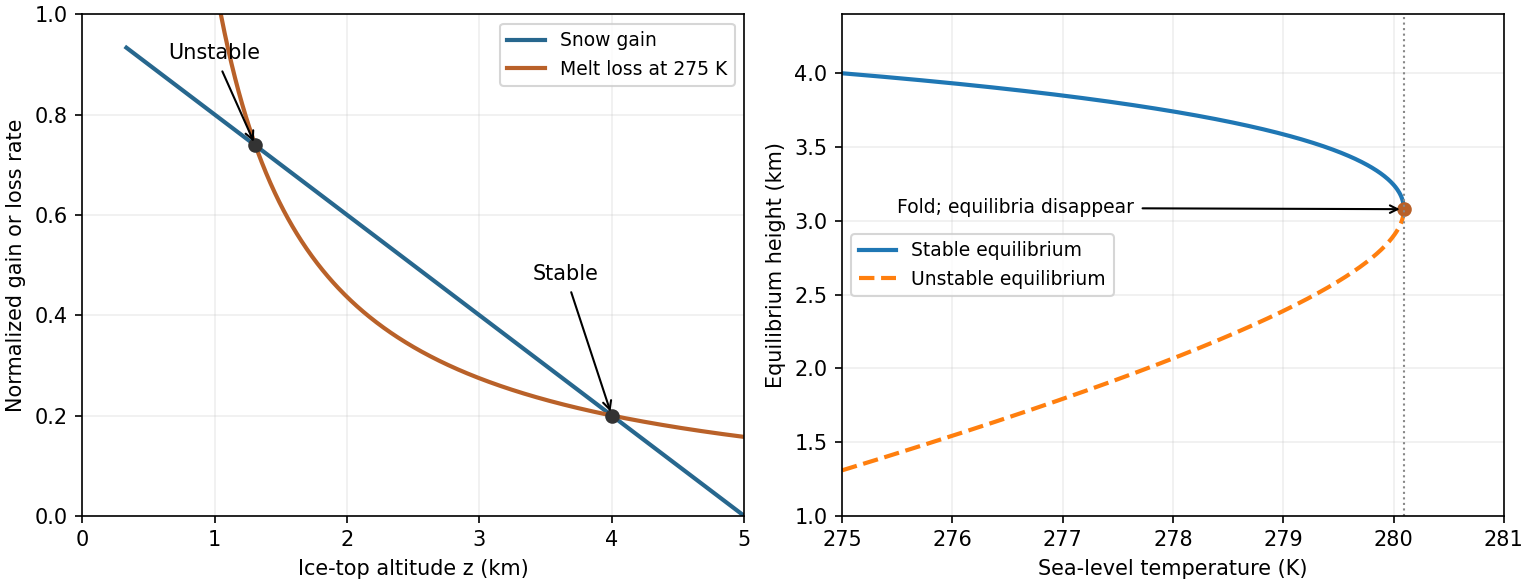
This combines a positive allowed interval with a strictly positive discriminant. At the larger root and small perturbations restore the ice cap; the smaller root has and is unstable. Since
a restoring local response requires
This is the lower height bound from the stability derivative; the stable equilibrium itself is . The minimum initial height for persistence, a different notion of threshold, is the unstable separator : initial heights above it approach , while lower heights lose ice and leave the model's cold branch. At equality in the discriminant condition the two equilibria merge, giving a marginal fold rather than a strictly stable ice cap.
Figure 1.
Snow accumulation, melt loss and the ice-cap stability threshold
. The initial curves have an unstable lower intersection and a stable upper intersection. Slow sea-level warming shifts the melt curve until both equilibria meet at a fold; all temperatures inside the reciprocal melt law are Celsius. Details.
Articles by others on the same topic (0)

There are currently no matching articles.