Assume ideal, nondegenerate particles in local thermodynamic equilibrium, ground-state atomic hydrogen, no molecules, and a common temperature. Let λj=h/2πmjkBT be the thermal de Broglie wavelength. Choose zero energy for a separated stationary proton and electron, so a neutral atom has ground-state energy −R. The classical chemical potentials areChemical equilibrium for H⇌p+e requires μH=μp+μe. Rearranging givesIncluding electron and proton spin degeneracy, ge=2, gp=2 and gH=4 when hyperfine splittings are neglected. Hence the statistical factor is one. Also mH≃mp, so λH3/λp3≃1. Charge neutrality gives np=ne, and thereforeThis is the specified ground-state Saha equation. Keeping excited atomic partition functions or a different spin-counting convention can change a prefactor, so its convention must be stated rather than silently adding a factor of two. The left side has dimensions of a number density, not a dimensionless electron-to-neutral ratio.
μe=kBTlngeneλe3,μp=kBTlngpnpλp3,μH=−R+kBTlngHnHλH3.
nHnenp=gHgegpλe3λp3λH3e−R/(kBT).
nHne2=h3(2πmekBT)3/2exp(−kBTR).
Let N=nH+np be the conserved number density of hydrogen nuclei, whether ionized or bound, and x=np/N=ne/N the ionization fraction. The ideal gas pressure counts neutral atoms, free protons and free electrons:At low temperature x≃0 and P≃NkBT. Heating through the ionization region increases the particle count as well as their thermal energy, giving a steeper rise. At high temperature x≃1, so P≃2NkBT and the asymptotic slope is twice the low-temperature slope. There is a smooth ionization crossover, not a pressure discontinuity.
P=NkBT(1+x),1−xx2=NS(T),S(T)=h3(2πmekBT)3/2e−R/(kBT).
The held graph is legible. Representative readings are P(5000K)≃6.8Pa and P(15000K)≃41.4Pa, with readout uncertainties of roughly 0.3–0.5Pa and about 100K. They give N≃P/(kBT) on the neutral branch and N≃P/(2kBT) on the ionized branch, respectively. Both are consistent withThe error is a conservative graph-reading estimate, not a fitted experimental confidence interval.
N≃(1.0±0.05)×1020m−3.
For that density, the Saha equation gives x≃0.50 at 9000K, x≃0.81 at 10000K, and x≃0.9992 at 15000K. Differentiating the ionization relation givesThe calculated maximum slope occurs near 9.25×10³K, consistent with the source's visibly steepest region at roughly (9.3±0.4)×103K. This checks the actual slope rather than identifying it without justification with exactly half ionization.
x′=2−xx(1−x)(2T3+kBT2R),P′=NkB(1+x+Tx′).
Taking the neutral ground-state gas as the zero of internal binding energy, the matter energy density is translational kinetic energy plus ionization energy:At 15000K, with R=13.6eV, these terms are about 62 and 218Jm−3, givingRest energies are excluded. A separate equilibrium radiation field, if the gas were in a blackbody cavity, would add its own radiation energy density; it is not part of this gas-only estimate.
u=23NkBT(1+x)+NxR.
u≃2.8×10²Jm−3.
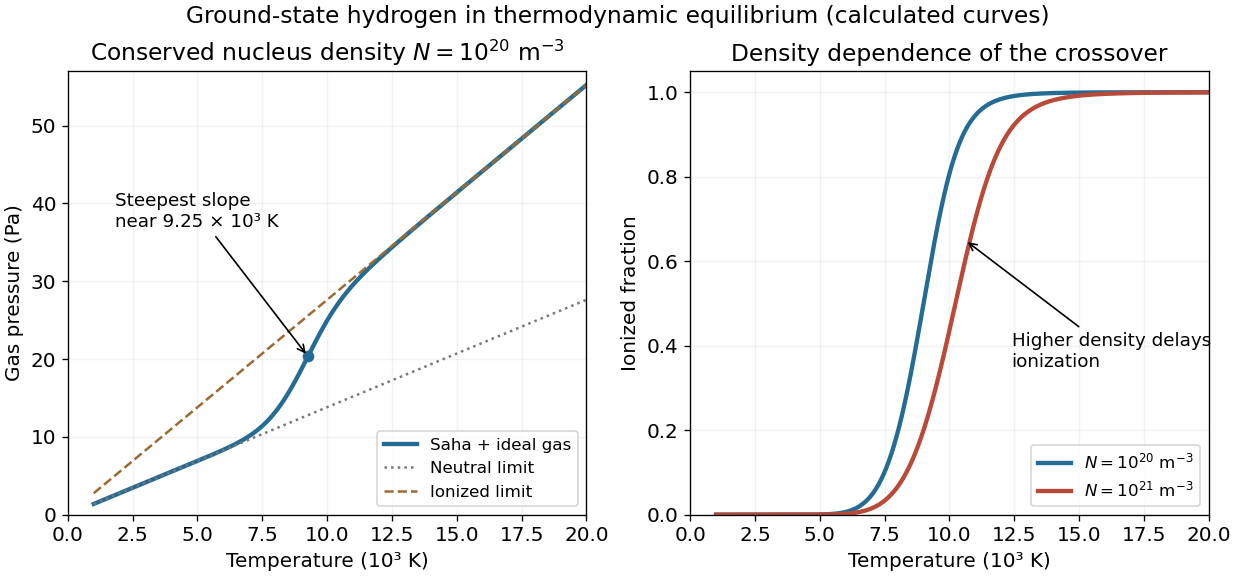

Increasing the conserved nucleus density to 10N multiplies the low-temperature neutral-gas slope and high-temperature ionized-gas slope by ten. However, at a fixed intermediate temperature, x2/(1−x)=S(T)/(10N) is smaller, so a smaller fraction is ionized. The curved transition therefore moves to higher temperature; the new graph is not simply ten times the old graph throughout the crossover.
At a fixed chosen ionization fraction, S(T) must increase tenfold. Locally this requireswhich is of order 103K in this region. Directly evaluating the same Saha equation at 1021m−3 moves the maximum pressure slope from about 9250 to 10560K. The two asymptotic slopes still have ratio two, because each hydrogen nucleus still contributes one particle when neutral and two when fully ionized.
ΔT≃3/(2T)+R/(kBT2)ln10,
Ancestors (10)
- S16
- 2015
- Past exam of the short options paper shared by Prelims and Parts A and B of the physics course of the University of Oxford
- Short options paper shared by Prelims and Parts A and B of the physics course of the University of Oxford
- Physics course of the University of Oxford
- Undergraduate course of the University of Oxford
- Course of the University of Oxford
- University of Oxford
- List of universities
- Home
Discussion (0)
New discussionThere are no discussions about this article yet.
Articles by others on the same topic (0)
There are currently no matching articles.