Assume ideal, nondegenerate particles in local thermodynamic equilibrium, ground-state atomic hydrogen, no molecules, and a common temperature. Let λj=h/2πmjkBT be the thermal de Broglie wavelength. Choose zero energy for a separated stationary proton and electron, so a neutral atom has ground-state energy −R. The classical chemical potentials areChemical equilibrium for H⇌p+e requires μH=μp+μe. Rearranging givesIncluding electron and proton spin degeneracy, ge=2, gp=2 and gH=4 when hyperfine splittings are neglected. Hence the statistical factor is one. Also mH≃mp, so λH3/λp3≃1. Charge neutrality gives np=ne, and thereforeThis is the specified ground-state Saha equation. Keeping excited atomic partition functions or a different spin-counting convention can change a prefactor, so its convention must be stated rather than silently adding a factor of two. The left side has dimensions of a number density, not a dimensionless electron-to-neutral ratio.
μe=kBTlngeneλe3,μp=kBTlngpnpλp3,μH=−R+kBTlngHnHλH3.
nHnenp=gHgegpλe3λp3λH3e−R/(kBT).
nHne2=h3(2πmekBT)3/2exp(−kBTR).
Let N=nH+np be the conserved number density of hydrogen nuclei, whether ionized or bound, and x=np/N=ne/N the ionization fraction. The ideal gas pressure counts neutral atoms, free protons and free electrons:At low temperature x≃0 and P≃NkBT. Heating through the ionization region increases the particle count as well as their thermal energy, giving a steeper rise. At high temperature x≃1, so P≃2NkBT and the asymptotic slope is twice the low-temperature slope. There is a smooth ionization crossover, not a pressure discontinuity.
P=NkBT(1+x),1−xx2=NS(T),S(T)=h3(2πmekBT)3/2e−R/(kBT).
The held graph is legible. Representative readings are P(5000K)≃6.8Pa and P(15000K)≃41.4Pa, with readout uncertainties of roughly 0.3–0.5Pa and about 100K. They give N≃P/(kBT) on the neutral branch and N≃P/(2kBT) on the ionized branch, respectively. Both are consistent withThe error is a conservative graph-reading estimate, not a fitted experimental confidence interval.
N≃(1.0±0.05)×1020m−3.
For that density, the Saha equation gives x≃0.50 at 9000K, x≃0.81 at 10000K, and x≃0.9992 at 15000K. Differentiating the ionization relation givesThe calculated maximum slope occurs near 9.25×10³K, consistent with the source's visibly steepest region at roughly (9.3±0.4)×103K. This checks the actual slope rather than identifying it without justification with exactly half ionization.
x′=2−xx(1−x)(2T3+kBT2R),P′=NkB(1+x+Tx′).
Taking the neutral ground-state gas as the zero of internal binding energy, the matter energy density is translational kinetic energy plus ionization energy:At 15000K, with R=13.6eV, these terms are about 62 and 218Jm−3, givingRest energies are excluded. A separate equilibrium radiation field, if the gas were in a blackbody cavity, would add its own radiation energy density; it is not part of this gas-only estimate.
u=23NkBT(1+x)+NxR.
u≃2.8×10²Jm−3.
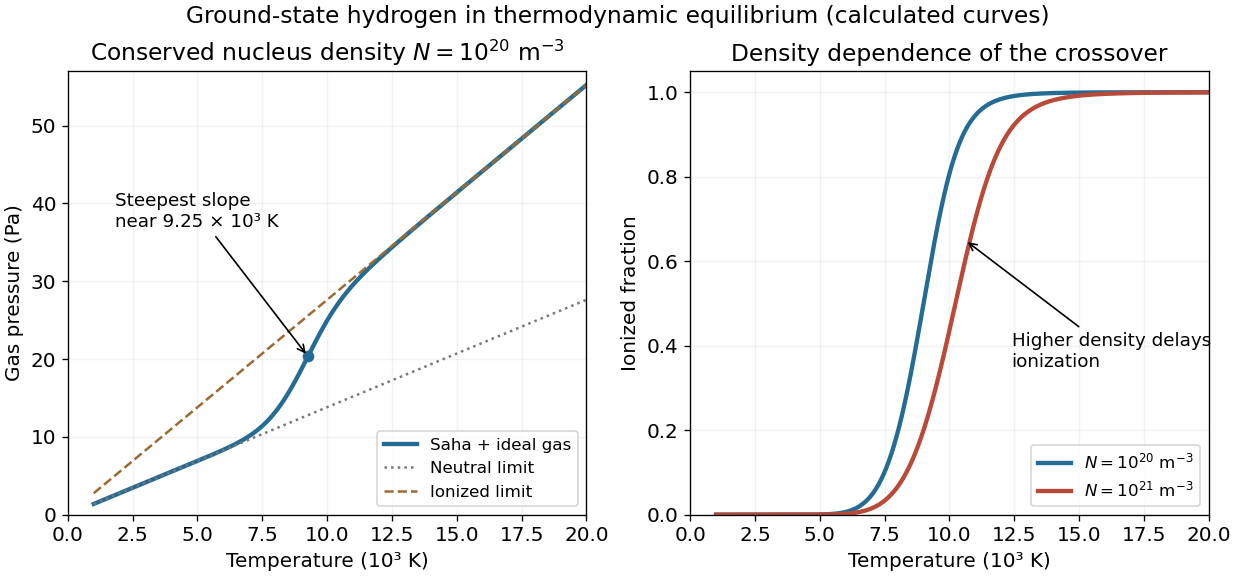

Increasing the conserved nucleus density to 10N multiplies the low-temperature neutral-gas slope and high-temperature ionized-gas slope by ten. However, at a fixed intermediate temperature, x2/(1−x)=S(T)/(10N) is smaller, so a smaller fraction is ionized. The curved transition therefore moves to higher temperature; the new graph is not simply ten times the old graph throughout the crossover.
At a fixed chosen ionization fraction, S(T) must increase tenfold. Locally this requireswhich is of order 103K in this region. Directly evaluating the same Saha equation at 1021m−3 moves the maximum pressure slope from about 9250 to 10560K. The two asymptotic slopes still have ratio two, because each hydrogen nucleus still contributes one particle when neutral and two when fully ionized.
ΔT≃3/(2T)+R/(kBT2)ln10,
The electron Debye length is the scale over which a weak electrostatic disturbance is screened. Take the ions as an immobile neutralizing background and the electrons as an isothermal Boltzmann distribution. For a small potential ϕ,Poisson's equation then becomes ∇2ϕ=ϕ/λD2 away from the perturbing source, withA test charge has a screened potential proportional to e−r/λD/r. For fully static screening with mobile ions, inverse squared Debye lengths from all species add; the displayed expression is the electron scale used below.
ne(ϕ)=n0eeϕ/(kBT)≃n0(1+kBTeϕ),ρ≃−kBTn0e2ϕ.
λD=nee2ϵ0kBT.
The electron plasma frequency is the natural collective oscillation frequency when electrons are displaced from a nearly fixed ion background. Displace a uniform electron fluid by ξ along a slab normal. The charge separation produces the restoring electric force −nee2ξ/ϵ0 on an electron. Hence meξ¨=−nee2ξ/ϵ0 andIt sets a response time 1/ωp and the cold unmagnetized electromagnetic cutoff frequency. These collective effects arise from long-range electric fields, even when individual binary collisions are infrequent.
ωp=ϵ0menee2.
Define the plasma parameter here as the number of electrons in an electron Debye sphere,Some texts instead use neλD3, or its inverse as a coupling parameter. A weakly coupled collective plasma has ND≫1; fluctuations from individual nearby particles are small compared with the collective description.
ND=34πneλD3.
A Coulomb collision means the cumulative deflection or relaxation produced by many small-angle encounters, not necessarily a hard contact between two particles. The Coulomb logarithm lnΛC≃ln(bmax/bmin) summarizes the impact-parameter range, with bmax of order λD. A process is collisionless when its timescale is much shorter than the appropriate collisional relaxation time, or its length scale is much smaller than a corresponding mean free path. It still contains collective interactions.
For fully ionized ions of charge Ze, a thermal electron–ion momentum-relaxation rate has the scalingup to numerical factors depending on the Debye-sphere and collision-time conventions. More explicitly, the Maxwellian rate used below gives νei/ωp≃0.089ZlnΛC/ND, or tcolωp≃11.3ND/(ZlnΛC). Specifying this factor prevents mixing a small coupling parameter with a large Debye-sphere population.[ref]
νei∼ϵ02me1/2(kBT)3/2Znee4lnΛC,tcol∼ZlnΛCωpND,
NRL Plasma Formulary (2019). Fundamental Plasma Parameters and Coulomb Collisions: electron thermal and collision-rate conventions
Use collisional inverse bremsstrahlung in a weakly coupled, unmagnetized plasma. The specified density is ne=1026m−3, and kBT=1000eV. The electron Debye length is 2.35×10⁻⁸m, the plasma frequency is 5.64×10¹⁴s−1, and the laser angular frequency is ω=2πc/λ=1.79×1015s−1. Thus X=ωp2/ω2≃0.099<1: the plasma is underdense and a propagating wave exists.
Estimate bmin as the larger of the classical Coulomb-deflection length Ze2/(4πϵ0kBT) and the electron quantum length ℏ/mekBT. Both are about 9×10⁻¹²m here, giving lnΛC≃8. With the usual thermal collision convention,The Z factor follows from niZ2=neZ.[ref]
νei≃2.91×10⁻⁶Te[eV]3/2ne[cm−3]ZlnΛCs−1≃4.4×1011s−1.
NRL Plasma Formulary (2019). Coulomb collision-rate normalization and thermal parameters; densities in cubic centimetres and temperatures in eV
The weakly collisional Drude model gives ϵr=1−ωp2/[ω(ω+iνei)] for fields proportional to e−iωt. Expanding at νei≪ω yields a real refractive index nr=1−X≃0.949 and intensity attenuation coefficientConsequently the intensity e-folding absorption length isi.e. of order a centimetre. Taking a Coulomb logarithm between about 5 and 10 gives roughly 5–10mm. The electric-field amplitude decay length is twice this intensity length. This estimate assumes a uniform slab thick enough to define an absorption length and neglects gradients, nonlinear quiver heating and other absorption mechanisms.
αI=2Imk≃cνei1−XX.
LI=νeiXc1−X≃6.6×10⁻³m,
For a sinusoidal laser field of peak amplitude E0, an electron's peak nonrelativistic quiver speed is vq=eE0/(meω). Choose the one-component electron thermal speed vT=kBT/me=1.33×107ms−1. The vacuum-equivalent laser intensity is I=ϵ0cE02/2, so the onset vq∼vT occurs atUsing 2kBT/me as the thermal-speed convention doubles this estimate; its order of magnitude is the physical content. Once the quiver is comparable to the thermal speed, a collision rate computed for an undriven thermal distribution is no longer adequate.
Ith≃2ϵ0c(emeωvT)2,Ith≃2.4×10¹⁵Wcm−2.
Relativistic motion begins when the normalized field a0=eE0/(mecω) is of order one. ThusThe ratio Irel/Ith=mec2/(kBT)≃511 checks the separation of the two regimes. These estimates use peak field and cycle-averaged vacuum intensity. The small refractive-index and interface-transmission corrections in this underdense plasma change only the few-percent prefactor, below the accuracy intended here.
Irel≃2ϵ0c(emecω)2≃1.2×10¹⁸Wcm−2.
Take B=Bz^. The magnetic Lorentz force givesThus vx+ivy=(vx(0)+ivy(0))e−iΩt, while vz is constant. Integrating the transverse velocity gives a circle of radius rL=v⊥/∣Ω∣ about a fixed guiding centre; adding z(t)=z0+v∥t gives a helical motion in a uniform magnetic field. The magnetic force does no work, so the speed and kinetic energy remain constant. The handedness reverses with the sign of q. If v∥=0 the helix degenerates to a circle; if v⊥=0 it is a straight line parallel to the field.
v˙x=Ωvy,v˙y=−Ωvx,v˙z=0,Ω=mqB.
Seek a constant transverse guiding-centre drift vd whose magnetic Lorentz force balances the applied force. DefineSince F⋅B=0, the vector triple-product identity gives qvd×B=−F. Writing v=vd+u therefore reduces the full equation to mu˙=qu×B, the ordinary gyromotion equation. Its transverse orbit is circular in the drifting frame, soAveraging over a gyroperiod removes the transverse oscillatory velocity and leaves this drift, together with any constant parallel velocity. For an electric force F=qE, this becomes the charge-independent E×B/B2 drift; a charge-independent force instead gives opposite drift directions for opposite charge signs.
vd=qB2F×B.
vgc=vd=q1B2F×B.
A purely toroidal magnetic field is stronger on the inner side of the torus and its field lines are curved. The resulting magnetic gradient drift and curvature drift move ions and electrons vertically in opposite directions. Charge separation can then produce an electric field whose E-cross-B drift moves the plasma across the nominal toroidal confinement region. Closing field lines into circles therefore does not by itself guarantee confinement.
A tokamak combines a strong externally produced toroidal field with a poloidal field supplied largely by toroidal plasma current. Field lines wind helically around nested magnetic flux surfaces. A particle following a field line samples different vertical and radial parts of the torus, so the systematic displacements associated with the toroidal geometry can compensate over its orbit rather than accumulating as in the pure-toroidal case. The poloidal field also provides the magnetic structure needed for force balance. This improves confinement but does not eliminate all orbit losses or transport: trapped particles, collisions, turbulence and magnetohydrodynamic instabilities remain important. Maintaining the plasma current and suitable field-line winding is part of the confinement problem.
The supplied confinement criterion alone fixes a product, not a unique current or machine size. Choose a representative ion density ni=1020m−3. ThenFor ni=1019 to 1021m−3, the same criterion gives τ≳10 to 0.1s. These are illustrative density choices, not additional source data.
τ≳ni1020s≃1s.
For a current estimate, assume a large-aspect-ratio circular tokamak with major radius R0=3m, minor radius a=1m, toroidal field Bϕ=5T and edge tokamak safety factor qs≃3. The geometrical winding relation and Ampère's law giveFor the stated assumptions,so toroidal plasma currents of order megaamperes are a natural scale. As a consistency check at T∼108K, quasineutral singly charged heavy hydrogen has total thermal pressure p≃2nikBT≃2.8×10⁵Pa. With 5T, 2μ0p/B2≃0.028, so the assumed magnetic pressure exceeds the thermal pressure. The particular current depends on geometry and field-line pitch; it cannot be inferred from the confinement product alone.
qs≃R0BθaBϕ,Bθ(a)≃2πaμ0Ip,Ip≃μ0R0qs2πa2Bϕ.
Ip≃2.8×10⁶A,
Ancestors (9)
- 2015
- Past exam of the short options paper shared by Prelims and Parts A and B of the physics course of the University of Oxford
- Short options paper shared by Prelims and Parts A and B of the physics course of the University of Oxford
- Physics course of the University of Oxford
- Undergraduate course of the University of Oxford
- Course of the University of Oxford
- University of Oxford
- List of universities
- Home
Discussion (0)
New discussionThere are no discussions about this article yet.
Articles by others on the same topic (0)
There are currently no matching articles.