For identical uniform bends in an ideal double-bend achromat, the standard minimum is ϵx,min=Cqγ2θ3/(415Jx), with bend angle θ=2π/48 and γ≃3000/0.511. Hence ϵx,min≃1.92 nmrad. This uses the achromat constraint; the unconstrained theoretical-minimum-emittance coefficient is three times smaller.
The bending-magnet critical photon energy is Ec=3ℏcγ3/(2ρ)≃0.665EGeV2BT keV, giving Ec≃8.38 keV.
Doubling the number of identical-angle bends halves each angle. The minimum emittance scales as θ3, so it becomes 0.240 nmrad. At unchanged energy and unchanged individual magnet length, the bending radius doubles and field halves, giving B=0.70 T and Ec≃4.19 keV.
At fixed stored current the loss per turn, proportional to E4∮ds/ρ2, halves: twice as many equal-length bends each have one quarter of the original contribution. Total radiation power therefore halves. The spectrum softens by the factor-two critical-energy change. The characteristic high-energy vertical opening angle remains of order 1/γ at fixed energy, while each magnet's horizontal sweep halves. At a fixed absolute photon energy the normalized spectral position changes, so a claim that every angular distribution is identical would be too strong. Lower emittance also reduces the electron source size/divergence subject to the optical functions.
Equilibrium emittance obeys ϵx=Cqγ2I5/(JxI2), with I5=∮H(s)∣ρ∣−3ds, H=γxη2+2αxηη′+βxη′2. Thus reduce both bend angles and the dispersion invariant inside bends, rather than merely focusing to a small beam size elsewhere. The damping partition can also be adjusted within stability constraints.
A DBA uses two bends and quadrupoles to return dispersion and its slope to zero at the cell boundaries; this provides dispersion-free insertion straights, at some emittance cost. A multi-bend achromat distributes the total angle over more weak bends and carefully controls the interior dispersion. A non-achromatic theoretical-minimum-emittance cell permits nonzero boundary dispersion and chooses the beta function and dispersion near a bend's optimum; longitudinal-gradient or reverse bends offer further control of radiation integrals. Strong focusing and dispersion suppression can increase natural chromaticity and sextupole demands, compromising dynamic aperture and momentum acceptance.
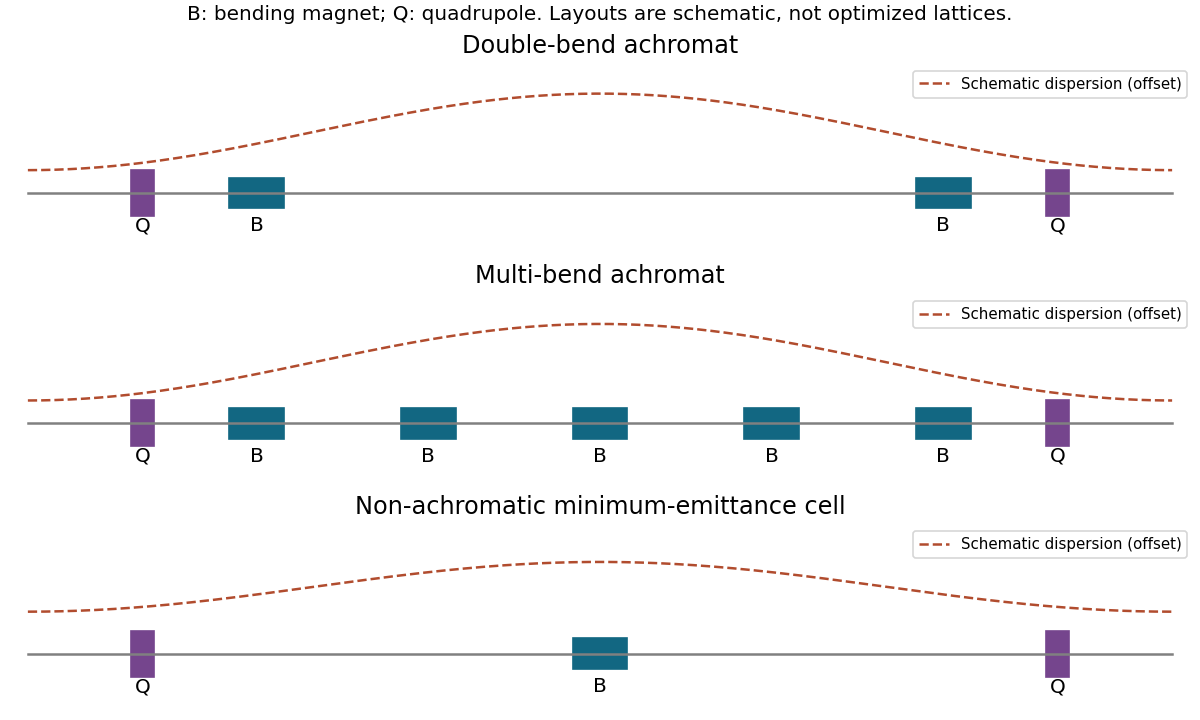
Schematic double-bend, multi-bend and non-achromatic emittance-design strategies
. Details. 
Ancestors (10)
- S19
- 2017
- Past exam of the short options paper shared by Prelims and Parts A and B of the physics course of the University of Oxford
- Short options paper shared by Prelims and Parts A and B of the physics course of the University of Oxford
- Physics course of the University of Oxford
- Undergraduate course of the University of Oxford
- Course of the University of Oxford
- University of Oxford
- List of universities
- Home
Discussion (0)
New discussionThere are no discussions about this article yet.
Articles by others on the same topic (0)
There are currently no matching articles.