Take a reference point immediately before the focusing quadrupole and let matrices act on (x,x′) from the right. With q=1/f, define QF=(1−q01), QD=(1q01) and D(L)=(10L1). One cell isIts determinant is one. A different starting point gives a conjugate matrix with the same trace and stability; the orthogonal transverse plane replaces q by −q.
M=D(L2)QDD(L1)QF=(1−L1q−L1L2q2−L1q2L1+L2+L1L2q1+L1q).
For a periodic uncoupled lattice, trM=2cosμ in the Twiss representation. Here cosμ=1−L1L2q2/2, so bounded nondegenerate cell motion requiresThe zero-strength endpoint is only marginal and usually gives a drifting Jordan block. The phase advance increases from zero to π on the positive-strength stable branch. Repeating the cell N times gives ring eigenvalues e±iNμ and tune Nμ/(2π); it does not enlarge the stable strength interval. Integer ring phase advances can be resonance-sensitive in the presence of errors even when the ideal repeated matrix is bounded.
0<L1L2q2<4,∣∫Gds∣<L1L22Bρ.
For fixed quadrupole fields and fractional momentum offset δ, q(δ)=q0/(1+δ). Differentiate cosμ=1−L1L2q2/2 at zero to obtain dμ/dδ=−L1L2q02/sinμ=−2tan(μ/2). ThusBoth transverse planes have the same natural result; the ring value is N times this. It vanishes only in the zero-focusing limit, outside robust stable operation. Additional correcting elements, such as sextupoles where dispersion is nonzero, are required for zero corrected chromaticity.
ξcell=2π1dδdμ=−π1tan2μ.
For identical uniform bends in an ideal double-bend achromat, the standard minimum is ϵx,min=Cqγ2θ3/(415Jx), with bend angle θ=2π/48 and γ≃3000/0.511. Hence ϵx,min≃1.92 nmrad. This uses the achromat constraint; the unconstrained theoretical-minimum-emittance coefficient is three times smaller.
The bending-magnet critical photon energy is Ec=3ℏcγ3/(2ρ)≃0.665EGeV2BT keV, giving Ec≃8.38 keV.
Doubling the number of identical-angle bends halves each angle. The minimum emittance scales as θ3, so it becomes 0.240 nmrad. At unchanged energy and unchanged individual magnet length, the bending radius doubles and field halves, giving B=0.70 T and Ec≃4.19 keV.
At fixed stored current the loss per turn, proportional to E4∮ds/ρ2, halves: twice as many equal-length bends each have one quarter of the original contribution. Total radiation power therefore halves. The spectrum softens by the factor-two critical-energy change. The characteristic high-energy vertical opening angle remains of order 1/γ at fixed energy, while each magnet's horizontal sweep halves. At a fixed absolute photon energy the normalized spectral position changes, so a claim that every angular distribution is identical would be too strong. Lower emittance also reduces the electron source size/divergence subject to the optical functions.
Equilibrium emittance obeys ϵx=Cqγ2I5/(JxI2), with I5=∮H(s)∣ρ∣−3ds, H=γxη2+2αxηη′+βxη′2. Thus reduce both bend angles and the dispersion invariant inside bends, rather than merely focusing to a small beam size elsewhere. The damping partition can also be adjusted within stability constraints.
A DBA uses two bends and quadrupoles to return dispersion and its slope to zero at the cell boundaries; this provides dispersion-free insertion straights, at some emittance cost. A multi-bend achromat distributes the total angle over more weak bends and carefully controls the interior dispersion. A non-achromatic theoretical-minimum-emittance cell permits nonzero boundary dispersion and chooses the beta function and dispersion near a bend's optimum; longitudinal-gradient or reverse bends offer further control of radiation integrals. Strong focusing and dispersion suppression can increase natural chromaticity and sextupole demands, compromising dynamic aperture and momentum acceptance.
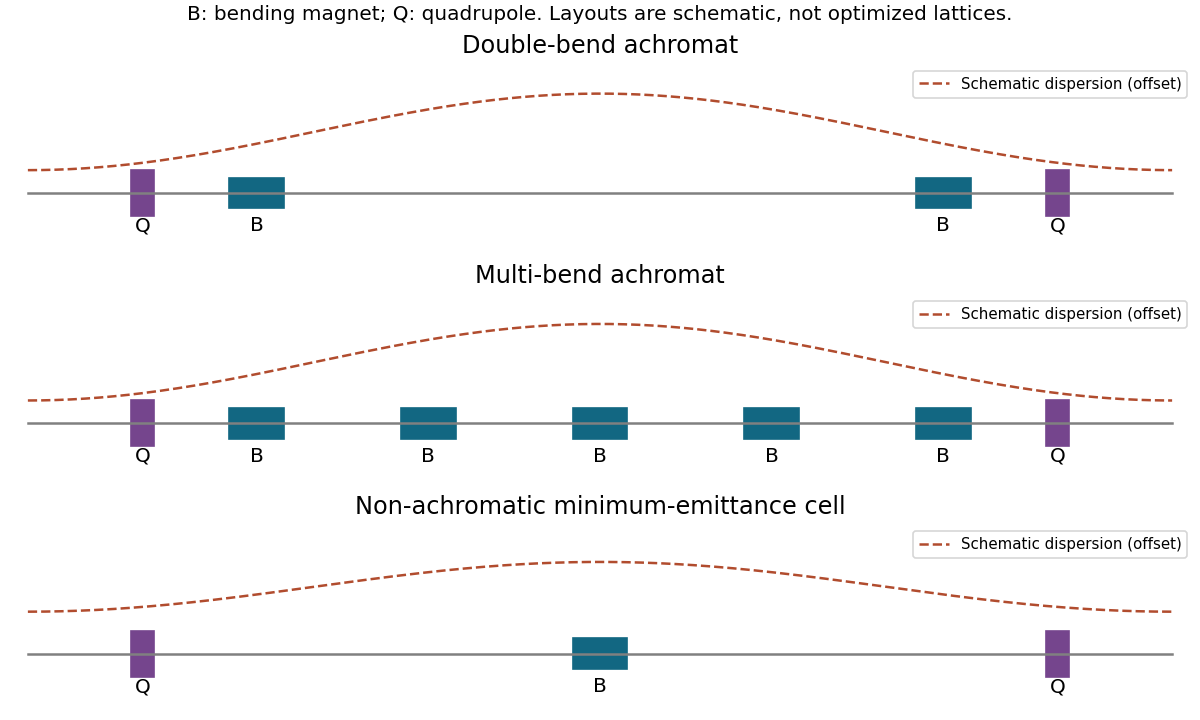
Schematic double-bend, multi-bend and non-achromatic emittance-design strategies
. Details. 
Use the explicit equation n/nc=0.002; the surrounding phrase reverses the verbal ratio. It gives nc=2.0×1021 cm−3. From ω02=nce2/(ϵ0me),This is an underdense optical plasma. Treating the ratio as nc/n=0.002 would instead contradict the specified underdense condition.
λ=2πcϵ0me/(nce2)≃0.747 μm.
The supplied density is 4×1024 m−3. ThereforeThe cold relativistic field scale is E0=mecωp/e≃1.92×1011 V m−1, corresponding to an energy gradient eE0≃192 GeVm−1. It is an upper scale for the stipulated large-amplitude wave, not proof that the particular weak driver produces that field.
ωp≃1.13×10¹⁴ s−1,λp=2πc/ωp≃16.7 μm.
The laser driver should occupy at most roughly half a plasma period to excite the accelerating density response effectively. Interpreting pulse length as full significant spatial duration gives ℓmax∼λp/2≃8.35 μm,τmax∼27.8 fs. If the source's σ denotes the rms width of a Gaussian envelope instead, the resonant scale is commonly kpσ∼1, or σ∼2.66 μm and 8.9 fs; full duration and rms width cannot be assigned the same numerical value without a pulse-shape convention. The robust condition is a sub-plasma-period pulse.
For linear polarization, a0=eEL/(mecω0) and I=ϵ0cEL2/2. Substitution gives a0≃0.855λμmI/(1018 Wcm−2)≃0.64. Thus the specified peak electron quiver motion is at most mildly relativistic, not highly relativistic. Its quiver Lorentz factor is of order 1+a02≃1.19. The supplied 40 TW fixes a focal area through P/I, but does not increase a0 once the intensity is specified. This exposes a limitation of assuming a strongly nonlinear, fully wavebreaking wake in the preceding estimates.
In the cold underdense model, 1−vg/c≃n/(2nc) and γϕ2≃nc/n=500. A relativistic electron slips through half an accelerating sinusoidal wavelength over Ld≃γϕ2λp≃8.35 mm. For Ez=E0sinϕ and injection at the start of that half-cycle, integration over 0<ϕ<π givesInjection at the field crest and acceleration only to its next zero gives half this value, about 0.51 GeV; this explains a common factor-two convention in dephasing estimates. Multiplying the peak field by the entire dephasing length is instead an upper bound, not the sinusoid's actual integral. These are ideal wave-amplitude estimates: a0<1 need not excite E0, and finite pump depletion, pulse evolution and injection physics may reduce the gain. Without a specified nonlinear wake shape, the data warrant an order-GeV cold-wave upper scale, not a unique precision maximum for an actual experiment.
ΔEmax≃4γϕ2mec2≃1.0 GeV.
Ancestors (9)
- 2017
- Past exam of the short options paper shared by Prelims and Parts A and B of the physics course of the University of Oxford
- Short options paper shared by Prelims and Parts A and B of the physics course of the University of Oxford
- Physics course of the University of Oxford
- Undergraduate course of the University of Oxford
- Course of the University of Oxford
- University of Oxford
- List of universities
- Home
Discussion (0)
New discussionThere are no discussions about this article yet.
Articles by others on the same topic (0)
There are currently no matching articles.