The curvature constant specifies the intrinsic spatial curvature of homogeneous constant-time slices. Positive curvature has spherical geometry, zero curvature Euclidean geometry, and negative curvature hyperbolic geometry. A conventional coordinate normalization uses k=+1,0,−1, with the scale factor carrying the curvature radius; rescaling that factor changes the numerical magnitude assigned to a dimensional curvature coefficient.
The sign alone does not determine the future expansion once a cosmological constant is admitted. Nor does negative or zero local curvature by itself determine the global topology: quotient spaces can share the same local curvature.
For conserved nonrelativistic matter, ρM=ρM0a−3, where a=R/R0 and a0=1. Substitution into the Friedmann equation giveswithThe source writes the dimensionless normalized factor as R in its final expression; this is equivalent to setting R0=1 consistently in the curvature coefficient. Evaluating today gives ΩM+Ωk+ΩΛ=1. Here the printed Λ already has dimensions of inverse time squared. If the cosmological constant is instead defined geometrically with inverse-length-squared units, replace this Λ by Λgeomc2.
H2=H02(ΩMa−3+Ωka−2+ΩΛ),
ΩM=3H028πGρM0,Ωk=−H02R02kc2,ΩΛ=3H02Λ.
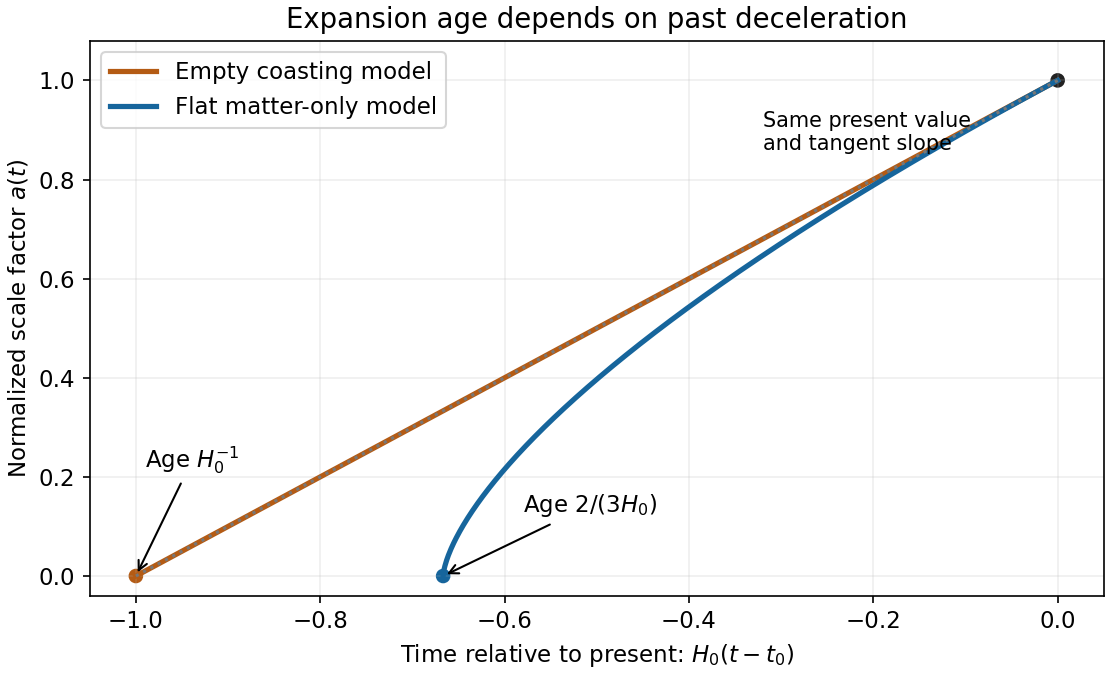
With zero curvature and no cosmological constant, the present normalization requires ΩM=1. Thus a˙=H0a−1/2, and choosing the big bang as t=0 givesFor an empty expanding model, Ωk=1 and the curvature must be negative. The equation becomes a˙=H0, givingThe latter is the Milne slicing of flat spacetime; its zero-scale-factor origin is not a matter-density curvature singularity. In the matter model, gravity decelerates expansion, so the earlier slope was greater than the present slope and the same present size was reached in less time. With the stipulated H0, the two model ages are approximately 8.69 and 13.0 Gyr.
a(t)=(23H0t)2/3,t0=3H02.
a(t)=H0t,t0=H0−1.

Adiabatic photon redshifting gives T∝a−1. Using the stipulated temperatures,In the flat dust approximation of part c, t=t0a3/2, so trec≃(2/3H0)1000−3/2≃2.75×105 years. This approximation omits the significant radiation contribution near the actual recombination epoch.
1+zrec≃1000,zrec≃999.
The elementary travel-distance estimate is ctrec≃8.4×10⁴ pc, whose corresponding comoving scale today is about 84 Mpc. In an expanding universe, however, that is not the exact proper particle-horizon radius. Integrating the null geodesic givesfor dust. Thus the proper horizon at this epoch is about 0.25 Mpc and its present comoving size about 250 Mpc. The factor three accounts for expansion during light propagation. These scales describe the limited causal domain in the simple decelerating model. The near-uniform CMB temperature across much more widely separated last-scattering regions motivates the horizon problem; the question's rough ct estimate and the exact dust horizon should not be conflated.
dhor(t)=a(t)c∫0ta(t′)dt′=3ct
Ancestors (10)
- S2
- 2018
- Past exam of the short options paper shared by Prelims and Parts A and B of the physics course of the University of Oxford
- Short options paper shared by Prelims and Parts A and B of the physics course of the University of Oxford
- Physics course of the University of Oxford
- Undergraduate course of the University of Oxford
- Course of the University of Oxford
- University of Oxford
- List of universities
- Home
Discussion (0)
New discussionThere are no discussions about this article yet.
Articles by others on the same topic (0)
There are currently no matching articles.