The Reynolds number compares inertial and viscous terms in the momentum equation:Here is fluid mass density, a characteristic speed, a swimmer or flow length, and the dynamic viscosity. The advective inertia scale is and the viscous force-density scale is , whose ratio is Re. For an illustrative micron-scale swimmer with and in water, taking and gives .
At such low Re, Stokes flow is the useful approximation. For an incompressible Newtonian fluid it obeys and , with negligible inertia. Swimming is not a sequence of propulsive impulses followed by coasting: drag balances propulsive forces almost instantaneously. For example, the drag on a slowly translating sphere is . A freely swimming organism has approximately zero total external force and torque; its body motion balances the forces and torques generated by its appendages.
The linear equations have kinematic reversibility of Stokes flow: reversing the boundary velocities reverses the fluid motion. A reciprocal stroke that retraces exactly the same sequence of shapes therefore retraces its displacement. This is the scallop theorem. A single hinge opening and closing along the same shape path cannot propel an ideal swimmer through an otherwise quiescent Newtonian Stokes fluid, regardless of merely changing how quickly it opens relative to closing.
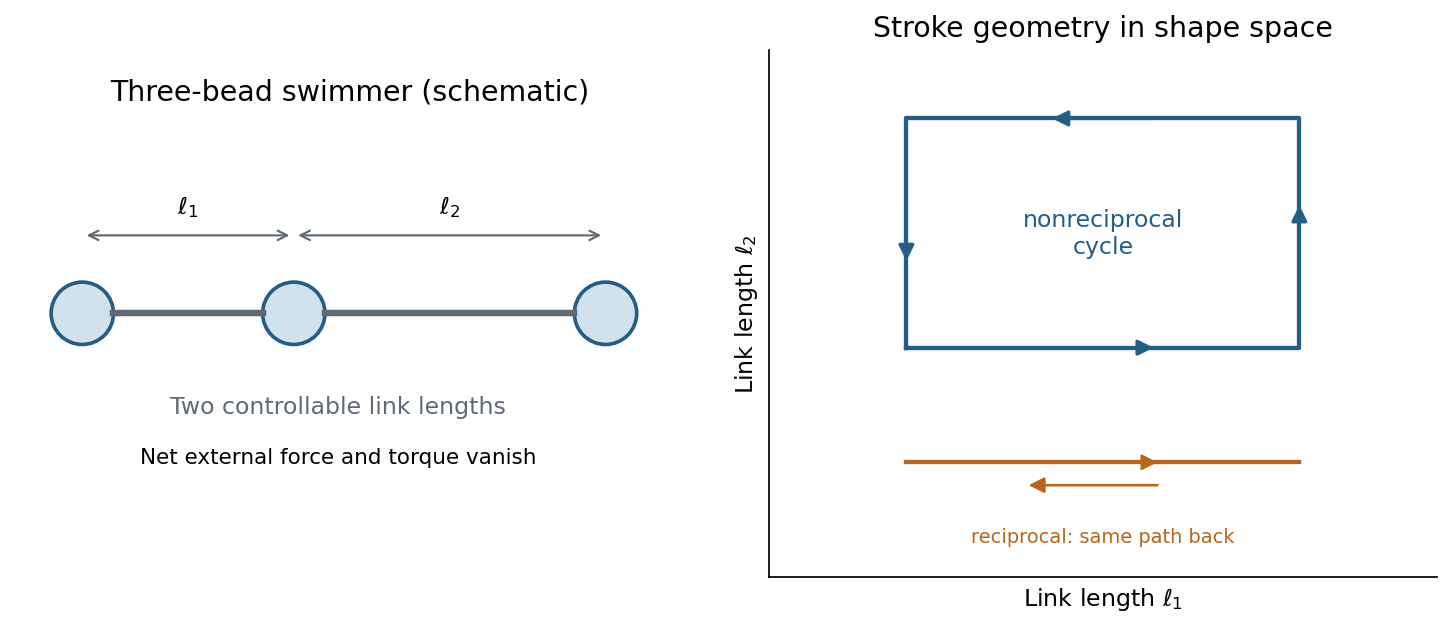
A three-bead swimmer can use a nonreciprocal loop in its two-length shape space, unlike a retraced one-parameter stroke
. Details. 
A useful design has at least two shape coordinates driven out of phase, so the stroke follows a loop rather than a retraced line in shape space. In the three-bead example the two link lengths change in a cycle; hydrodynamic interactions differ at different points of the cycle, allowing net translation. The drawing illustrates this mechanism without assigning a particular swimming speed.
Biological routes include continuous rotation of a chiral helical flagellum, nonreciprocal ciliary strokes, and traveling bending waves along a flagellum. An elongated filament generally has greater drag for motion normal to itself than along itself; this drag anisotropy helps convert those motions into propulsion. The body may counterrotate to balance appendage torque. Micro-organisms must exploit nonreciprocal shape changes, rotation or another mechanism consistent with viscous force balance; inertia-based swimming intuition fails. Viscoelastic surroundings or appreciable inertia can invalidate the particular Newtonian assumptions behind the simple scallop result.
A grafted polymer chain is tethered to a surface at one end. Let its isolated coil size be , where is the number of statistical units and their statistical segment length. For a good solvent, the Flory approximation gives ; an ideal chain has . Let be the number of tethers per unit area, distinct from the membrane tension in Question 1. Their typical lateral separation is .
At low coverage, , the chains hardly overlap. Each forms a polymer mushroom, retaining roughly the isolated-coil conformation apart from the constraint of the solid surface. Raising coverage until makes neighboring coils overlap. The crossover criterion isFor in a good solvent, maintaining isolated coil shapes would crowd segments into the same lateral regions, increasing excluded-volume and osmotic free energy. Chains stretch predominantly away from the surface to relieve that crowding, at the cost of their conformational entropy. The resulting dense tethered layer is a polymer brush.
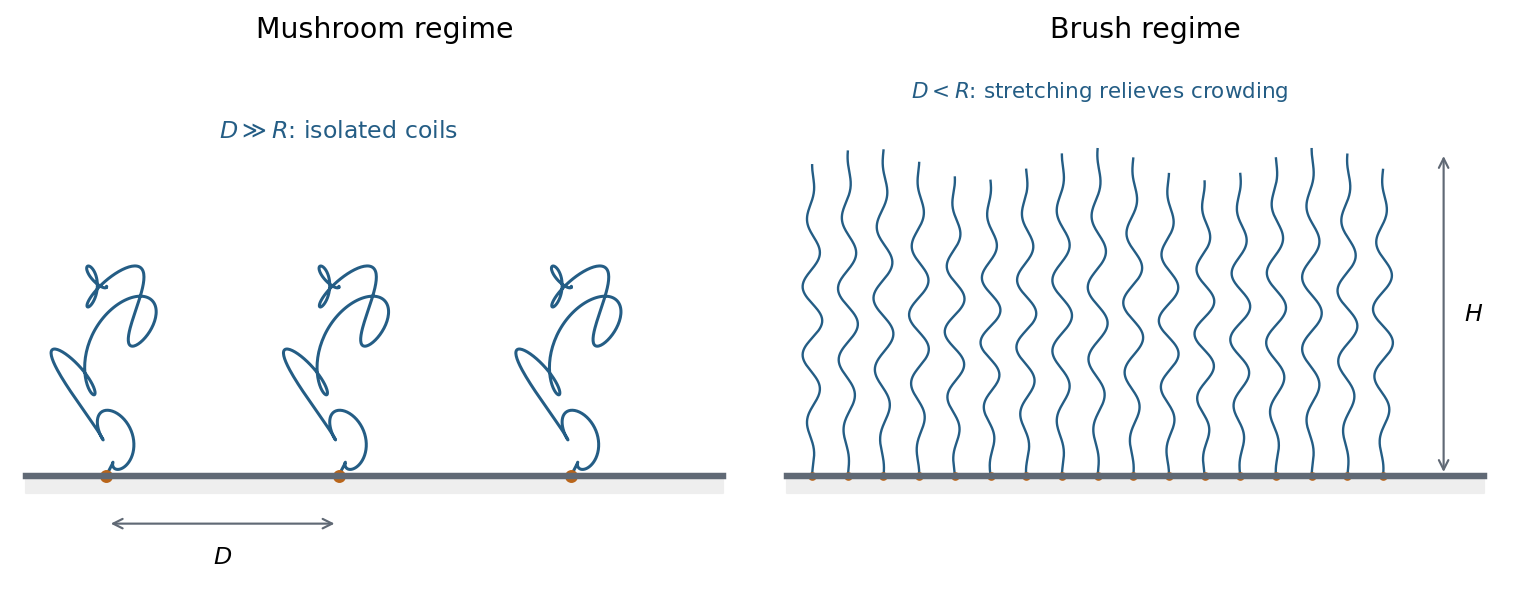
Sparse grafted coils form mushrooms; overlap at higher grafting density stretches chains into a brush
. Details. 
A simple scaling estimate makes the balance explicit. For brush height , the monomer concentration is of order . The free energy per chain in units of iswhere is the effective segment excluded volume. The first term is Gaussian stretching; the second is the cost of segment crowding in a good solvent. Minimizing with respect to height givesWhen , this is . Height increases with chain length and grafting density, while the lateral spacing is fixed by the attachment points. The estimate assumes stretching strong compared with an isolated coil but still much smaller than contour length ; it does not describe fully extended chains. Poor-solvent attraction can instead collapse the layer, so solvent quality must be specified before using the good-solvent formula.
The mushroom-to-brush change is a crowding crossover for finite chains, rather than automatically a sharp thermodynamic phase transition. A swollen brush can provide steric stabilization: bringing two coated surfaces together further compresses and crowds their chains, producing a repulsive free-energy cost. The controlling comparison is tether separation versus isolated coil size, and the brush height follows from competition between chain stretching and segment interactions.
The requested model is the standard linear solid model: a spring of modulus in parallel with a Maxwell branch consisting of a spring in series with a dashpot of viscosity . Both parallel branches have the same strain; their stresses add. In the Maxwell branch the spring and dashpot have the same stress and their strains add. The equilibrium spring prevents indefinite flow at long times.
For harmonic strain , define the dynamic modulus by . The Maxwell branch has compliance . Defining therefore givesThe same mechanical model can represent a shear modulus if the appropriate shear stresses and strains are used consistently.
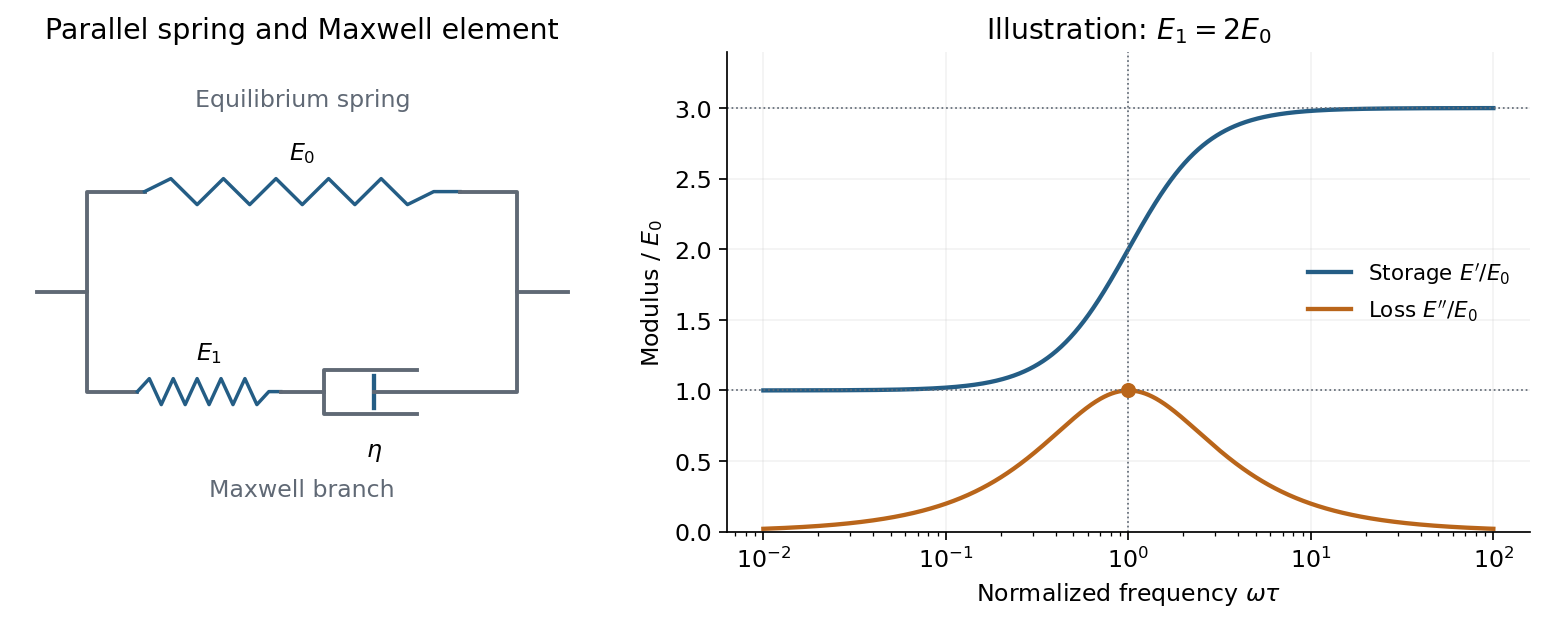
A spring parallel to a Maxwell element gives finite low- and high-frequency storage moduli and one loss-modulus peak
. Details. 
Writing , its storage modulus and loss modulus areWith this time convention the physical stress is and leads the strain by the loss angle. The dissipated energy per unit volume per cycle is . Thus describes elastic storage and describes dissipation.
At low frequency, , the dashpot flows during a cycle and relaxes the Maxwell spring, leaving , . At high frequency, , the dashpot hardly deforms within a cycle, so both springs carry elastic load: , while . The loss modulus is maximal at , with peak value .
The equivalent constitutive equation isAfter a sudden strain is imposed and held, the stress relaxes as . It falls from the instantaneous modulus to the nonzero relaxed modulus . This single-time relaxation is the simplest improvement over a purely elastic solid or a Maxwell fluid with zero long-time modulus.
The loss tangent is . Its maximum need not coincide with the loss-modulus maximum: the peak frequencies in a standard linear solid give for the loss tangent. The model captures one viscoelastic crossover between two finite elastic plateaux, with dissipation concentrated near the relaxation frequency.
Articles by others on the same topic
There are currently no matching articles.