Write the particle volume fraction as . In a stable, repulsion-dominated colloid, low gives a disordered fluid. Increasing makes the interaction between neighboring particles important and can produce an ordered crystal, separated from the fluid by a phase coexistence curve. Increasing the Debye–Hückel screening length at fixed charge strengthens the repulsion at a given separation and allows freezing at smaller geometrical volume fraction.
The geometric intuition is that particles behave as though they occupy more than their bare diameter: roughly, an effective exclusion diameter extends out to the separation where is of order . A hard sphere comparison then uses . This explains the trend; it is not an exact freezing criterion.
At short Debye–Hückel screening length and negligible attraction, the diagram approaches hard sphere fluid–crystal coexistence. For longer-ranged soft repulsion, body-centered cubic lattice and face-centered cubic lattice crystals can both be stable, with the former often appearing towards the softer, lower-density freezing boundary. Screened-Coulomb simulations exhibit both these crystal structures.[ref]
https://doi.org/10.1103/PhysRevLett.57.2694. Kremer, Robbins and Grest, Phase Diagram of Yukawa Systems: Model for Charge-Stabilized Colloids
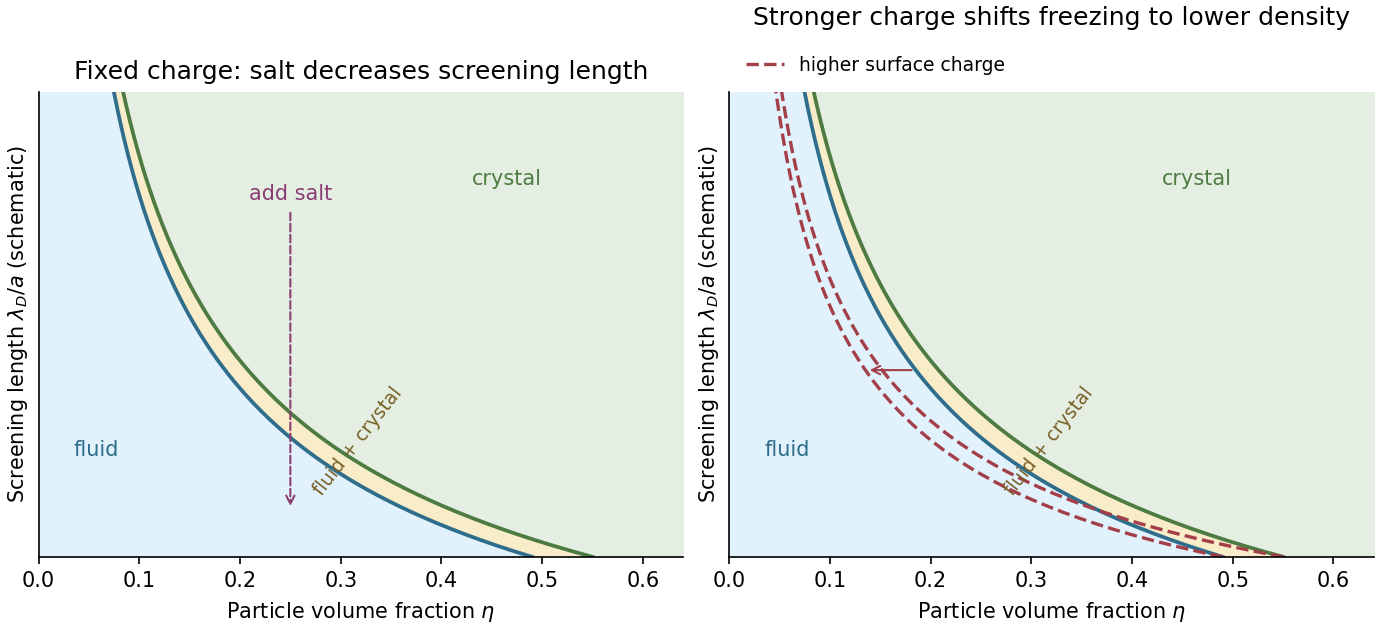

No universal quantitative diagram follows from alone: the charge, Hamaker constant and surface conditions must also be fixed. If salt suppresses the stabilizing barrier enough for Van der Waals force attraction to dominate, a colloid-poor/colloid-rich separation or aggregation can replace part of this repulsive reference diagram. Dense colloidal glasses or colloidal gels may also be observed after kinetic arrest; they should not be mistaken for additional thermodynamic equilibrium thermodynamic phases.
Articles by others on the same topic
There are currently no matching articles.