For an ideal chain, independent Kuhn length steps give the random walk relationwhere denotes the end-to-end displacement of a subchain. Equivalently the mass-size fractal exponent is . Numerical factors depend on the chosen definition of blob diameter.
A subchain smaller than the adsorption height explores three dimensions much as a free ideal chain does. At scales exceeding , adsorption restricts its perpendicular extent to order , so the coil is anisotropic. Its in-plane projection may still have a random walk law for an ideal chain, but the isotropic three-dimensional blob construction cannot be extrapolated to . This is the reason to use adsorption blobs of size .
Here is the absolute temperature and the Boltzmann constant. An adsorption blob contains monomers, so there are such blobs. Confining a blob removes an amount of conformational entropy of order ; thus the positive confinement contribution to the Helmholtz free energy isThe statement about one blob's entropy is used as an entropy loss relative to the free chain, rather than as an absolute entropy.
In the assumed slab model, contacts occur within a monomer-scale distance of the substrate. The contact fraction is approximately , giving . Multiplying this by the negative contact energy yieldsThe two contributions express the competition between loss of conformational entropy and gain of adsorption energy. The numerical coefficients are the ones stipulated by this blob approximation.
Minimize the Helmholtz free energy at fixed . Its derivative isThe physical stationary point for isTo check the minimum directly, put . Then , which is globally minimized at . The binding free energy gain per monomer is consequently .
The weak-adsorption blob picture requires , or in this model. If is too large, the layer saturates at a monomer-scale thickness; if too small, a many-blob adsorbed layer has not formed.
The stretched segment is a Gaussian chain of Kuhn length steps, with unperturbed root-mean-square end-to-end distance . Its end-to-end probability density is proportional to , so its leading elastic Helmholtz free energy is . Adding the remaining segment's adsorption free energy givesAn additive constant independent of is irrelevant. At the optimal adsorption height this becomesThe original PDF's hint labels the positive quantity proportional to an entropy. It has units of energy and is the stretching free energy. The corresponding change of conformational entropy is . This dimensional and sign correction is essential to the minimization.
This is the leading extensive Gaussian chain approximation: endpoint normalization and junction corrections give subleading terms. It requires many stretched monomers and , rather than extension near the full contour length.
During slow peeling in atomic force microscopy, adjusts to minimize the Helmholtz free energy at each imposed height. Define the positive binding gain for the adsorbed segment. The stationary point satisfiesSince , this is a minimum while . The upward pulling force is the height derivative of the minimized free energy. The implicit term vanishes because , givingUsing ,It is independent of : extra pulling height releases more monomers while leaving the fractional extension of the stretched part unchanged. Equivalently . This is the equilibrium peeling force of an adsorbed Gaussian chain.
The plateau ends when , atThereafter all monomers are detached and the Gaussian chain force is , agreeing continuously with the plateau at . Very near the start and final release, finite-chain and junction effects lie outside the blob approximation.
For the usual interpretation of a real chain in a good solvent, the detachment force is smaller in the weak-adsorption regime. Excluded volume swells the chain, increasing the cost of confinement near the substrate. The adsorbed layer becomes thicker and its binding free energy per monomer decreases. The same contact energy therefore does not mean the same total binding strength.
The scaling argument can include both adsorption and stretching. Let , where for an ideal chain and approximately for a self-avoiding walk in three dimensions. With the same contact-fraction approximation,Minimization gives and . At detachment, a tensile blob of size costs approximately ; its monomer count is . Equating the stretching gain per monomer to givesThus , compared with , so their ratio scales as for weak attraction. These are scaling relations, not exact prefactors. The real-chain adsorption exponents here use the same simple uniform-contact model as the earlier parts; a more detailed surface theory of critical phenomena can refine them. The thicker, more weakly bound layer reflects the higher cost of confining a good solvent chain.[ref]
https://dasher.wustl.edu/bio5357/readings/rubinstein-chapter3.pdf. Rubinstein and Colby, Polymer Physics, chapter 3, equations (3.59)–(3.66)
“Real” alone does not specify solvent quality: a collapsed chain in a poor solvent, strong adsorption, or substantial bending stiffness requires a different comparison. The smaller-force conclusion concerns the flexible good solvent chain implicit in the excluded-volume correction.
The gap is not a fixed mechanical separation. Thermal fluctuations of the wall compete with drift towards the microtubule under the opposing force. A monomer can be incorporated only after the gap reaches its length. The Smoluchowski equation describes this overdamped drift and diffusion of gap probability density.
For gap potential energy , the equation and its probability current areThe drift mobility is , the overdamped consequence of the fluctuation-dissipation relation for a Langevin particle. Equivalently, this coefficient is fixed by requiring the zero-current solution to be the Boltzmann distribution . Solve this equation with the appropriate exclusion, incorporation and probability-normalization conditions. The steady flux through the incorporation threshold gives the addition rate ; the elongation speed is .
There is a regime distinction in the printed problem. The absorbing boundary imposed in part (c) means instantaneous incorporation once a gap opens, and leads to the diffusion-limited Brownian ratchet with constant load. A genuinely reaction-limited polymerization Brownian ratchet instead assumes fast gap equilibration followed by a finite chemical addition rate, giving an exponential gating factor multiplying that chemical rate. The equations requested in the subsequent parts specify the former model, which is the one solved here.
In the steady state, conservation of probability requires , so is constant. The sign is positive because increasing gap reaches the incorporation boundary, whereas the deterministic drift points towards smaller gap. ThusAn integrating factor givesSubstitution makes the check particularly transparent:so . The constant offset is necessary for nonzero transport; a pure Boltzmann distribution would have and could not describe a steady succession of addition events. The limit is taken after applying the boundary conditions, avoiding the apparent singularity of the displayed parametrization.
In this polymerization Brownian ratchet model, a gap of width immediately accommodates one monomer. That event advances the tip by and resets the gap to zero. The threshold is therefore an absorbing boundary condition for a diffusion,All waiting-time probability lies within , so the steady occupation probability density satisfiesThere is a reinjection flux at equal to the absorption flux at . The nonpenetration constraint at zero is a reflecting boundary condition for a diffusion during each individual waiting episode. For the stationary reset process it must not be confused with setting the net current to zero: the source at reset supplies . This is how a normalized steady density can coexist with a nonzero exit flux.
Put and . The absorbing boundary condition for a diffusion gives , henceThis is nonnegative throughout the allowed interval. Normalizing the probability density givesThereforeEquivalently the normalized density isThe denominator is positive for , since . The dimensions are consistent: has units of inverse time, and of inverse length, and is dimensionless.
For a small opposing force, the relevant parameter is . A Taylor series givessoIn particular the zero-force rate is finite, despite the numerator and denominator of the original expression both vanishing.
For , the exponential dominates the denominator:Opening a monomer-sized gap is exponentially rare at high opposing force. The algebraic prefactor belongs to this first-passage model and must not be discarded when quoting the leading asymptotic rate.
Each addition starts a new statistically identical waiting episode at zero gap. Thus the addition rate is the reciprocal of a mean first-passage time, not the reciprocal of the mean gap:This can also be derived without the steady density. If is the mean time to reach starting at gap , its backward Smoluchowski equation isThe first boundary is reflecting and the second absorbing. An integrating factor gives , whenceAt weak force, is the time for a freely diffusing wall to move a monomer length, with reflection at the tip. At strong force, opening the gap requires work , with Boltzmann distribution suppression . The drift establishes a near-tip thermal length and a diffusion time ; consequentlyThe exponentially long wait explains why the growth slows. There is no additional chemical waiting time in the imposed absorbing-threshold model; such a time would be needed to describe the separate reaction-limited polymerization Brownian ratchet regime.
In a magnesium chloride chemical solution, the principal pair interactions are hard sphere exclusion, repulsion of overlapping electric double layers, and attractive Van der Waals forces. The positive surface attracts chloride counterions and repels magnesium coions; mobile ions screen the bare Coulomb's law interaction. The competition between screened electrostatic repulsion and Van der Waals force attraction is described by DLVO theory.
For well-separated identical weakly charged spheres, the approximate repulsive pair potential energy, at centre separation , isIt is a screened Coulomb pair potential. An attractive Hamaker constant adds a negative short-range contribution, while overlap is forbidden. Very near contact, solvation and molecular surface structure can also matter. No polymer-induced interaction should be assumed before polymer is added in part (f).
The particle carries positive surface charge density . Its surrounding electric double layer has an excess of negative chloride counterions and a deficit of positive magnesium coions. Thus decreases to zero, decreases towards its bulk value, and increases towards its bulk value. The diffuse charge density is negative and tends to zero.
If denotes the bulk number of dissolved salt formula units per unit volume, the far-field number densities are and . The bulk is neutral even though these number densities differ. In the dilute mean-field picture the total diffuse electric charge is , ensuring overall electroneutrality. A molecularly bound compact layer would require additional surface-chemistry information and is not assumed in the supplied potential.
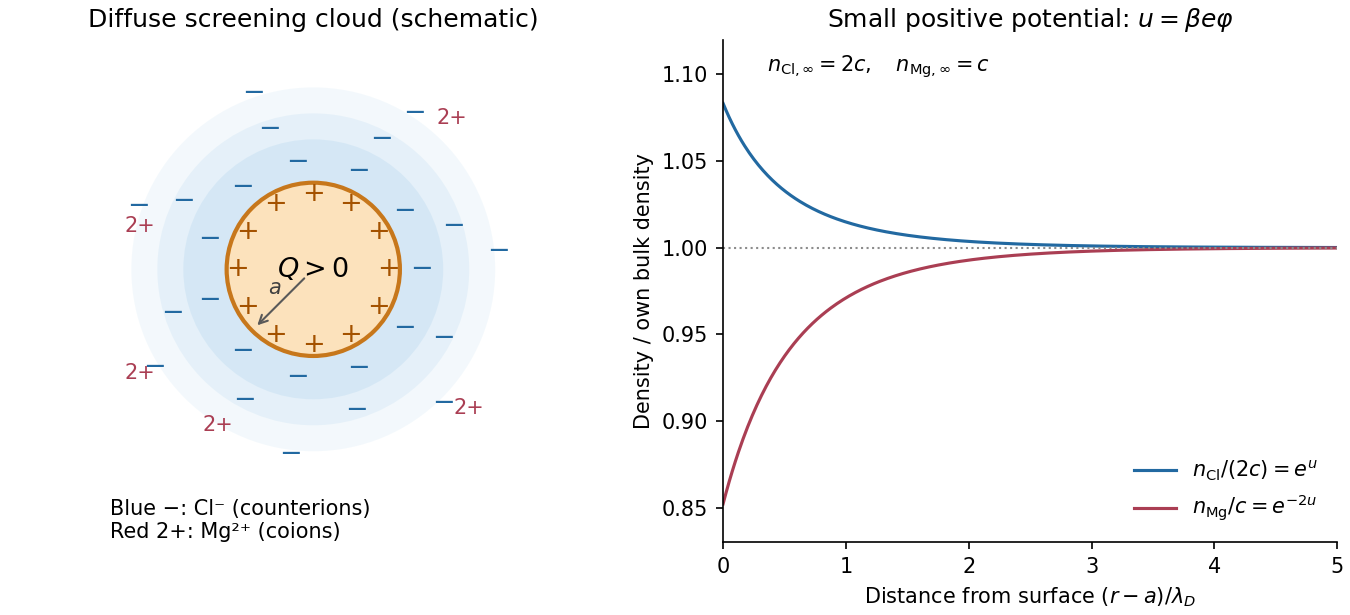

Let be the permittivity, , the elementary charge, and the bulk salt formula-unit number density. The Boltzmann distribution givesConsequently the exterior Poisson-Boltzmann equation isFor small , meaning , linearize the exponentials. The Debye–Hückel approximation givesThis is also : the divalent cation contributes and the two monovalent anions contribute . In terms of molar salt concentration in , replace by ; if is in , use . The molar ionic strength is in the same concentration units.
The boundary conditions are and, by Gauss's law,Here the surface charge is uniform and the spherically symmetric interior field is zero. Set ; the radial equation reduces to . Decay excludes the growing exponential, so write . Then , givingIt solves the linearized Poisson-Boltzmann equation, not the full nonlinear equation at finite . The radial ion profiles, consistently to first order, areThe exponential Boltzmann distribution formulas above express the full mean-field relation, but substituting a linearized potential into them is accurate only to the retained order. A useful electroneutrality check isThe result is the Debye-Hückel potential of a charged sphere.
Write the particle volume fraction as . In a stable, repulsion-dominated colloid, low gives a disordered fluid. Increasing makes the interaction between neighboring particles important and can produce an ordered crystal, separated from the fluid by a phase coexistence curve. Increasing the Debye–Hückel screening length at fixed charge strengthens the repulsion at a given separation and allows freezing at smaller geometrical volume fraction.
The geometric intuition is that particles behave as though they occupy more than their bare diameter: roughly, an effective exclusion diameter extends out to the separation where is of order . A hard sphere comparison then uses . This explains the trend; it is not an exact freezing criterion.
At short Debye–Hückel screening length and negligible attraction, the diagram approaches hard sphere fluid–crystal coexistence. For longer-ranged soft repulsion, body-centered cubic lattice and face-centered cubic lattice crystals can both be stable, with the former often appearing towards the softer, lower-density freezing boundary. Screened-Coulomb simulations exhibit both these crystal structures.[ref]
https://doi.org/10.1103/PhysRevLett.57.2694. Kremer, Robbins and Grest, Phase Diagram of Yukawa Systems: Model for Charge-Stabilized Colloids
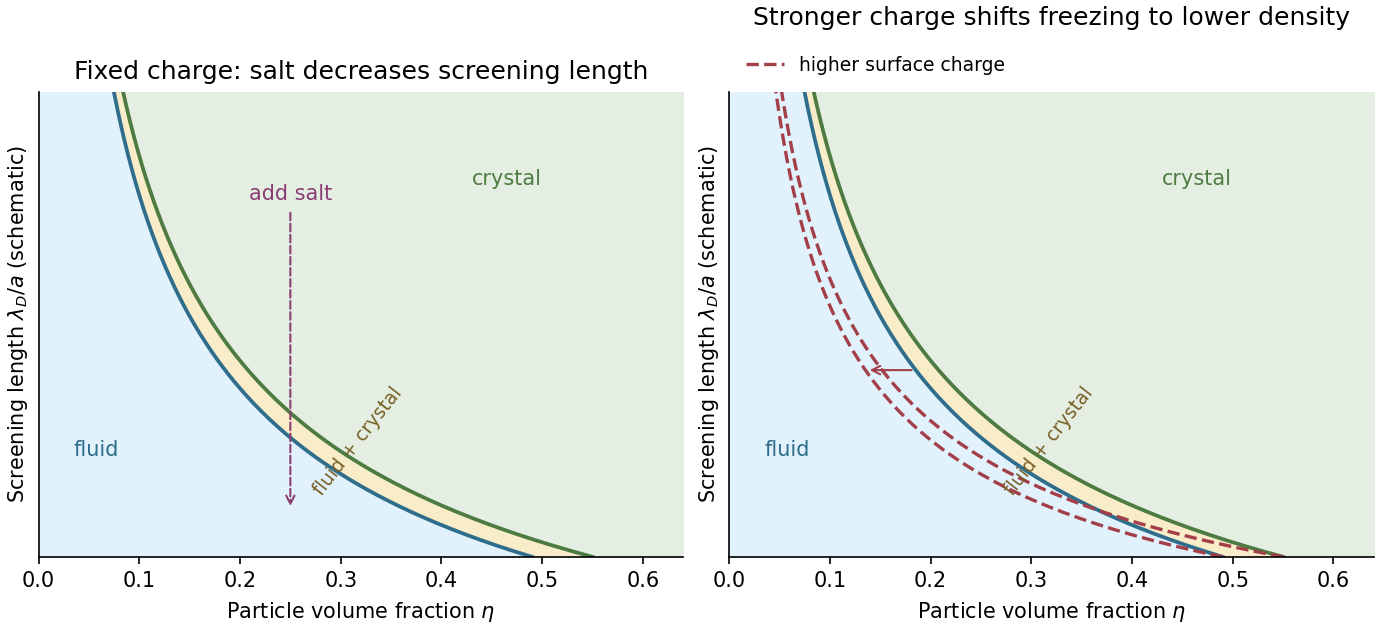

No universal quantitative diagram follows from alone: the charge, Hamaker constant and surface conditions must also be fixed. If salt suppresses the stabilizing barrier enough for Van der Waals force attraction to dominate, a colloid-poor/colloid-rich separation or aggregation can replace part of this repulsive reference diagram. Dense colloidal glasses or colloidal gels may also be observed after kinetic arrest; they should not be mistaken for additional thermodynamic equilibrium thermodynamic phases.
First hold the surface electric charge fixed and increase the bulk salt concentration. Since , the Debye–Hückel screening length decreases as . For surface gap ,Thus both the range and the strength of repulsion decrease. In the repulsive phase diagram, the sample moves downwards at fixed volume fraction and can melt from a crystal into a fluid. Because screening length is already a diagram axis, changing salt moves the state through that diagram rather than independently changing its fixed-charge coexistence curves. If Van der Waals forces become dominant, however, adding salt may instead destabilize the dispersion and cause aggregation. These are distinct physical regimes.
Second increase at fixed salt concentration and particle size. The electric charge is , so the pair repulsion increases approximately as within the Debye–Hückel approximation, while the reservoir screening length remains unchanged. Freezing then becomes possible at lower volume fraction or shorter screening length. At fixed , the coexistence curves shift towards lower ; a previously fluid sample may crystallize.
These statements assume fixed, uniform charge and a salt reservoir dominating the screening. Strong charging requires nonlinear screening and possibly charge regulation. At very low added salt or appreciable particle concentration, particle-released counterions also contribute to ionic strength, so the screening length is no longer independently fixed by the added salt alone.
For dissolved, nonadsorbing polyethylene glycol, the usual new interaction is a depletion force. Polymer centres are excluded from a layer of thickness of order their radius of gyration around each particle. When the particles approach, their exclusion layers overlap. This increases the volume accessible to polymer and its translational entropy, lowering the colloid pair free energy. Equivalently the surrounding polymer osmotic pressure pushes the particles together.
In the dilute-polymer Asakura-Oosawa model, let be the surface gap and . Thenfor , and for . Here is the reservoir polymer osmotic pressure. The overlap-volume formula follows by adding two equal spherical cap volumes with height . Thus the added attraction has range about and grows with polymer concentration. The total interaction is approximately hard exclusion plus screened electrostatic repulsion plus Van der Waals force and depletion attractions.
Increasing polymer concentration therefore creates a family of phase diagrams, rather than a unique shift determined by polymer size alone. Where the attraction overcomes repulsion, colloid-poor fluid can coexist with a colloid-rich phase, and fluid–crystal coexistence generally broadens. For sufficiently long-ranged attraction, stable fluid–fluid separation can occur. For the stipulated small polymer, the attraction is short-ranged: fluid–fluid separation can be metastable to crystallization, and a rapid attraction increase can instead produce an arrested colloidal gel. Residual long-ranged repulsion can oppose bulk separation. Simulations and free-volume calculations confirm that longer-ranged electrostatic repulsion can counteract depletion-driven separation.[ref]
https://arxiv.org/abs/cond-mat/0509790. Fortini, Dijkstra and Tuinier, Phase behaviour of charged colloidal sphere dispersions with added polymer chains
The nonadsorption assumption matters. If the polyethylene glycol adsorbs to the particles, a dense attached layer can give steric stabilization, whereas chains attaching to two particles can produce polymer bridging. The paper does not specify surface affinity or polymer concentration, so depletion is the standard conditional answer, not a prediction of an inevitable particular final phase.
Articles by others on the same topic
There are currently no matching articles.