In a magnesium chloride chemical solution, the principal pair interactions are hard sphere exclusion, repulsion of overlapping electric double layers, and attractive Van der Waals forces. The positive surface attracts chloride counterions and repels magnesium coions; mobile ions screen the bare Coulomb's law interaction. The competition between screened electrostatic repulsion and Van der Waals force attraction is described by DLVO theory.
For well-separated identical weakly charged spheres, the approximate repulsive pair potential energy, at centre separation , isIt is a screened Coulomb pair potential. An attractive Hamaker constant adds a negative short-range contribution, while overlap is forbidden. Very near contact, solvation and molecular surface structure can also matter. No polymer-induced interaction should be assumed before polymer is added in part (f).
The particle carries positive surface charge density . Its surrounding electric double layer has an excess of negative chloride counterions and a deficit of positive magnesium coions. Thus decreases to zero, decreases towards its bulk value, and increases towards its bulk value. The diffuse charge density is negative and tends to zero.
If denotes the bulk number of dissolved salt formula units per unit volume, the far-field number densities are and . The bulk is neutral even though these number densities differ. In the dilute mean-field picture the total diffuse electric charge is , ensuring overall electroneutrality. A molecularly bound compact layer would require additional surface-chemistry information and is not assumed in the supplied potential.
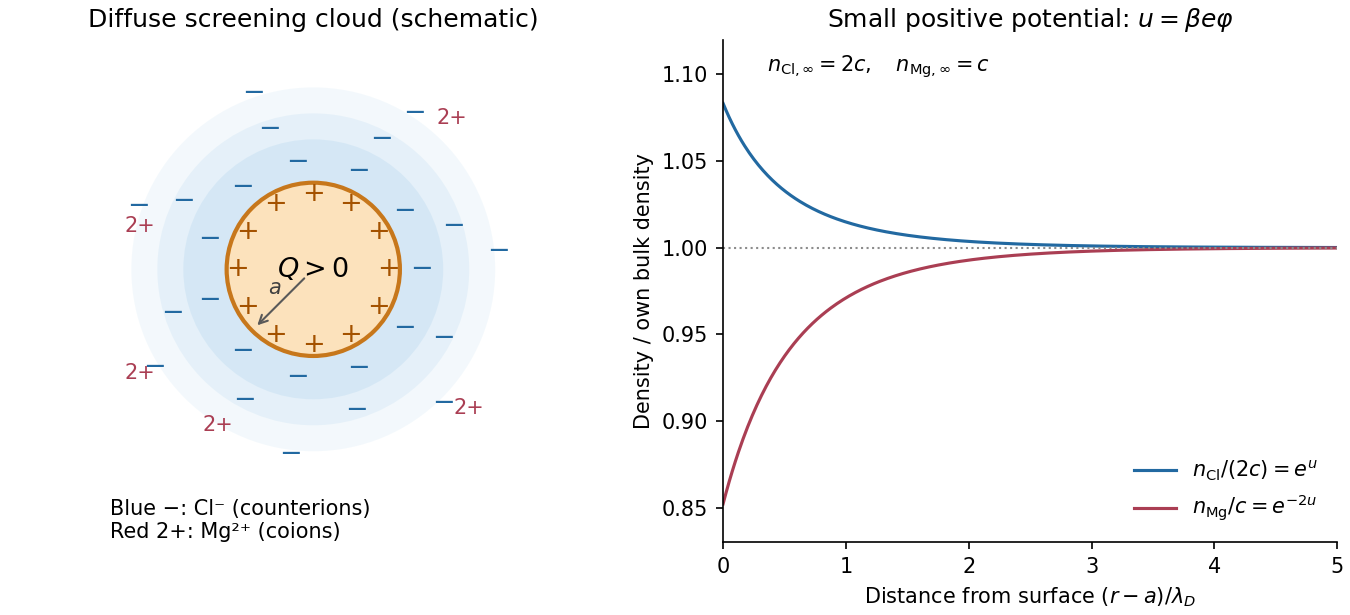

Let be the permittivity, , the elementary charge, and the bulk salt formula-unit number density. The Boltzmann distribution givesConsequently the exterior Poisson-Boltzmann equation isFor small , meaning , linearize the exponentials. The Debye–Hückel approximation givesThis is also : the divalent cation contributes and the two monovalent anions contribute . In terms of molar salt concentration in , replace by ; if is in , use . The molar ionic strength is in the same concentration units.
The boundary conditions are and, by Gauss's law,Here the surface charge is uniform and the spherically symmetric interior field is zero. Set ; the radial equation reduces to . Decay excludes the growing exponential, so write . Then , givingIt solves the linearized Poisson-Boltzmann equation, not the full nonlinear equation at finite . The radial ion profiles, consistently to first order, areThe exponential Boltzmann distribution formulas above express the full mean-field relation, but substituting a linearized potential into them is accurate only to the retained order. A useful electroneutrality check isThe result is the Debye-Hückel potential of a charged sphere.
Write the particle volume fraction as . In a stable, repulsion-dominated colloid, low gives a disordered fluid. Increasing makes the interaction between neighboring particles important and can produce an ordered crystal, separated from the fluid by a phase coexistence curve. Increasing the Debye–Hückel screening length at fixed charge strengthens the repulsion at a given separation and allows freezing at smaller geometrical volume fraction.
The geometric intuition is that particles behave as though they occupy more than their bare diameter: roughly, an effective exclusion diameter extends out to the separation where is of order . A hard sphere comparison then uses . This explains the trend; it is not an exact freezing criterion.
At short Debye–Hückel screening length and negligible attraction, the diagram approaches hard sphere fluid–crystal coexistence. For longer-ranged soft repulsion, body-centered cubic lattice and face-centered cubic lattice crystals can both be stable, with the former often appearing towards the softer, lower-density freezing boundary. Screened-Coulomb simulations exhibit both these crystal structures.[ref]
https://doi.org/10.1103/PhysRevLett.57.2694. Kremer, Robbins and Grest, Phase Diagram of Yukawa Systems: Model for Charge-Stabilized Colloids
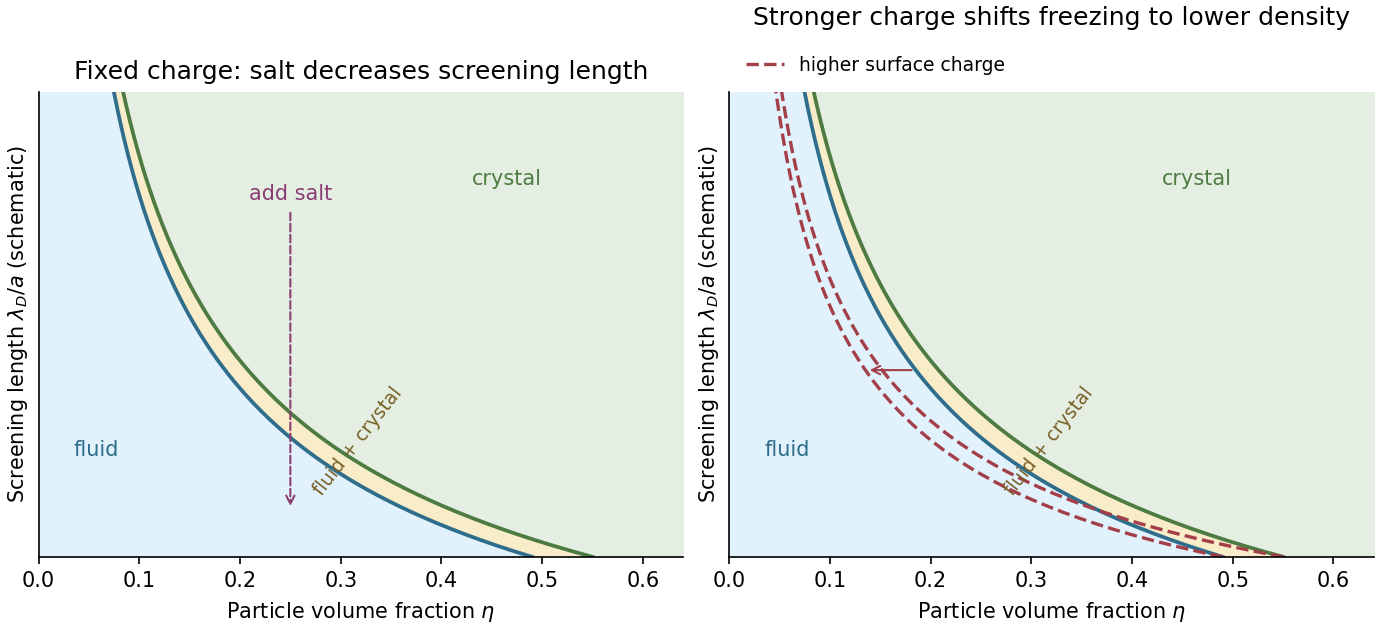

No universal quantitative diagram follows from alone: the charge, Hamaker constant and surface conditions must also be fixed. If salt suppresses the stabilizing barrier enough for Van der Waals force attraction to dominate, a colloid-poor/colloid-rich separation or aggregation can replace part of this repulsive reference diagram. Dense colloidal glasses or colloidal gels may also be observed after kinetic arrest; they should not be mistaken for additional thermodynamic equilibrium thermodynamic phases.
First hold the surface electric charge fixed and increase the bulk salt concentration. Since , the Debye–Hückel screening length decreases as . For surface gap ,Thus both the range and the strength of repulsion decrease. In the repulsive phase diagram, the sample moves downwards at fixed volume fraction and can melt from a crystal into a fluid. Because screening length is already a diagram axis, changing salt moves the state through that diagram rather than independently changing its fixed-charge coexistence curves. If Van der Waals forces become dominant, however, adding salt may instead destabilize the dispersion and cause aggregation. These are distinct physical regimes.
Second increase at fixed salt concentration and particle size. The electric charge is , so the pair repulsion increases approximately as within the Debye–Hückel approximation, while the reservoir screening length remains unchanged. Freezing then becomes possible at lower volume fraction or shorter screening length. At fixed , the coexistence curves shift towards lower ; a previously fluid sample may crystallize.
These statements assume fixed, uniform charge and a salt reservoir dominating the screening. Strong charging requires nonlinear screening and possibly charge regulation. At very low added salt or appreciable particle concentration, particle-released counterions also contribute to ionic strength, so the screening length is no longer independently fixed by the added salt alone.
For dissolved, nonadsorbing polyethylene glycol, the usual new interaction is a depletion force. Polymer centres are excluded from a layer of thickness of order their radius of gyration around each particle. When the particles approach, their exclusion layers overlap. This increases the volume accessible to polymer and its translational entropy, lowering the colloid pair free energy. Equivalently the surrounding polymer osmotic pressure pushes the particles together.
In the dilute-polymer Asakura-Oosawa model, let be the surface gap and . Thenfor , and for . Here is the reservoir polymer osmotic pressure. The overlap-volume formula follows by adding two equal spherical cap volumes with height . Thus the added attraction has range about and grows with polymer concentration. The total interaction is approximately hard exclusion plus screened electrostatic repulsion plus Van der Waals force and depletion attractions.
Increasing polymer concentration therefore creates a family of phase diagrams, rather than a unique shift determined by polymer size alone. Where the attraction overcomes repulsion, colloid-poor fluid can coexist with a colloid-rich phase, and fluid–crystal coexistence generally broadens. For sufficiently long-ranged attraction, stable fluid–fluid separation can occur. For the stipulated small polymer, the attraction is short-ranged: fluid–fluid separation can be metastable to crystallization, and a rapid attraction increase can instead produce an arrested colloidal gel. Residual long-ranged repulsion can oppose bulk separation. Simulations and free-volume calculations confirm that longer-ranged electrostatic repulsion can counteract depletion-driven separation.[ref]
https://arxiv.org/abs/cond-mat/0509790. Fortini, Dijkstra and Tuinier, Phase behaviour of charged colloidal sphere dispersions with added polymer chains
The nonadsorption assumption matters. If the polyethylene glycol adsorbs to the particles, a dense attached layer can give steric stabilization, whereas chains attaching to two particles can produce polymer bridging. The paper does not specify surface affinity or polymer concentration, so depletion is the standard conditional answer, not a prediction of an inevitable particular final phase.
Articles by others on the same topic
There are currently no matching articles.