We first derive the stress and energy facts used in both parts. The Cauchy traction is force per unit area in the deformed configuration. The first Piola-Kirchhoff traction is force per unit reference area. Their force vectors are measured in the same spatial coordinates, but the area measures and the normals used to specify the surface are different.
Parametrize a reference surface by . Its oriented area vector is . Under deformation, the two tangents become . The cross-product identitytherefore proves Nanson's formula . Equality of the physical force on corresponding surface patches now givesSince this holds for every reference normal,The first Piola-Kirchhoff stress tensor is generally not symmetric, whereas the Cauchy stress tensor is symmetric in the absence of couple stresses.
For the stated energy on orientation-preserving gradients, differentiation givesA stress-free state satisfies . Taking determinants yields , so and : precisely . These states are also the global energy minimizers. If are the singular values, the arithmetic-geometric mean inequality gives , with equality only when the singular values are equal. The function decreases up to and increases thereafter, with minimum . Thus , with equality precisely at rotations. A constant shift of the energy can set this minimum to zero without changing the stress.
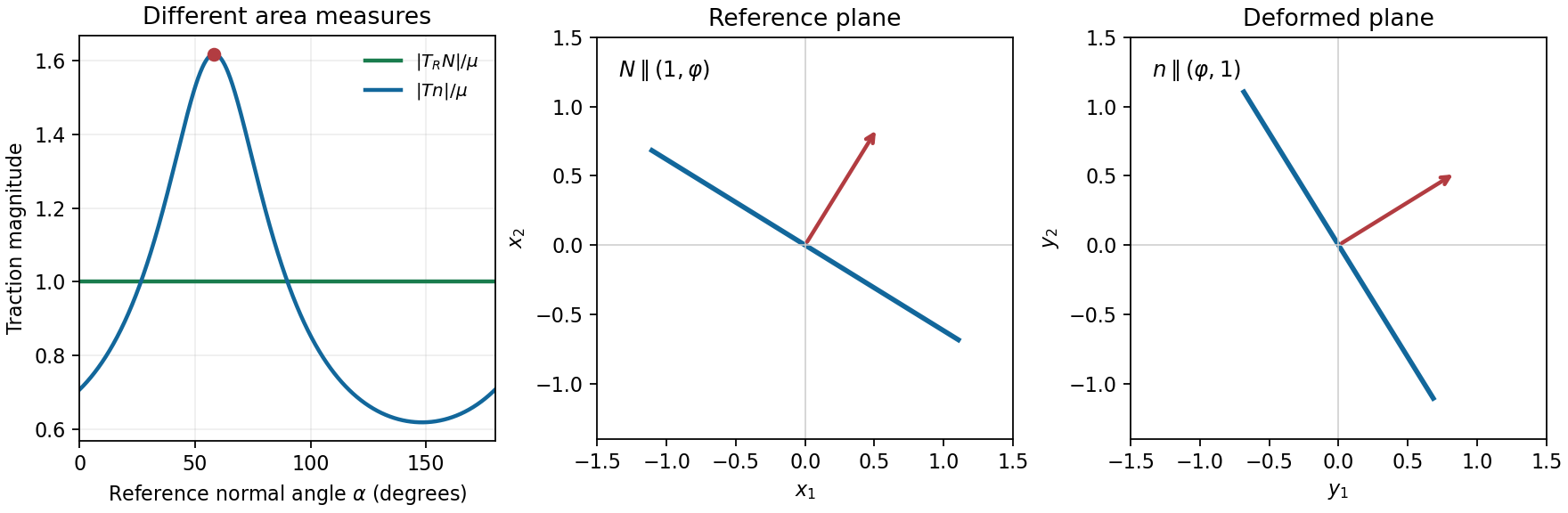
For the given simple shear,For a unit normal , . Hence every reference plane whose normal lies in the plane is maximizing:There is a family of maximizing planes, rather than one distinguished normal.
Using and the preceding first Piola-Kirchhoff stress tensor,Its eigenvalues are , , and zero. Because it is symmetric, its largest traction magnitude on a unit spatial normal is the largest absolute eigenvalue. Put . The positive eigenvalue has the strictly largest modulus, with normalThe question asks for the plane in the reference configuration, so this spatial normal must be pulled back. Nanson's formula gives parallel to , andTherefore the required plane and maximum areEither sign of its unit normal describes the same plane. Maximizing over reference normals is equivalent to maximizing over spatial normals because the map is a bijection of unit normals.

Articles by others on the same topic
There are currently no matching articles.