Let be the magnitude of the electron's electric charge, , , and . The Lorentz force is , so the electron and Positron acquire opposite momenta:Using the relativistic energy-momentum relation, , and integrating from rest gives the world linesFor , the world lines are vertical at on a spacetime diagram. They join smoothly to the accelerated branches with zero initial velocity. At small , and ; at large , their velocities approach , respectively. Each accelerated world line is a branch of a hyperbola, since and . The electric field separates the opposite electric charges in this orientation. The asymptotes are lightlike, while every finite-time tangent is timelike.
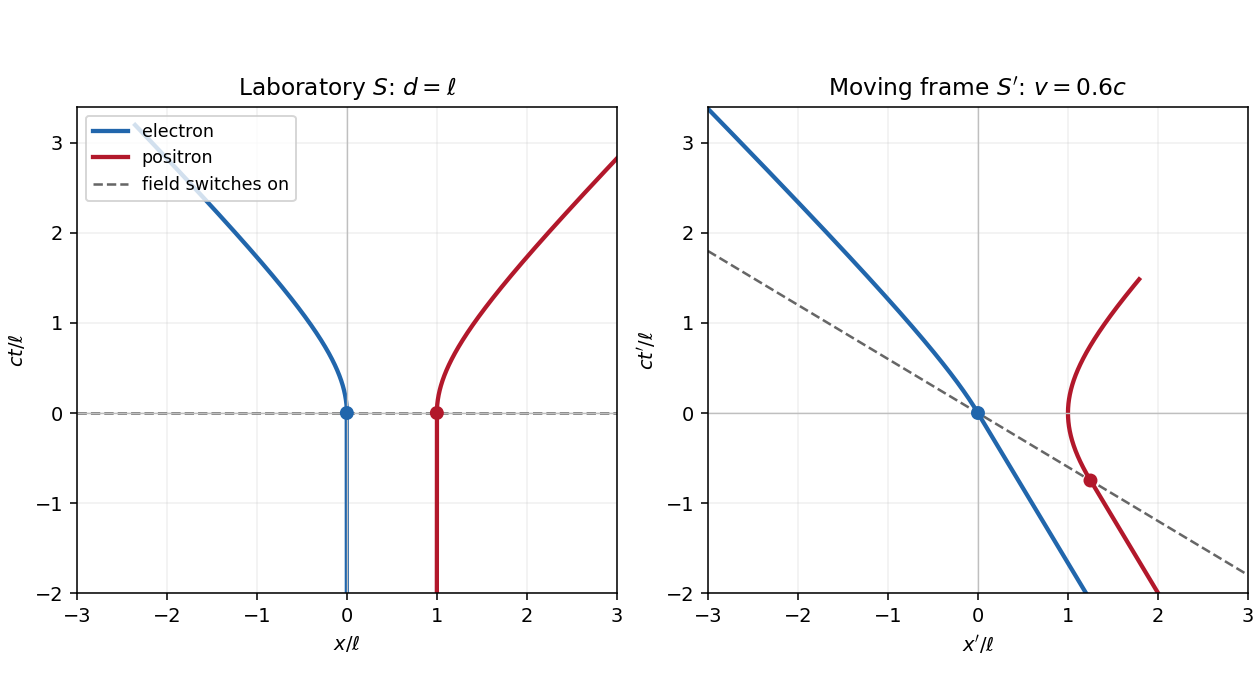

Write for the Lorentz factor of the inertial frame , distinguishing it from the particles' changing Lorentz factors. Apply the Lorentz transformationto each world line in a. Both particles initially have velocity in . The switching events have coordinatesThus the Positron starts accelerating earlier in . Its velocity first becomes less negative, vanishes when its laboratory velocity reaches , and then becomes positive. The electron continues at until , then accelerates toward . The relativistic velocity-addition formula makes this precise:The electric field parallel to the Lorentz boost has unchanged magnitude, but its switching surface is , rather than everywhere.
In the laboratory, the total three-momentum is zero for all : the two Lorentz forces cancel at equal laboratory times. In , each active force is still , since this is one-dimensional motion with a parallel electric field. Define . For the total three-momentum, evaluated at equal , isThis follows by integrating from its switching event and from its later switching event. During the interval between them only the Positron feels the prescribed electric field, so momentum conservation for the particle pair fails. Once both forces act, the total three-momentum is constant again.
The equal-time momentum of an externally driven particle pair illustrates a distinction. The sum of particle four-momenta at a fixed pair of events is always a four-vector. However, a fresh sum at equal time in each inertial frame generally uses different events. Here transforming an equal- laboratory sum would give , which varies with ; this differs from the equal- answer above. For example, with and , the late-time equal- sum is , whereas transforming the equal- sum gives . This is a concrete failure of treating the pair's equal-time sums as components of a single frame-independent four-vector.
A closed system's total four-momentum, including the electromagnetic field and the apparatus supplying it, is conserved and independent of the choice of spacelike integration surface under the usual isolated-system boundary conditions. The particles alone exchange energy and momentum with an external system, so neither that independence nor universal particle-only momentum conservation is guaranteed.
With the reversed electric field, reflection about exchanges the electron and Positron. They therefore meet there with equal and opposite momenta. Each travels , and the work-energy theorem gives its kinetic energy:Their combined kinetic energy is , while each total relativistic energy is . The laboratory is the center-of-momentum frame of the colliding pair.
Local four-momentum conservation in the electron-positron annihilation excludes one real photon: the incoming total four-momentum is timelike, with zero spatial component and positive energy, while a single photon's four-momentum is null and has . Two photons can balance their momenta by travelling in opposite directions, soThe equal photon energies follow from opposite equal momenta, not merely from sharing the incoming energy arbitrarily. Here . This is the free local annihilation idealization implicit in the question; significant momentum transfer to the external apparatus would change the kinematic system being considered.
The laboratory remains the center-of-momentum frame. At the relativistic collision mass threshold, the two final W bosons can have arbitrarily small opposite momenta. The available relativistic energy is , soEach incoming particle must acquire about of kinetic energy, travelling about . Equality is the ideal kinematic threshold; a nonzero production rate needs energy above it. This estimate neglects acceleration losses and treats the W bosons with the supplied nominal rest mass.
A linear particle accelerator avoids repeatedly bending high-energy electrons and Positrons. This greatly reduces the bending synchrotron radiation loss, which at fixed bending radius grows approximately as the fourth power of the relativistic energy for a given particle species. Its useful collision energy can therefore be increased without the severe circular electron collider radiation penalty. The price is long structures or high accelerating gradients: each bunch normally passes once, requiring substantial beam power, fresh bunches, and very tight focusing for high luminosity. A circular particle accelerator reuses its accelerating structures and circulates bunches through many collisions, but needs a large ring and substantial radiofrequency power to replace synchrotron radiation losses. Heavier particles such as protons radiate far less at a given energy and radius, although a proton's constituent structure makes the hard-collision energy less sharply specified than in an electron-positron annihilation experiment.
Articles by others on the same topic
There are currently no matching articles.