Incompressibility and give . The permitted vector identity, with zero vorticity, gives . Substituting into Euler's equation yieldsThe bracket is spatially constant in a connected fluid region, soAdding a function of time to the potential changes only and leaves the velocity unchanged.
Each perturbation potential is harmonic in its own half-space:Write and . Linearizing the material-interface condition at givesBernoulli's equation at the displaced interface gives . Using the supplied pressure jump therefore yieldsThe potentials decay toward their respective infinities. The hydrostatic displacement terms are retained in this dynamic condition.
Put and , . Harmonicity and decay selectThe kinematic conditions give and . Inserting them into the dynamic condition and cancelling the nonzero interface amplitude givesExpansion proves
Let , . Completing the square in the dispersion relation givesThe coefficients are real. There is an exponentially growing temporal mode exactly when the right side is negative, because one root then has positive imaginary part in . Rearrangement givesEquality is the marginal threshold rather than exponential growth.
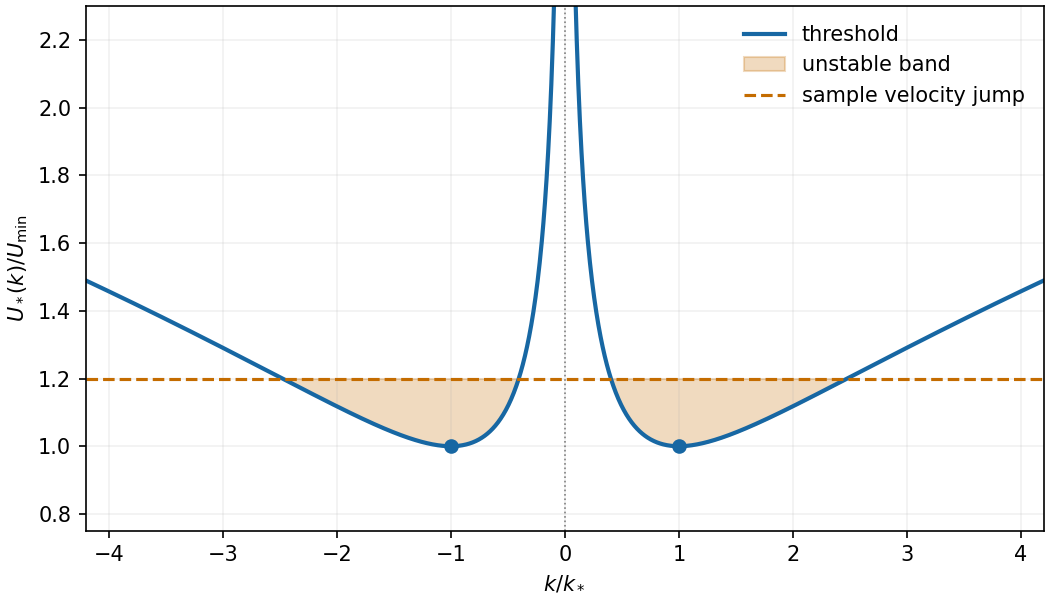
For positive surface tension the threshold is even in , tends to infinity as and as , and has its two equal minima atMinimizing for givesThus the initial state has some exponentially growing mode exactly when . If , the unstable band isGravity suppresses long wavelengths and surface tension suppresses short ones; intermediate wavelengths become unstable when the shear is large enough.

Articles by others on the same topic
There are currently no matching articles.