The material derivative measures change while following a moving gas parcel. The four equations respectively express mass conservation, momentum conservation, internal-energy balance, and the ideal gas law. The first accounts for density change under expansion or compression. The second is Newton's law with pressure as the only force. In the third the specific internal energy is and pressure work heats compression and cools expansion. The fourth relates thermodynamic pressure, density and temperature; is the gas constant per unit mass.
Continuity gives . Using , the temperature equation gives . ThereforeConsequentlyEach smooth parcel evolves isentropically under these adiabatic inviscid equations; the argument does not cover entropy-producing shocks.
Conservation of the parcel's entropy makes constant along its trajectory. Its initial value is , soThis is a relation following the specified parcel; parcels with different initial entropy can have different constants.
Linearization about the uniform resting state givesFor irrotational motion write . The momentum equation integrates to after choosing the time-dependent potential gauge. Substituting into the pressure equation yieldsThe constant is the adiabatic sound speed, also given by at the base state.
Rigid impermeable walls require zero normal fluid velocity, so the potential satisfies a homogeneous Neumann condition. In the cylinder,It is also single-valued and periodic in , and regular on the axis. No tangential no-slip boundary condition is imposed on this inviscid acoustic potential.
Use . Periodicity gives or , , with only the cosine branch for . The end-wall conditions give , . With radial separation constant , the remaining equation isFor , boundedness on the axis selects . The cylindrical wall then requires . Thus the modes are real and imaginary parts ofHere take the positive derivative zeros and include the separate constant radial mode , . For zero radial separation constant, regularity gives when , which fails the wall condition, and a constant for . This avoids counting a formal derivative zero at the origin that would make identically zero. The completely constant mode has zero frequency and no velocity; the remaining modes are acoustic oscillations. The self-adjoint Neumann Laplacian has these separated modes as a complete system, so no additional nonzero natural frequencies occur.
Incompressibility and give . The permitted vector identity, with zero vorticity, gives . Substituting into Euler's equation yieldsThe bracket is spatially constant in a connected fluid region, soAdding a function of time to the potential changes only and leaves the velocity unchanged.
Each perturbation potential is harmonic in its own half-space:Write and . Linearizing the material-interface condition at givesBernoulli's equation at the displaced interface gives . Using the supplied pressure jump therefore yieldsThe potentials decay toward their respective infinities. The hydrostatic displacement terms are retained in this dynamic condition.
Put and , . Harmonicity and decay selectThe kinematic conditions give and . Inserting them into the dynamic condition and cancelling the nonzero interface amplitude givesExpansion proves
Let , . Completing the square in the dispersion relation givesThe coefficients are real. There is an exponentially growing temporal mode exactly when the right side is negative, because one root then has positive imaginary part in . Rearrangement givesEquality is the marginal threshold rather than exponential growth.
For positive surface tension the threshold is even in , tends to infinity as and as , and has its two equal minima atMinimizing for givesThus the initial state has some exponentially growing mode exactly when . If , the unstable band isGravity suppresses long wavelengths and surface tension suppresses short ones; intermediate wavelengths become unstable when the shear is large enough.
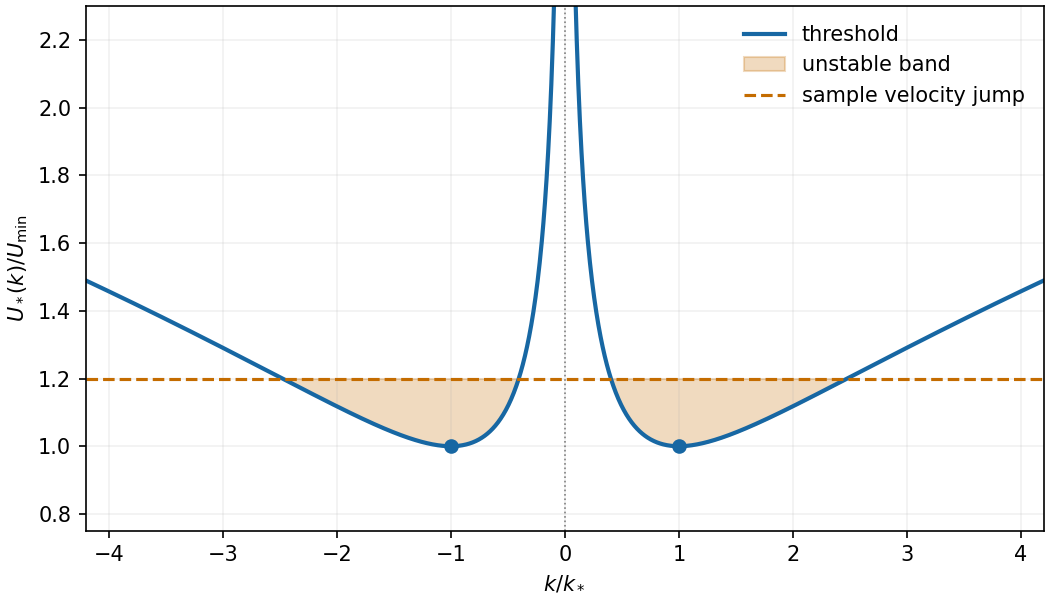
Even instability threshold with minima at the gravity-capillary balance; the sample shear destabilizes the shaded intermediate bands
. Details. 
For positive depth put . The equations becomeAdding or subtracting twice the second equation to the first givesThus the two characteristic speeds are and the corresponding conserved Riemann invariants are . At a dry front the two speeds coincide; the positive-depth formulas are applied up to that limit.
Before a signal traveling left at speed can reach the wall, the portion remains at rest with , . In the rarefaction fan, right-running characteristics bring the unchanged invariant . The left-running family originates at the removed dam and has speed . Solving these two relations givesAt the dry front , so its speed and location are and , consistent with the stated constant-speed condition. Therefore, for ,The velocity is zero in the untouched region and in the fan. Ahead of the front there is no fluid, so and a fluid velocity need not be assigned. In particular the wall remains at until time .
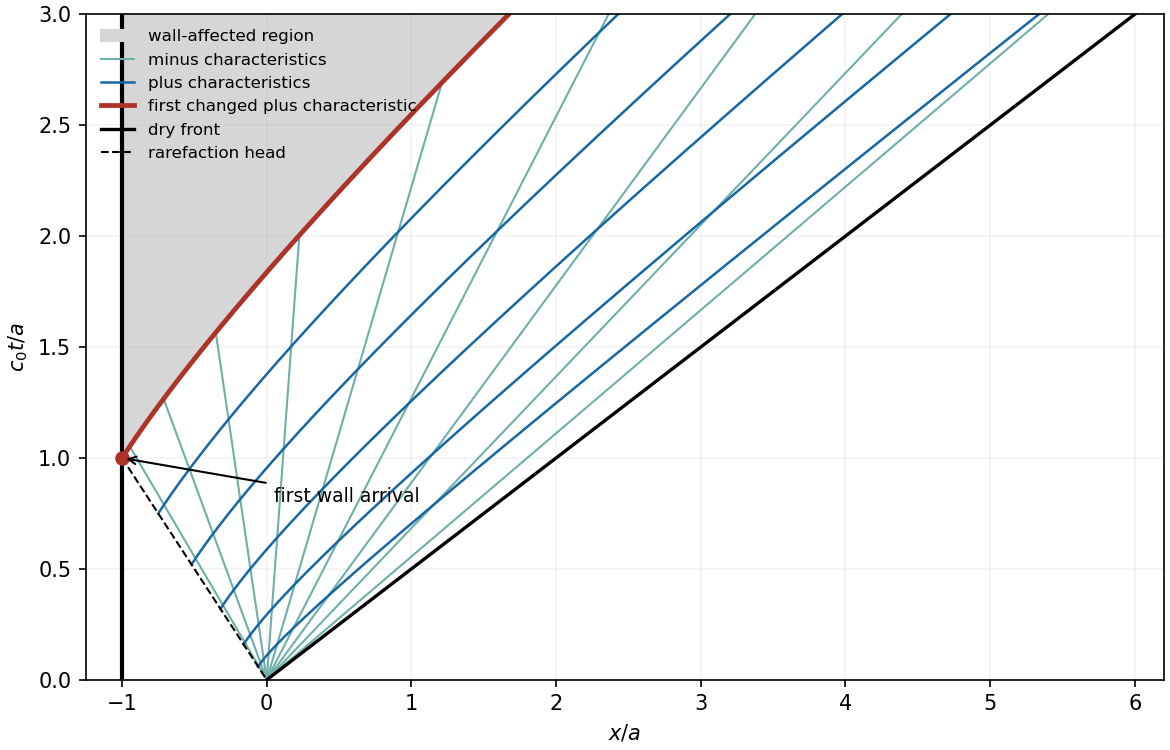
Dam-break characteristics in units with a and c0 equal to one; the wall first affects the fan at time one
. Details. 
Inside the fan, . Hence a right-running characteristic satisfiesMultiplication by the integrating factor givesIntegration yields . Requiring determines , soThe invariant stays constant along it until it enters a region affected by new boundary data.
The head of the rarefaction reaches the wall at with . The right-running characteristic through that event is obtained by setting in the preceding formula:It bounds the region reached by the first wall-induced change in . To its right the characteristic information remains the original dam-break information, soBehind it, the impermeable wall must keep . Continuing the original fan there would instead give for . Reflected characteristic data therefore change and invalidate the simple fan formula. The shaded region in the characteristic diagram represents this changed domain of dependence; it includes once that interval becomes nonempty. Its first positive extent occurs when .
Articles by others on the same topic
There are currently no matching articles.