For positive depth put . The equations becomeAdding or subtracting twice the second equation to the first givesThus the two characteristic speeds are and the corresponding conserved Riemann invariants are . At a dry front the two speeds coincide; the positive-depth formulas are applied up to that limit.
Before a signal traveling left at speed can reach the wall, the portion remains at rest with , . In the rarefaction fan, right-running characteristics bring the unchanged invariant . The left-running family originates at the removed dam and has speed . Solving these two relations givesAt the dry front , so its speed and location are and , consistent with the stated constant-speed condition. Therefore, for ,The velocity is zero in the untouched region and in the fan. Ahead of the front there is no fluid, so and a fluid velocity need not be assigned. In particular the wall remains at until time .
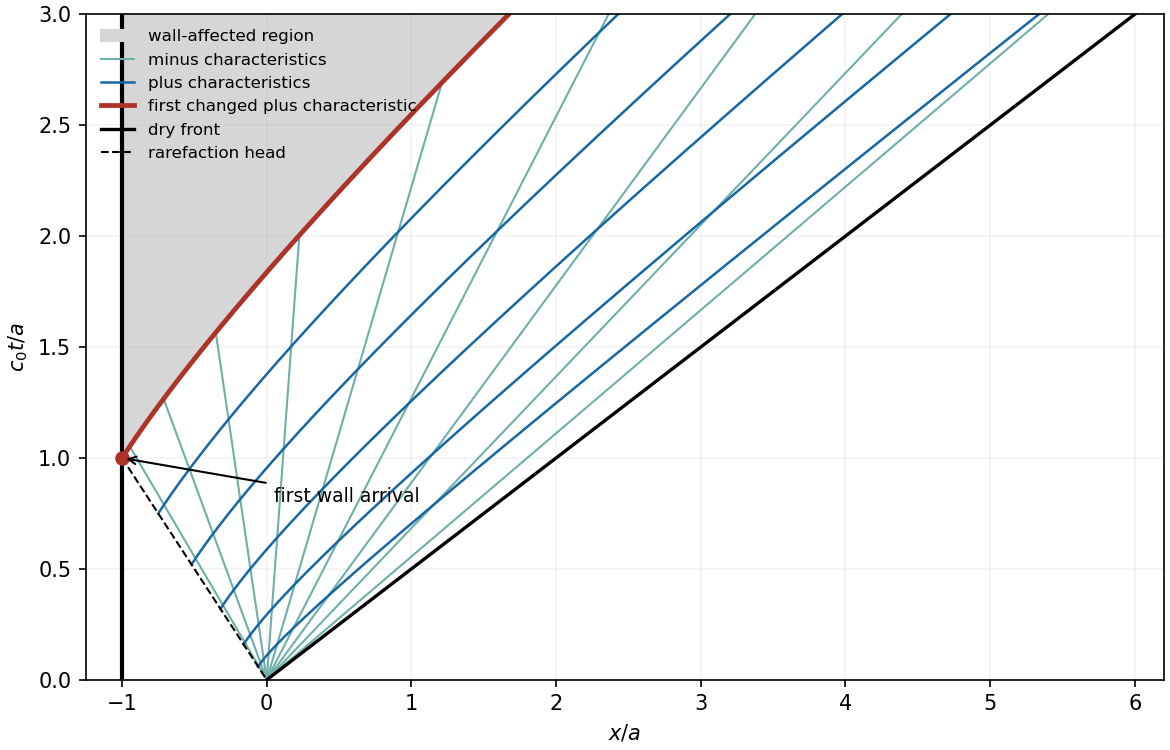
Dam-break characteristics in units with a and c0 equal to one; the wall first affects the fan at time one
. Details. 
Inside the fan, . Hence a right-running characteristic satisfiesMultiplication by the integrating factor givesIntegration yields . Requiring determines , soThe invariant stays constant along it until it enters a region affected by new boundary data.
The head of the rarefaction reaches the wall at with . The right-running characteristic through that event is obtained by setting in the preceding formula:It bounds the region reached by the first wall-induced change in . To its right the characteristic information remains the original dam-break information, soBehind it, the impermeable wall must keep . Continuing the original fan there would instead give for . Reflected characteristic data therefore change and invalidate the simple fan formula. The shaded region in the characteristic diagram represents this changed domain of dependence; it includes once that interval becomes nonempty. Its first positive extent occurs when .
Articles by others on the same topic
There are currently no matching articles.