The spatial transform of is . Convolution with the impulsive source and the inverse transform therefore give simply . Take without loss of generality and set .
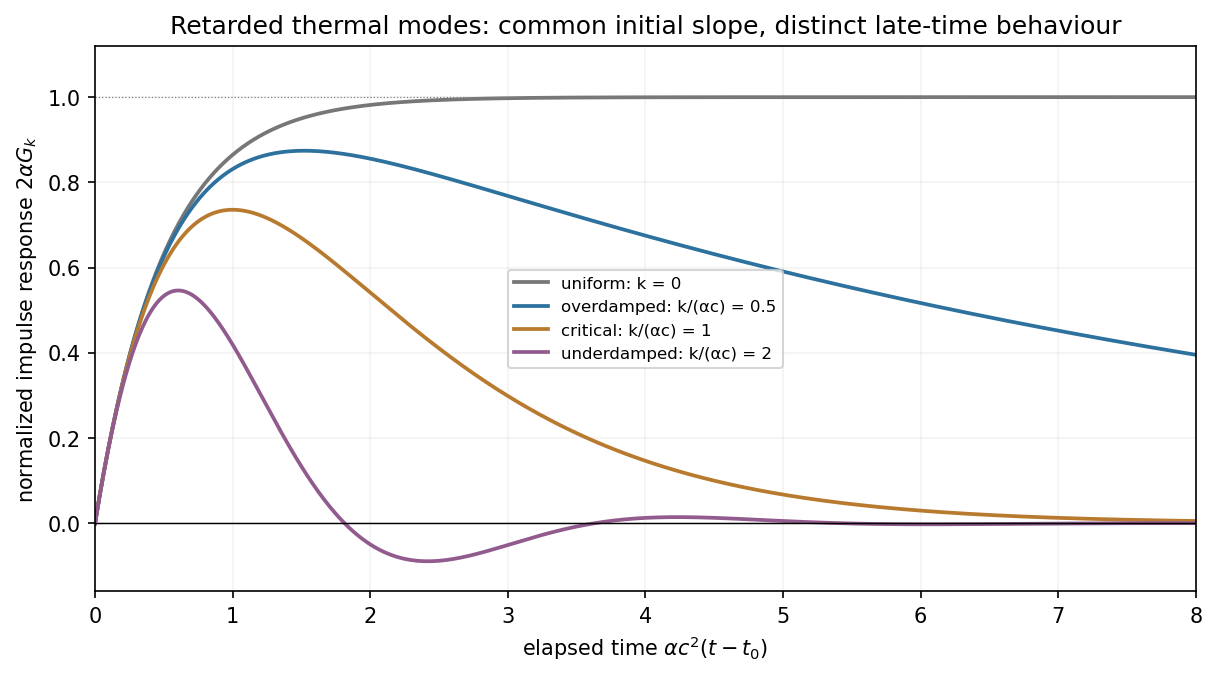
For , let . ThenFor , let . ThenBoth satisfy and , so the impulse changes the time derivative rather than discontinuously changing temperature. The first case rises and then relaxes without sign oscillations for a nonzero mode; the second oscillates as its amplitude decays. The limiting equality gives , and gives the nondecaying uniform increment discussed above.
A cosine source has both positive and negative regions, so this linear solution can be understood as a temperature perturbation about a background; its negative values are not assertions of negative absolute temperature. The temporal oscillations arise from the second-time-derivative term. Dropping that term changes the initial-jump structure as well as removing the underdamped regime.

Articles by others on the same topic
There are currently no matching articles.