Use the forward spatial transform and inverse . The retarded transformed Green function obeysIt vanishes for negative . Continuity at zero excludes an unwanted term; integrating across zero then fixes . Define and . The two homogeneous exponents are . Imposing the two matching conditions gives the Fourier-mode Green function of the telegraph equation,For an explicit time-Fourier route, use . ThenFor , both poles lie below the real axis. Closing above for gives zero; closing below for is clockwise, giving times the residue sum. Since , this iswhich reduces to the same damped sine or hyperbolic sine above. The pole on the real axis is interpreted by the retarded limiting prescription, or directly by the initial-value matching above.
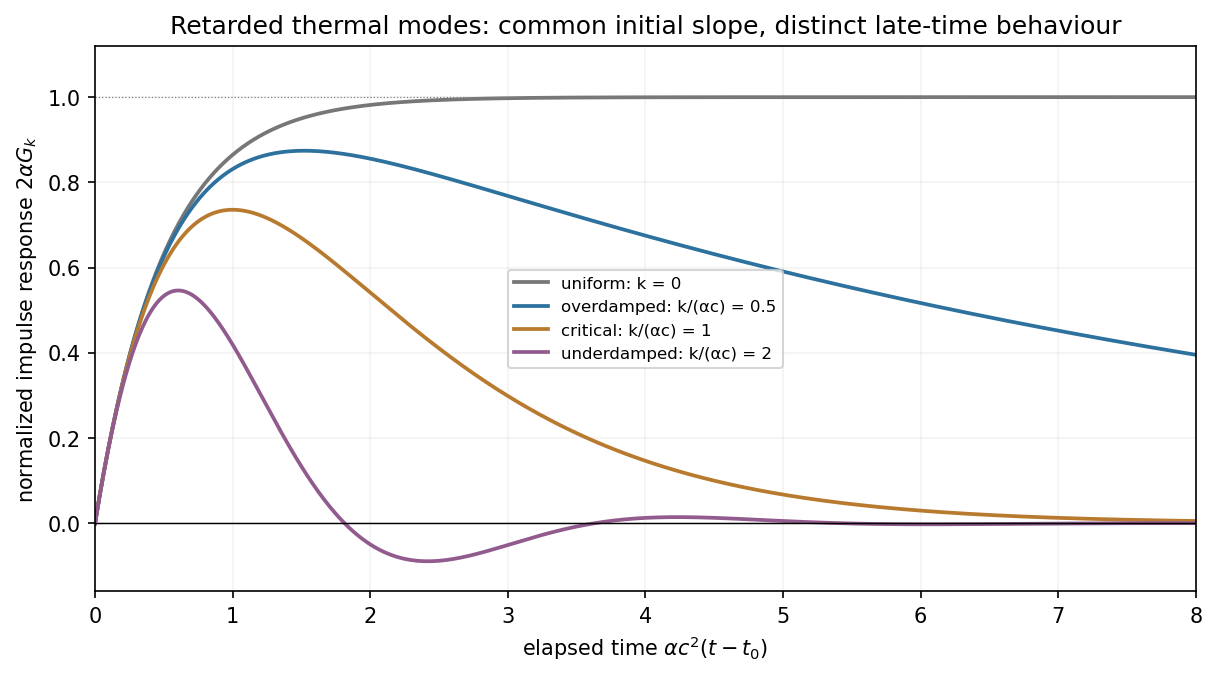
For the response is overdamped and nonoscillatory. For , put ; analytic continuation gives , a real damped oscillation. At equality the finite limit is .
All nonzero Fourier modes decay. The uniform mode instead has for positive time, leaving a constant temperature increment. At small wavenumber the slow decay exponent is , so the diffusion limit of the damped heat-transmission equation has diffusivity . The full hyperbolic equation has finite propagation speed , unlike the limiting parabolic heat equation.
The spatial transform of is . Convolution with the impulsive source and the inverse transform therefore give simply . Take without loss of generality and set .
For , let . ThenFor , let . ThenBoth satisfy and , so the impulse changes the time derivative rather than discontinuously changing temperature. The first case rises and then relaxes without sign oscillations for a nonzero mode; the second oscillates as its amplitude decays. The limiting equality gives , and gives the nondecaying uniform increment discussed above.
A cosine source has both positive and negative regions, so this linear solution can be understood as a temperature perturbation about a background; its negative values are not assertions of negative absolute temperature. The temporal oscillations arise from the second-time-derivative term. Dropping that term changes the initial-jump structure as well as removing the underdamped regime.

Articles by others on the same topic
There are currently no matching articles.