An element with unperturbed coordinate length has mass and transverse speed squared . Its actual length isAt fixed tension the extra elastic energy to this order is . Subtracting it from the kinetic energy givesHere prime means and dot means . The approximation retains quadratic transverse energy and neglects higher-order slope effects and longitudinal motion. The resulting field equations are for , with wave speed when .
Adding a constant to changes neither its time nor space derivatives, so the action is invariant. The associated Noether density and flux areThe wave equation gives . ThereforeThis is total physical transverse momentum. It is conserved for a whole isolated infinite string with vanishing boundary flux, periodic boundary conditions, or endpoints exerting no net transverse force. For a finite subsystem momentum can flow through its ends, and fixed supports can exchange momentum with the string. Thus the local conservation law always holds in this model, while constancy of the integrated charge requires the stated boundary condition.
An infinitesimal rotation about gives and . Both the squared transverse velocity and squared transverse slope are rotational invariants. Noether's theorem therefore givesDifferentiating and using the two wave equations givesConsequently is the angular momentum about the equilibrium string axis, conserved when the net endpoint torque flux vanishes. For a finite segment, . It is not momentum associated with translating the coordinate ; its symmetry rotates the two physical transverse displacement components into one another.
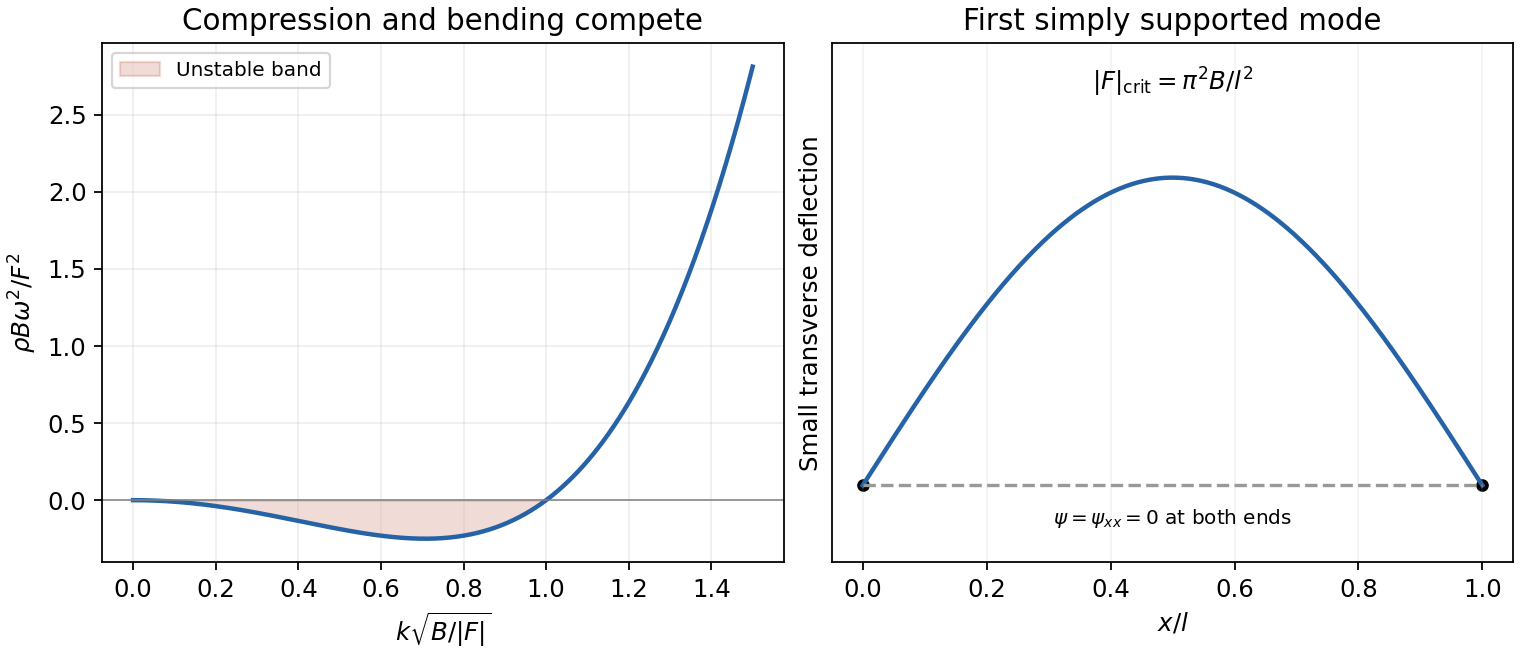
For one transverse displacement the density isIts variation is . Integrating once in time and twice in space gives the bulk coefficientThe spatial boundary contribution is integrated over time. ThusInsert to obtainFor compression , sufficiently long waves have and grow exponentially. Positive bending rigidity stabilizes short wavelengths; without it the compressed small-slope model would have no short-wavelength regularization.
With endpoints held at zero displacement but free to rotate, variation permits arbitrary endpoint and gives the natural zero-moment condition there. These are simply supported endpoints. The normal modes areThe first mode becomes unstable when , soEquivalently the compressive load exceeds . At equality the linear mode is neutral and nonlinear terms are needed to determine its post-buckling amplitude. The quadratic energy of is , giving the same sign test.
The endpoint displacement condition alone does not impose clamping. The quoted threshold uses the natural free-slope boundary condition of the stated variational problem. If rotations were also fixed, the admissible modes and threshold would change; one must not import a clamped-end formula into this result.

Articles by others on the same topic
There are currently no matching articles.