A Landau free energy is a coarse-grained thermodynamic potential expressed as a function of a proposed macroscopic order parameter. Its coefficients include microscopic and thermal effects already averaged over. At fixed external thermodynamic conditions, equilibrium selects its global minimum; other local minima can represent metastable states. It is not the internal energy of a single microscopic magnetic configuration. Here the real scalar represents a selected component of magnetization: zero describes the disordered state, while nonzero values distinguish two oppositely ordered states.
Every power is even, so the internal discrete symmetry isFor a magnetic order parameter, this represents reversal of the magnetization, as under time reversal in zero applied magnetic field. A nonzero field would generally add an odd term and break this symmetry explicitly. This scalar model has no continuous internal rotation symmetry; physical rotational symmetry of a vector magnet is not implied by treating one real component. The condition makes the polynomial bounded below at large .
For the requested ordered phase on cooling, take the usual implicit assumption , and write . If the temperature directions reverse; if this expansion has no temperature-driven transition. The source explicitly states only .
The stationary points of the Landau free energy obeyFor , makes every term of nonnegative, so is the unique global minimum. For , its curvature is negative. Setting gives , whose unique positive root isAt a nonzero stationary point,Thus both are stable and have lower free energy than . The equilibrium magnetization isFor fixed and , expand the square root:It tends continuously to zero. Hence the continuous phase transition has the order-parameter critical exponentThis is the mean-field critical exponent; fluctuation corrections beyond Landau theory are not included.
For at , the quartic term lowers the free energy near , while the positive sextic term stabilizes it at larger . The nonzero stationary points haveThey are global minima. The stationary point has zero quadratic curvature but is a flat local maximum because its leading nonzero term is negative. Thus the system is already ordered at , with a finite magnetization.
More explicitly, a continuous onset from could occur only where vanishes, namely at . But the global minima there are the finite values above. For sufficiently large positive , only is stable. Therefore the equilibrium minimum must change at some positive by crossing between a zero and a finite nonzero order parameter. This is a first-order phase transition. Its actual temperature lies above and is calculated next; itself is the disordered spinodal point, not the coexistence temperature.
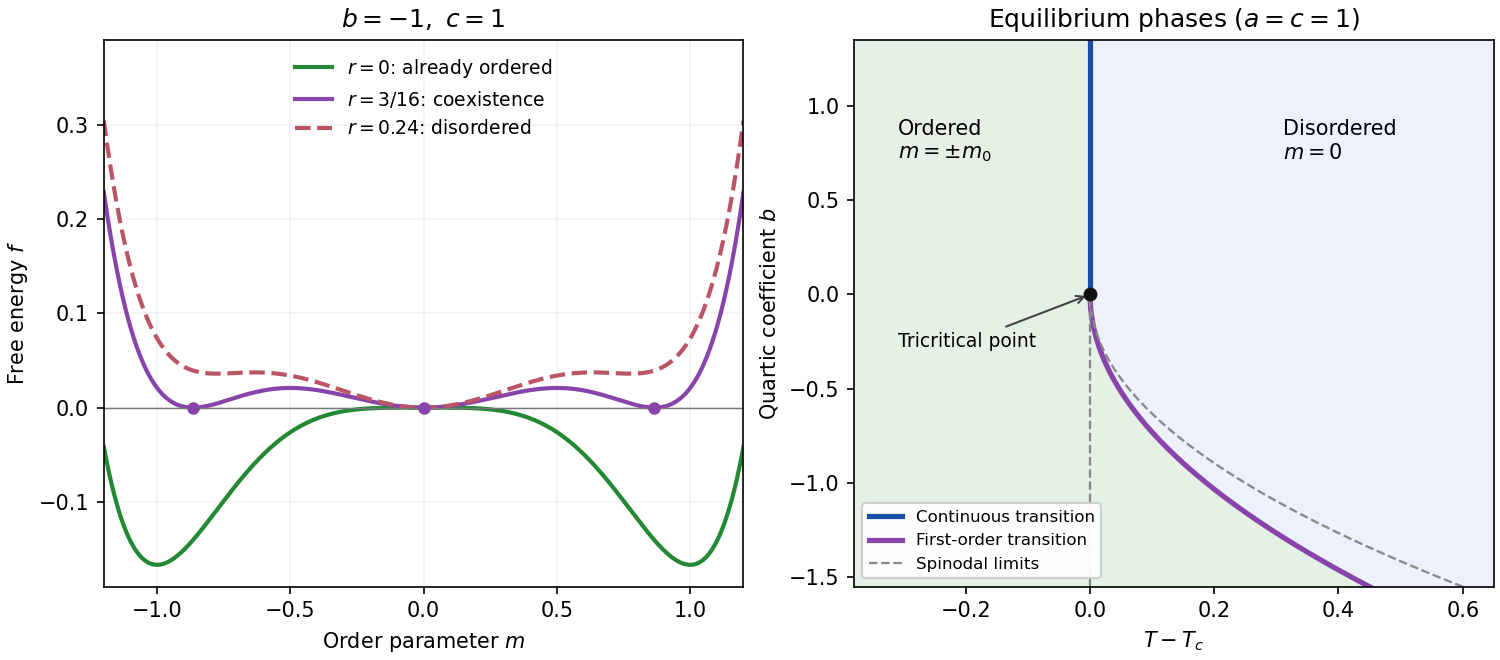

At phase coexistence, the finite ordered global minimum has the same free energy as . With and , stationarity and equal values giveSubtracting eliminates :Substitute back to get , soThe three degenerate equilibrium values at this temperature are and . A useful global check, avoiding confusion with a spinodal point, is the exact factorizationAll three zeros are therefore global minima. Their curvatures are positive: and .
The ordered local minimum first appears on cooling at , where the nonzero stationary roots merge. It becomes globally stable only at ; the disordered minimum remains metastable down to . These different temperatures distinguish phase coexistence from loss of local stability.
Let , with fixed. The equilibrium phase diagram has boundariesFor either branch, larger is disordered and smaller is ordered. Both signs of the ordered magnetization are symmetry-related global minima throughout the ordered region, rather than separate regions selected by temperature and .
The branches meet at the tricritical point . Directly on , minimizing givesThe transition there remains continuous, with a different mean-field critical exponent. For , the metastability boundaries are for the disordered state and for the ordered state. The first-order phase transition curve lies strictly between them, as shown in the figure. These spinodal curves describe possible hysteretic continuation of local minima, not equilibrium phase boundaries.
Articles by others on the same topic
There are currently no matching articles.