
Internal energy is the energy stored in the microscopic degrees of freedom of a thermodynamic system: random molecular kinetic energy, internal molecular excitations, and interaction potential energy. Its value requires a specified system and an energy reference. In thermodynamic equilibrium, internal energy is a state function; it records the present state, without remembering whether a previous change came from stirring, compression or heat transfer. This makes internal energy the common accounting quantity connecting mechanical experiments to thermal ones.[ref]
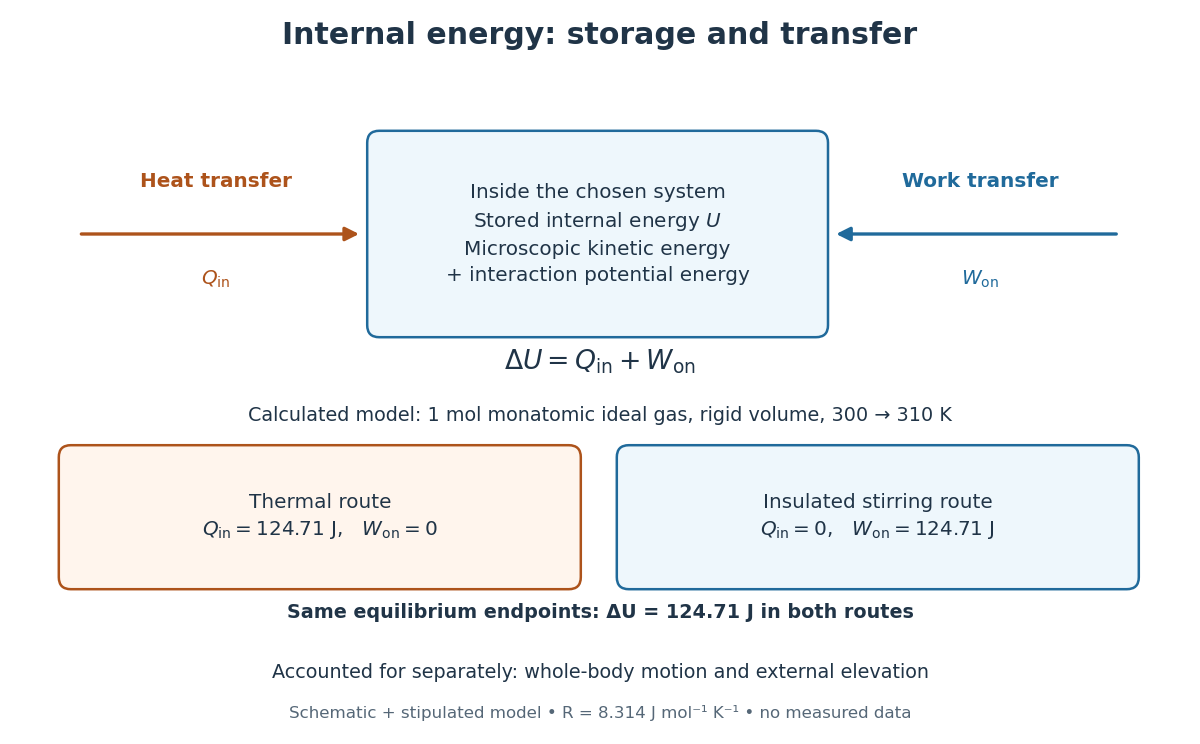
Heat and work describe energy crossing the system boundary during a process. They are not separately stored contents of the system. For a closed system whose bulk kinetic energy and external potential energy have unchanged endpoint values, the first law of thermodynamics givesHere is positive for incoming heat, and is positive for net work done on the system. Two routes between the same equilibrium states have the same , although their heat and work can differ. The infinitesimal notation distinguishes a state function change from path-dependent transfers.[ref]
For a calculated example, take one mole of a classical monatomic gas in the ideal gas regime, at fixed volume, from to . With stipulated molar gas constant , its internal energy change is . A purely thermal route supplies with . An ideal insulated stirring route supplies with , measured between equilibrium endpoints after the motion dies away. The same stored increment has two different transfer histories; neither history defines a separate kind of stored energy.
The familiar internal energy of an ideal gas is a useful special case. Neglect intermolecular interactions, hold the amount of substance and composition fixed, and suppose that independent quadratic terms per particle obey the classical equipartition theorem. Choosing the constant reference contribution as zero givesHere is absolute temperature, is the molar gas constant, and is the whole sample's heat capacity at constant volume. A monatomic gas has translational terms. A rigid diatomic molecule has when its two rotational terms are active and vibration is frozen; activating one harmonic oscillator vibration adds two terms, one kinetic energy and one potential energy, giving . The counting is of quadratic contributions, so a vibrational coordinate is not just one contribution.[ref]
This constant- formula applies only over a regime with those same active terms, classical translational statistics, nonrelativistic motion and unchanged composition. Quantum freezing, quantum degeneracy, chemical reactions or appreciable intermolecular interactions invalidate that simple counting. More generally, at fixed amount and composition an ideal gas can still have with varying heat capacity at constant volume, so use . A nonzero constant reference adds to without altering .


Internal energy is a thermodynamic property that represents the total energy contained within a system. It encompasses all forms of energy present at the microscopic level, including: 1. **Kinetic Energy**: This includes the energy associated with the motion of molecules and atoms within the system. As temperature increases, the kinetic energy of particles also increases. 2. **Potential Energy**: This is related to the positions and interactions of particles within the system.
New to topics? Read the docs here!