Take periodic orbital wavefunctions on the ring, and write . Between kicks the evolution over one period isIntegrating through an infinitesimal kick givesThe free-motion contribution during the vanishing kick duration disappears in the ideal impulsive limit. The sign of the phase follows from the negative kick potential.
Starting just after a kick, the particle evolves freely first and is kicked at the end of the interval. Operators act right to left, so one step is , andThe one-period product is the Floquet operator of this quantum kicked rotor. There is no additional kick at the initial endpoint . Changing the stroboscopic convention to just before each kick would change the displayed order; it is not appropriate for these endpoints.
Put . The function solves the two-dimensional Helmholtz equation, . Expand its angular dependence as a Fourier series,Substitution into the polar-coordinate Laplacian,givesWith , this is the Bessel differential equation. Regularity of the original plane wave at the origin excludes the singular second-kind solution. Thus is a constant multiple of the regular first-kind function, andFor integer negative orders, , so this indexing still supplies the regular radial solution. The radial equation fixes the form of each term; the small-radius plane-wave expansion fixes its coefficient.
For a nonnegative integer , expand the plane wave in powers of :The first contribution to the positive angular harmonic occurs at . Its coefficient is . Comparing this with gives for .
The plane wave is even in , so its and Fourier coefficients agree. Therefore , implying . HenceThis is the cosine form of the Jacobi-Anger expansion. The factorial asymptotic stated in the source is used for nonnegative order; applying it literally to negative integers would introduce an undefined factorial. The Integer-order Bessel reflection identity is the required extension, not a separate set of divergent radial solutions.
Define . The free propagator acts diagonally on each angular harmonic:The kick multiplies by the Jacobi-Anger seriesMultiply the two series and collect the output harmonic . The one-step coefficient update iswhere both sampling times are just after their respective kicks. Free evolution supplies the input-index phase before the kick mixes angular momenta.
The source uses the unnormalized basis functions . Thus a unit-norm wavefunction satisfies . If the basis is instead , its amplitudes have sum of squared moduli one and obey the same matrix update. Mixing these normalization conventions would change an energy expectation incorrectly.
On periodic ring states the angular-momentum index is an integer. At the stated resonance,so is the identity on every orbital state. After steps from the normalized ground state,Its phase varies in space but its position probability density remains uniform. Periodicity permits integration by parts, givingConsequentlyEquivalently, the angular-momentum probabilities are , with . The mean angular momentum remains zero while its variance grows as . This quantum resonance of the kicked rotor gives coherent ballistic energy growth. The Bessel second-moment identity connects the momentum spreading to that quadratic energy law; an incoherent random walk would instead give linear energy growth.
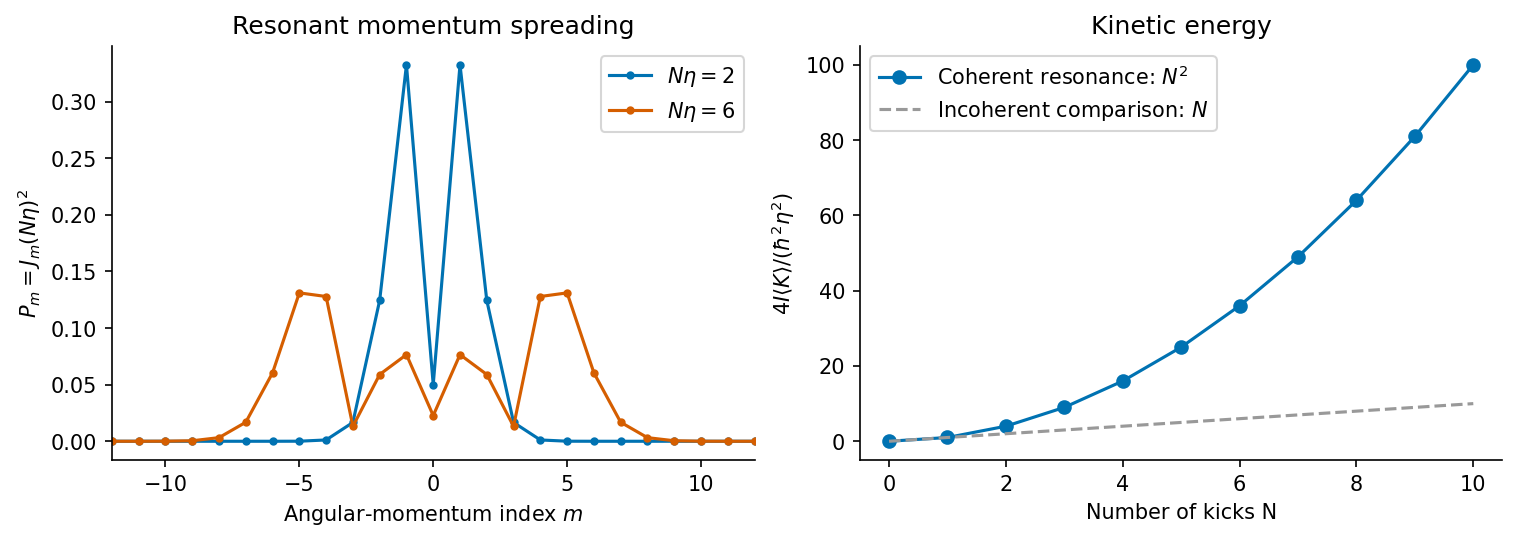
Original resonant kicked-rotor calculation: angular-momentum probabilities and the quadratic kinetic-energy law
. Details. 
Articles by others on the same topic
There are currently no matching articles.