For an analytic, local Landau theory with independent global rotations of the magnetization vector, a uniform scalar potential can depend only on . Keeping terms through fourth order in the field, dropping an additive constant, and retaining the leading isotropic positive gradient term gives the displayed quadratic-plus-quartic functional. The stiffness has been absorbed into the normalization of length and field. Higher powers and higher derivatives are neglected in this long-wavelength approximation.
The quartic truncation is stable at large when . The coefficient changes sign at the mean-field critical point; close to it one commonly writes . If , higher stabilizing powers are essential, so the displayed truncation alone cannot determine a stable first-order phase diagram. For and it is likewise unbounded.
For , spatially uniform stationary points obey . The global minima areThe corresponding minimum free-energy density is zero and , respectively. The disordered phase gives way continuously to a ferromagnet with an arbitrary direction of magnetization. At this mean-field transition the amplitude vanishes as ; long-wavelength critical fluctuations can modify mean-field exponents in three dimensions.[ref]
Statistical Field Theory by David Tong. §4.2, vector order parameter and rotationally invariant Landau expansion
Vary each field component independently and integrate the gradient term by parts, taking fixed boundary values or vanishing surface variations. With , the Euler-Lagrange equations for the free-energy saddle areThe anisotropy shifts the first two inverse susceptibilities in opposite directions. The derivative of is , which fixes the factor needed for both the magnetization and the free energies in c. Under natural free-boundary conditions the integration by parts instead supplies at the surface.
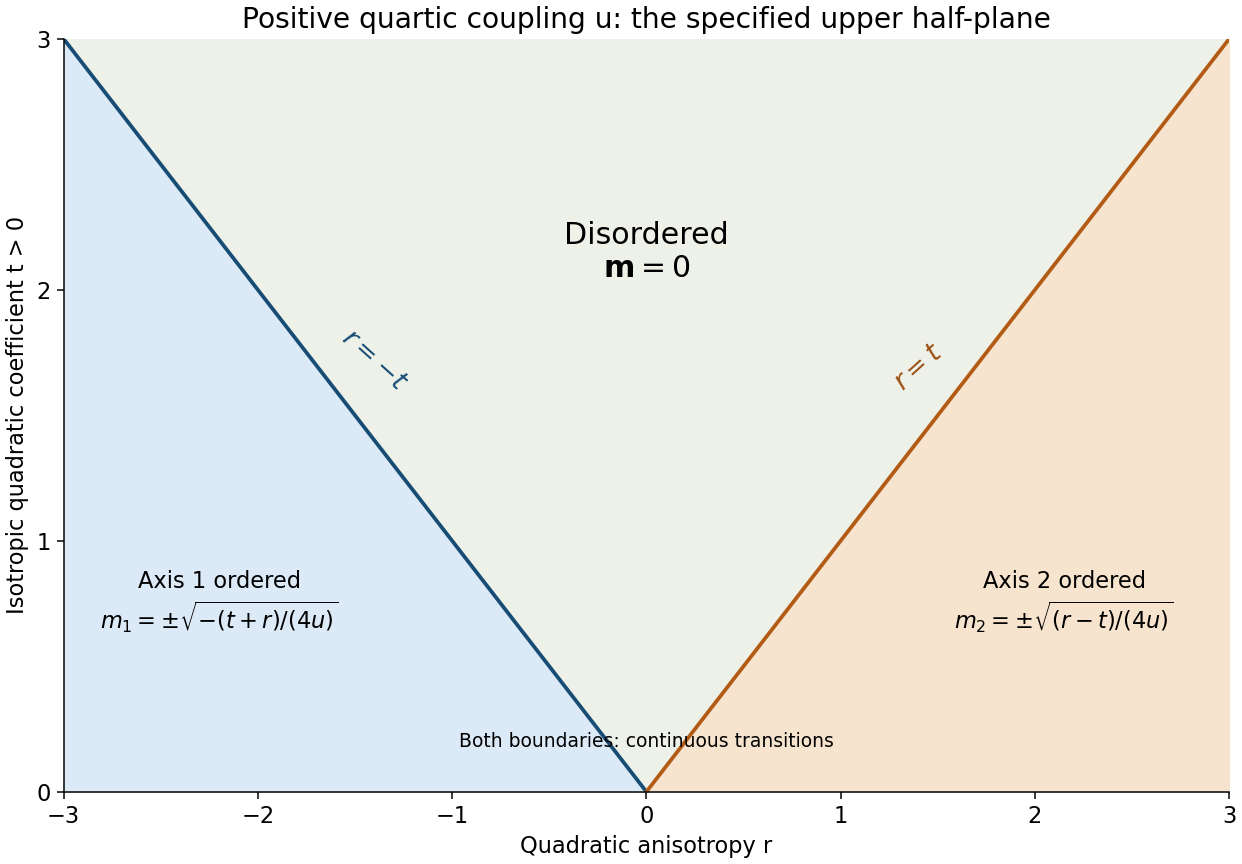
Assume , as required for the stable quartic model, and retain the stated domain . For the opposite-axis quadratic anisotropy of a vector order parameter, fix the magnitude . Then the anisotropy lowers the energy most by putting all magnetization along component 1 if and component 2 if . Component 3 has positive quadratic coefficient and cannot lower the uniform minimum. Minimizing the remaining amplitude givesThe component-1 and component-2 ordered regions each break a discrete sign symmetry, giving two easy-axis orientations rather than a sphere of equivalent directions. To check stability, in the component-1 minimum the longitudinal curvature is , while the two transverse curvatures are and . The component-2 case similarly has longitudinal curvature and transverse curvatures , all positive in its region. The disordered state is stable exactly when .
Both boundaries and are continuous, second-order mean-field transitions: the selected component vanishes with a square root, and the first derivatives of the minimum free energy agree across the boundary. In the stipulated upper half-plane , the two ordered phases are separated by a disordered wedge. There is no direct first-order boundary between them in that domain. Extrapolating a phase boundary through would answer a different, larger phase-diagram question.

Specify the Fourier transform before performing the Gaussian integral:At the functional is diagonal in both component and momentum, with inverse kernels , , and . The condition makes all three positive. The covariance of a Gaussian distribution with statistical weight is times the inverse kernel, henceIf is already the dimensionless free energy divided by , the numerators are one instead. Translational invariance forces opposite momenta to pair. There is no complex conjugate on the second field, so the delta function is at , not at . A correlation with would have the latter convention. Rotational symmetry in real space leaves dependence on alone once the momentum-conservation delta function is factored out. The correlation lengths are and ; the second component becomes soft as . The skipped letter in the source is preserved: this solution is part (e), with no inferred part (d).
Articles by others on the same topic
There are currently no matching articles.