The term is directed self-propulsion at fixed speed, while the two components of generate translational Brownian motion with diffusion coefficient . The angle has systematic angular velocity and rotational diffusion coefficient . With independent standard Brownian motions, the precise stochastic differential equations areIndependent translational and rotational noises are the usual interpretation; the supplied autocorrelations alone would not specify arbitrary cross-correlated noises.
The complete state is a Markov process: its future increments depend only on its present state and independent future noise. Its generator is . Position alone generally lacks the Markov property, since an unobserved current orientation carries memory into future displacements. At long scales orientation averaging produces the effective positional diffusion equation in solution.
Use the unwrapped angle on the real line. Integrating its Langevin equation gives , where is a centered Gaussian random variable with variance . ThereforeA wrapped angular difference is bounded and would not satisfy this formula.
For the orientation correlation, . The characteristic function gives , soThe translational noise is independent of the orientation, hence the cross terms vanish. Summing its two component correlations gives . Consequently, for ,The extension to negative time uses . Because the position contains Brownian motion, the instantaneous noise velocity and its correlation are distributions; the delta contribution is not a finite ordinary velocity at .
Integrate the two velocity factors over the time square . The white noise contribution is . The orientation contribution depends only on the time separation, givingThis double-integral derivation fixes the delta contribution without ambiguity about a half-weight at an endpoint. Put . Elementary integration givesUsing and multiplying out the second term yieldsThe constant and decaying terms cancel at , as required. The apparently singular case is evaluated from the integral, giving .
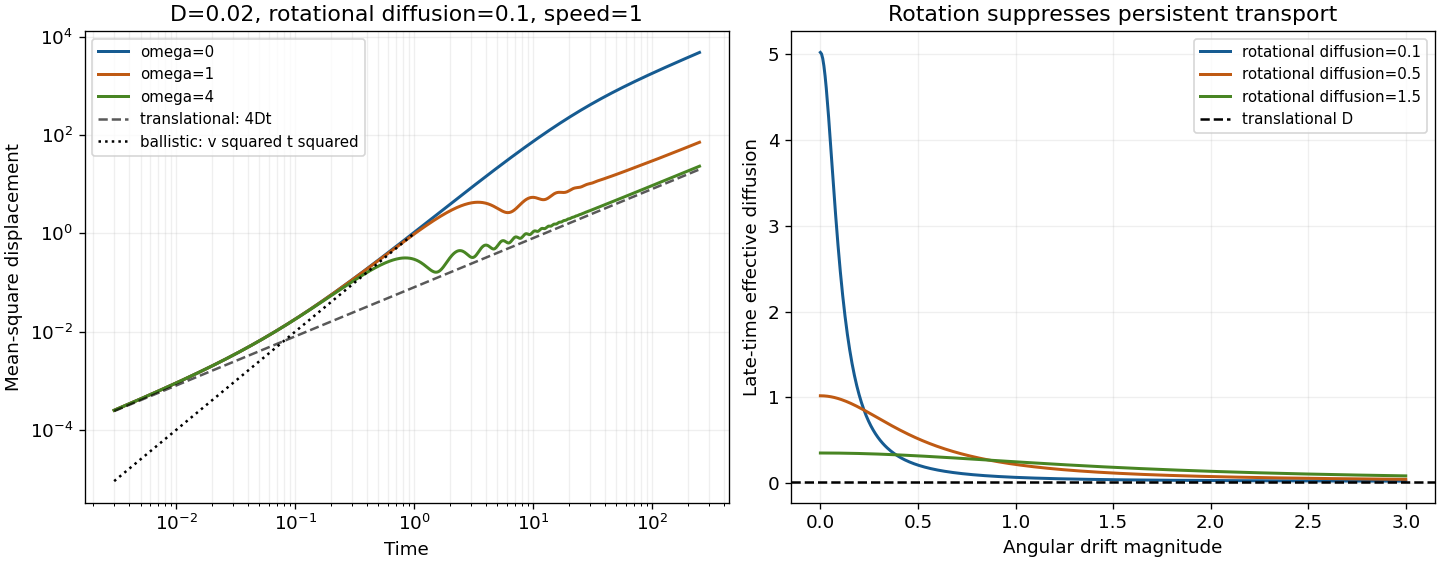
For , expand the exact expression:At asymptotically short time, translational diffusion dominates if . A ballistic window occurs when , provided these scales are separated. The swimmer then retains nearly constant direction.
For and , the oscillatory exponential decays andAt intermediate times, the angular drift bends persistent trajectories into arcs. If , several rotations occur before orientational decorrelation, producing oscillatory shoulders rather than a long straight ballistic regime. In the limit , , the active contribution is bounded and periodic: . At , it remains ballistic forever, so ordinary late-time active diffusion does not follow.

Articles by others on the same topic
There are currently no matching articles.