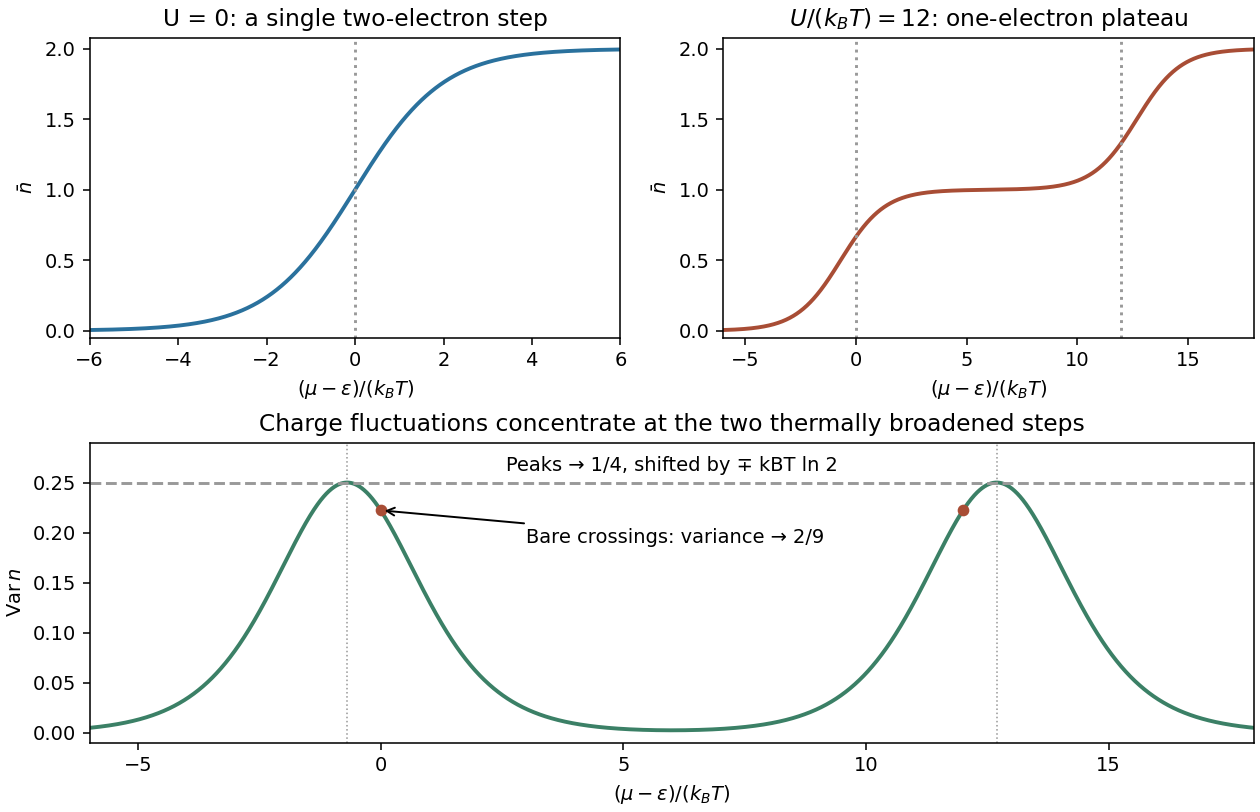
Write . For one nondegenerate fermionic quantum state, the allowed occupations 0 and 1 give . For a bosonic state, summing all nonnegative occupations gives , requiring or . Differentiating the logarithm,The interacting point defect has two distinct spin states, not one fermionic state. Its four microstates have grand-canonical weights , with . The first two single-electron weights are separate up/down spin possibilities; the double state has one electron of each spin. ThusFor , and . The sketch is a single smooth step from 0 to 2, centred on , where . As its width tends to zero.
For positive U with , the lowest grand energies are successively , and . Away from the two crossings,Finite temperature smooths each step over an energy range of order . Near the lower step double occupation is exponentially suppressed, so . Near the upper step put and neglect the empty state, giving . Spin degeneracy shifts the half-step positions to and .
For a grand-canonical probability , differentiation gives . Multiplying by and summing provesFor this defect, direct state counting givesAt , and thereforeThe same limit gives : empty, up and down states have equal weights, while the double state is suppressed. Replacing this degeneracy by a two-outcome equal-weight model would incorrectly give variance at this chemical potential.
Across the full chemical-potential range the variance has two well-separated narrow peaks and tends to zero on the 0, 1 and 2 plateaux. The limiting shapes are near the lower step and near the upper one. Each peak has height , at the shifted half-step position; the variance at the unshifted crossings is instead .

Articles by others on the same topic
There are currently no matching articles.