Use for molar volume to distinguish it from the fluctuating parcel volume below. The equation is . The parameter models excluded volume, while models the reduction in pressure from attractive interactions.
Below the critical temperature, a raw isotherm has a loop. The positive-slope segment is mechanically unstable and surrounding metastable portions do not give the stable equilibrium mixture. Replace the loop by a constant coexistence pressure satisfying the Maxwell equal-area condition,The endpoints are liquid and vapour molar volumes; intermediate mean volumes correspond to phase mixtures with changing proportions. Above the critical temperature, liquid-like and gas-like states connect continuously without a coexistence plateau.
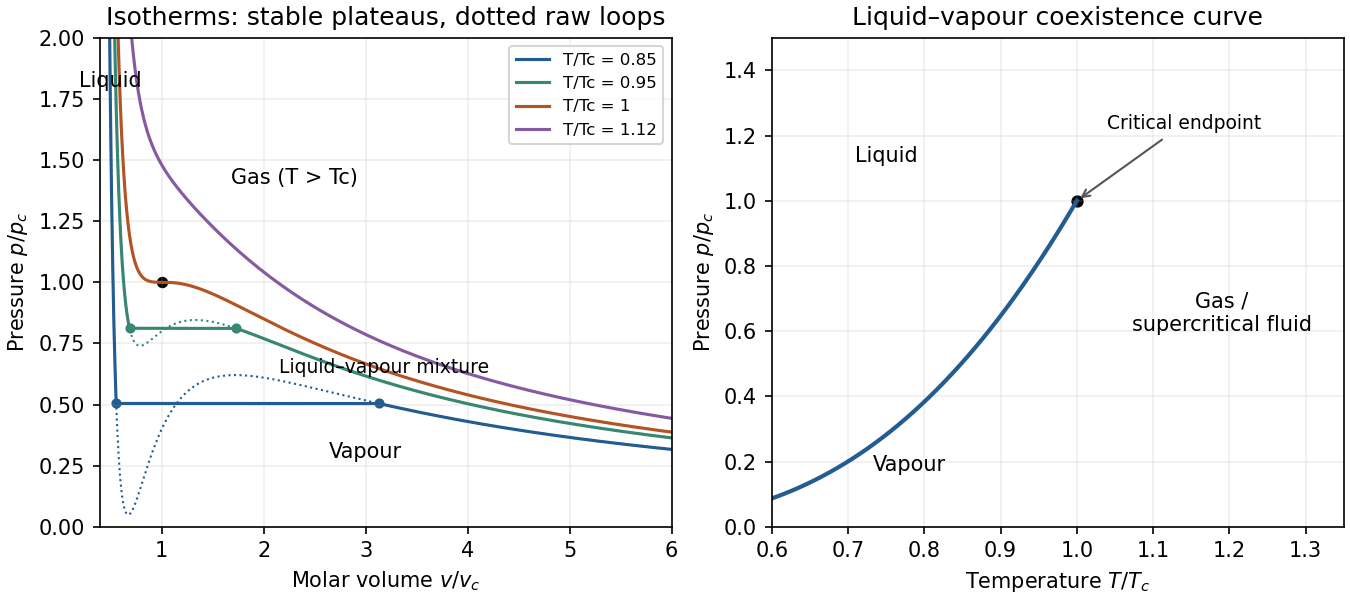
Original reduced van der Waals isotherms with computed Maxwell coexistence plateaus and the pressure–temperature coexistence curve ending at the critical point
. Details. 
In the pressure-temperature diagram, the liquid-vapour coexistence line ends at the critical point. Below it, the low-pressure side is vapour and the high-pressure side liquid. “Gas” conventionally denotes the region above the critical temperature, where compression alone cannot cross a liquid-vapour transition. The model has no solid phase.
The critical isotherm has an inflection: . Thuswhich giveFor fluctuations about a stable equilibrium value , the system plus reservoir has probability proportional to . Expanding availability,gives a Gaussian distribution and, to this order, withThis requires positive curvature and sufficiently small fluctuations; it is not exact when higher-order terms matter.
The whole cylinder's volume is fixed. For the volume fluctuations of a small fluid parcel, interpret the small quantity as a material parcel containing moles, whose volume can fluctuate against the much larger remainder. Its mean volume at the critical density is . At fixed temperature its availability is , soOn the critical isochore, approached from ,ConsequentlyEquivalently, , with . The mean-field variance diverges as , so its critical exponent is ; the root-mean-square fluctuation has exponent . A fixed spatial observation box instead has number fluctuations, not fluctuating geometric volume. Finite size and non-Gaussian terms cut off the literal divergence; the approximation fails exactly at the critical point.
Articles by others on the same topic
There are currently no matching articles.