Original paper: Public original PDF, physical pages 287–290; cover on page 287 and questions on pages 288–290.
For one oscillator, set . Its quantum-oscillator energy and heat capacity areAt low temperature, and : excitations freeze out but zero-point energy remains. At high temperature, and , recovering equipartition. The zero-point term does not contribute to heat capacity.
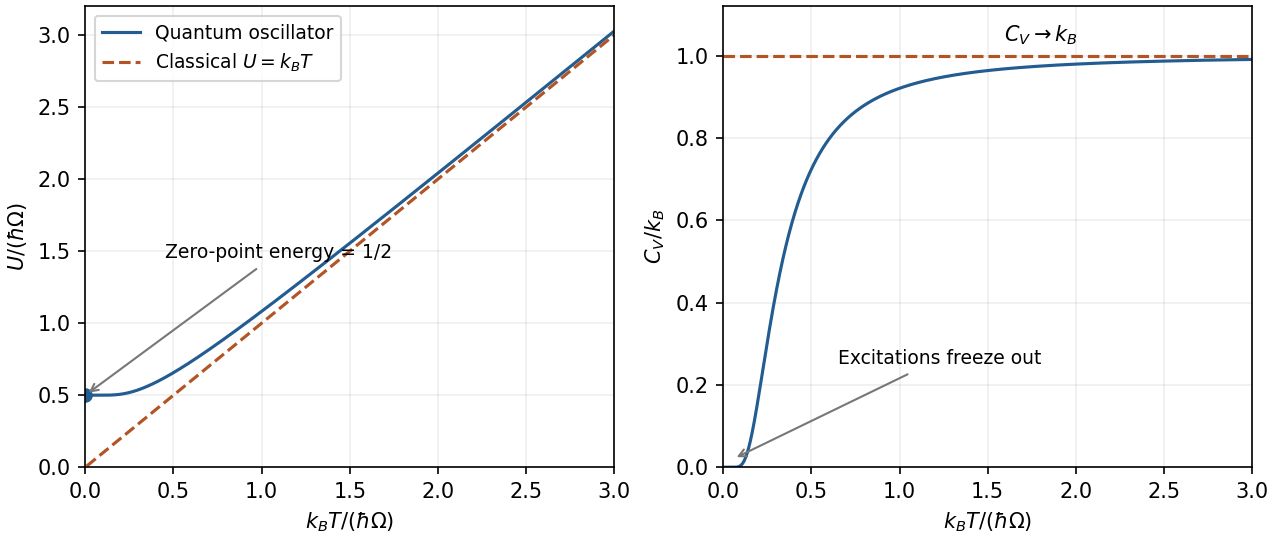
Original quantum-oscillator energy and heat-capacity curves, with zero-point energy, low-temperature freeze-out and classical high-temperature limits
. Details. 
Using and the stated Maxwell relation, interchange derivatives within a smooth single phase:Therefore depends only on temperature for the given temperature-linear equation of state. It need not be constant in temperature.
For identical classical noninteracting particles, use . At fixed ,so the canonical partition-function identities giveThus, for one mole,The supplied dependence includes only three translational degrees of freedom; additional thermally active internal modes would change the heat capacity.
For one Cartesian velocity component of a free Brownian particle, the inertial Langevin equation isThe random force and viscous drag obey the fluctuation-dissipation relation. With a thermal equilibrium velocity distribution, the relaxation time is andIntegrating velocity twice givesFor , this is Einstein's diffusion law, , with . In three dimensions . At the motion is ballistic, . A sphere in the Stokes-drag regime has , giving .
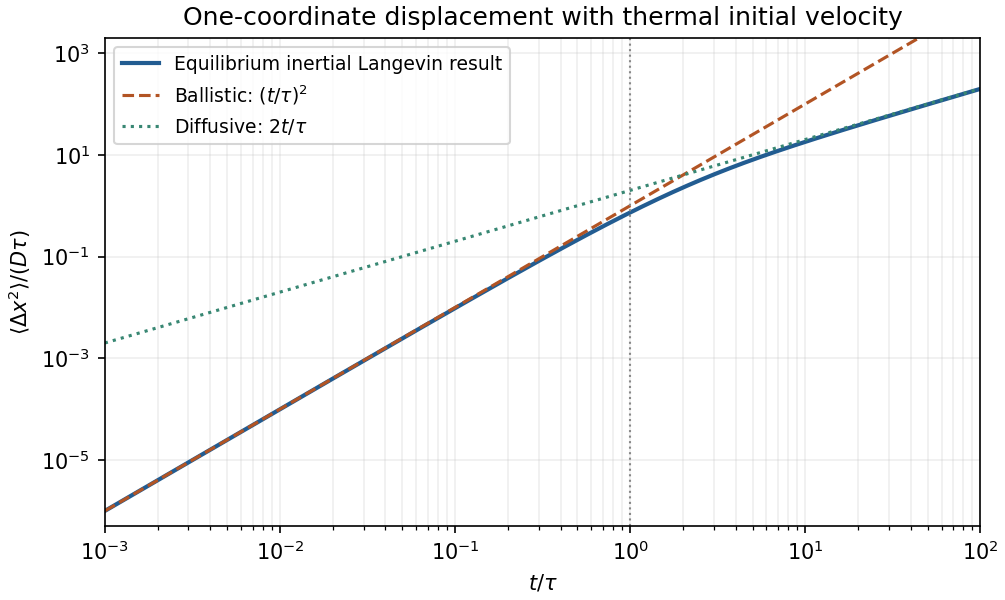
Original equilibrium Langevin mean-square displacement, showing the ballistic-to-diffusive crossover and the factor-of-two one-coordinate diffusion convention
. Details. 
Landau theory expands the free energy in an order parameter. For a scalar with sign-reversal symmetry and zero conjugate field, a useful sextic even Landau potential isEquilibrium selects the global minimum; other local minima can be metastable.
For , the minimum changes continuously from to as passes below zero. This is a second-order transition at : the order parameter is continuous, there is no latent heat, and thermodynamic derivatives such as heat capacity can be discontinuous.
For , the sixth-order term stabilizes the free energy. Equality of the ordered and disordered minima, together with , givesThe order parameter jumps at . The entropy generally jumps too, giving latent heat; metastable branches and barriers permit hysteresis, though equilibrium coexistence itself does not require hysteresis. The special case is tricritical. Mean-field exponents can fail where fluctuations dominate.
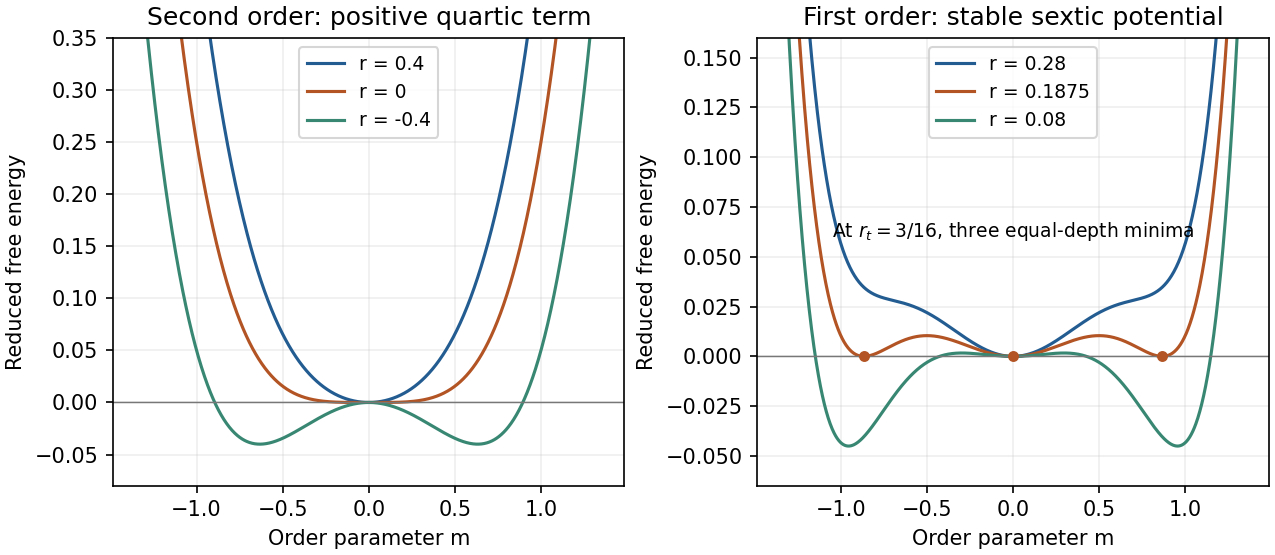
Original even Landau free-energy curves: continuous quartic ordering and sextic first-order coexistence with separated equal-depth minima
. Details. 
At , Pauli exclusion restricts thermally changed occupations to an energy interval of order about the Fermi energy. The affected fraction is of order ; their typical excitation energy is of order , so the thermal energy correction is proportional to and the heat capacity is linear in .
More precisely, with the total density of one-particle states per unit energy, including spin,For a three-dimensional ideal gas with quadratic dispersion, , henceThe fixed-particle-number Sommerfeld expansion gives . The temperature dependence of the chemical potential must be included when obtaining this expression; holding it artificially fixed changes the intermediate energy correction.
For one three-dimensional quadratic branch, the density of states per unit volume isWith , changing integration variable to givesA degeneracy factor multiplies both densities if additional equivalent branches are present. The first expression is the noncondensed density: a macroscopically occupied ground state must be counted separately.
Bose-Einstein condensation occurs when the excited states can no longer hold all particles and the ground-state occupation becomes macroscopic. At fixed total density,For field-induced triplon condensation, write , so . At fixed reference , the three requested dispersions have gaps , and zero respectively. Their curvature is unchanged. Because the actual thermodynamic chemical potential is zero, the Bose distribution requires . At , the minimum reaches zero and the noncondensed population saturates, permitting macroscopic occupation.
For the triplon condensation field scaling, the critical density at onset is . ThereforeThe low-temperature phase boundary rises from ; the condensed phase lies on the higher-field side.
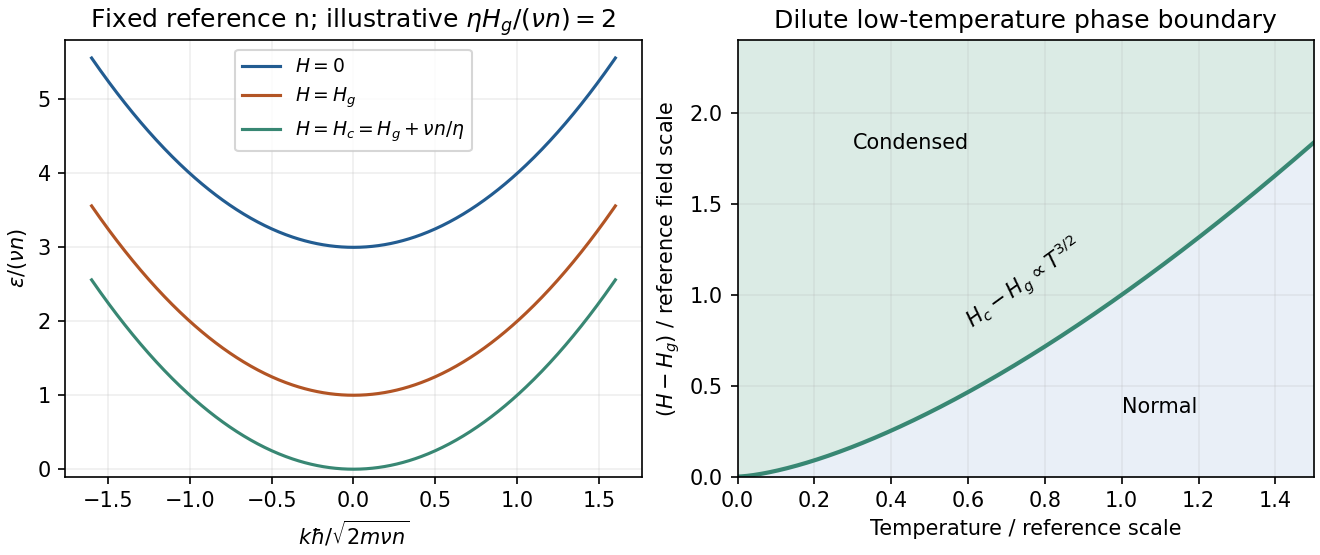
Original shifted-parabola triplon dispersions and low-temperature field–temperature phase diagram; model choices are dimensionless and illustrative
. Details. 
For , simply continuing the gap below zero would give unphysical Bose occupations. For the condensate density in a shifted-parabola triplon model, added condensate density keeps the minimum at zero: . At fixed temperature this giveswith below onset. At zero temperature it becomes within that model.
This prefactor is conditional on continuing the stated single-density mean-field shift into the condensed phase. A microscopic interacting Bose condensate has collective Bogoliubov excitations , with , which are linear at small . The normal-state shift alone does not fix the condensed interaction closure or identify with . The gap closes and the condensate density grows linearly with excess field in the simple mean-field description; the detailed collective dispersion needs that additional interaction model. A dilute-boson treatment of field-induced magnetic ordering makes this normal/condensed distinction explicitly.[ref]
Use for molar volume to distinguish it from the fluctuating parcel volume below. The equation is . The parameter models excluded volume, while models the reduction in pressure from attractive interactions.
Below the critical temperature, a raw isotherm has a loop. The positive-slope segment is mechanically unstable and surrounding metastable portions do not give the stable equilibrium mixture. Replace the loop by a constant coexistence pressure satisfying the Maxwell equal-area condition,The endpoints are liquid and vapour molar volumes; intermediate mean volumes correspond to phase mixtures with changing proportions. Above the critical temperature, liquid-like and gas-like states connect continuously without a coexistence plateau.
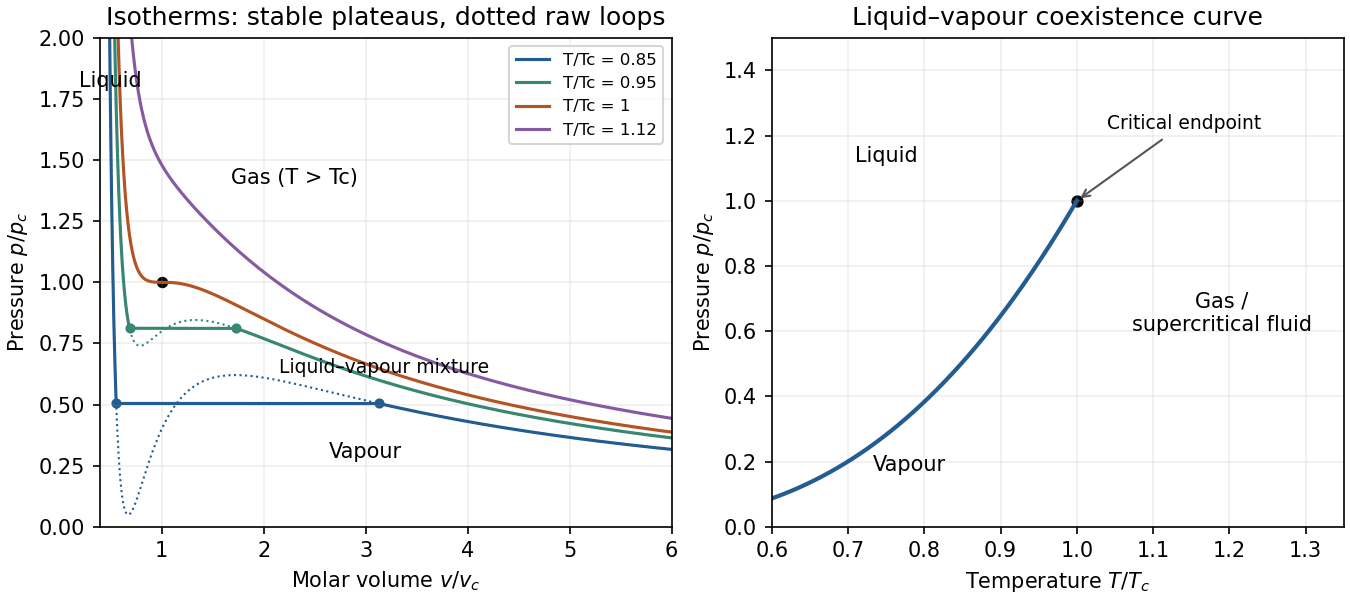
Original reduced van der Waals isotherms with computed Maxwell coexistence plateaus and the pressure–temperature coexistence curve ending at the critical point
. Details. 
In the pressure-temperature diagram, the liquid-vapour coexistence line ends at the critical point. Below it, the low-pressure side is vapour and the high-pressure side liquid. “Gas” conventionally denotes the region above the critical temperature, where compression alone cannot cross a liquid-vapour transition. The model has no solid phase.
The critical isotherm has an inflection: . Thuswhich giveFor fluctuations about a stable equilibrium value , the system plus reservoir has probability proportional to . Expanding availability,gives a Gaussian distribution and, to this order, withThis requires positive curvature and sufficiently small fluctuations; it is not exact when higher-order terms matter.
The whole cylinder's volume is fixed. For the volume fluctuations of a small fluid parcel, interpret the small quantity as a material parcel containing moles, whose volume can fluctuate against the much larger remainder. Its mean volume at the critical density is . At fixed temperature its availability is , soOn the critical isochore, approached from ,ConsequentlyEquivalently, , with . The mean-field variance diverges as , so its critical exponent is ; the root-mean-square fluctuation has exponent . A fixed spatial observation box instead has number fluctuations, not fluctuating geometric volume. Finite size and non-Gaussian terms cut off the literal divergence; the approximation fails exactly at the critical point.
Articles by others on the same topic
There are currently no matching articles.