Landau description. Introduce a macroscopic order parameter and expand an appropriate free energy analytically in that parameter, retaining terms permitted by the physical symmetries. Stable equilibrium minimizes this free energy globally; a local minimum with larger free energy is metastable. Coefficient changes with temperature can exchange the preferred minima. A continuous emergence from zero can produce a continuous transition, while competing separated minima can produce a first-order transition. Stability requires a positive highest retained even-power term. This local mean-field description neglects spatial fluctuations and nucleation dynamics unless gradient and dynamical terms are added; near a critical point those omissions can matter.
Local behavior at the origin. To determine constrained order-parameter boundary stability, note that and , the origin is a local minimum for and a local maximum for . At , the quadratic term vanishes, but for small positive . ThereforeThe equality case uses the stipulated domain . On an unrestricted real line, the nonzero cubic term would instead make it a stationary inflection point.
Global stability in both inline cases. For , complete the square in :The quartic coefficient guarantees a bounded global minimum. A negative value exists precisely when the minimum of this quadratic factor is negative. Hence case a, , has a nonzero globally stable phase with for every physical temperature. Case b, , has such a phase exactly forAt , the square's centre is at the boundary, but its negative constant still gives for small positive , so this endpoint is included.
At ,The two global minima have equal free energy, and . The coexistence barrier of a cubic-quartic Landau transition has its maximum at , with barrier height .
For locating the extrema away from coexistence,Retain only real positive roots; when both are positive, is a local maximum and a local minimum. For , only is positive. If , the pair first appears on cooling at ; if , a higher-free-energy nonzero minimum already exists at arbitrarily high temperature. These local-stability limits must not be mistaken for the global coexistence condition. The boundary also favors a nonzero minimum at every finite temperature, but has no finite .
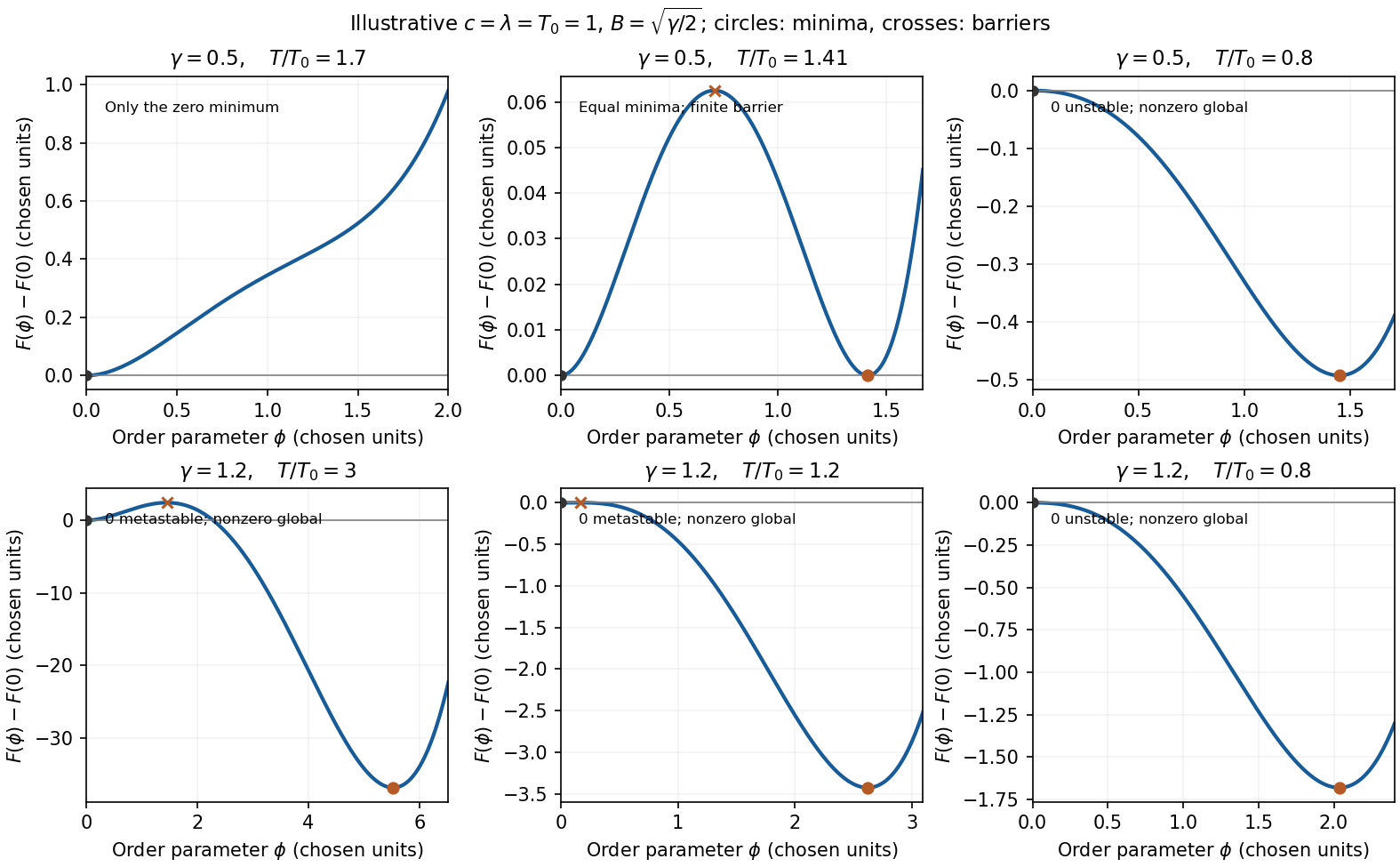

Cooling and transition temperature. For , equilibrium starts at the zero minimum at high temperature and switches to the nonzero minimum at . The jump is finite, , and there is a barrier between the coexisting states. This is a first-order transition. The latent heat of a temperature-dependent cubic-quartic Landau transition follows from differentiating the minimized free energy: the heat released on cooling isIf is an energy density rather than total energy, is likewise a density. An actual system can supercool below before nucleation, so is the equilibrium transition temperature.
For thermal symmetry nonrestoration in a cubic-quartic model, with , the equilibrium global minimum is nonzero already at arbitrarily high temperature. Following it does not force a transition. A system initially prepared in the metastable zero minimum can still leave it by nucleation while ; that minimum loses local stability at . This is the sense in which a change is possible rather than inevitable. There is no equilibrium coexistence temperature for in this model. A kinetic transition can depend on preparation and nucleation dynamics; is the limiting loss of local stability of the zero state, not a second coexistence temperature. Continuing to an imaginary value does not define a physical transition temperature.
Mass window in the specified electroweak phase transition model. For the mass window in a cubic electroweak transition model, put . The supplied ratios implyThe two strict conditions therefore requireSince is increasing for , the finite window isUsing the specified and givesAt u, , but . Thus 134 u lies outside the required window, failing the order-parameter-strength condition. This does not remove the polynomial model's finite first-order jump; it fails the additional requirement . The result is a bound within the specified simplified model, not a model-independent Higgs-mass bound.
Articles by others on the same topic
There are currently no matching articles.