Original source: Released examination PDF, physical pages 335–338. All three note alternatives and both longer questions are treated.
For a canonical ensemble, and . The kinetic and factorial factors do not depend on , so differentiating only the volume-dependent terms givesThus the equation of state isThe excluded-volume correction raises pressure relative to the same gas without that correction; the attractive mean-field term lowers it. No Stirling formula is required for this derivative.
Differentiate the Euler relation for a single-component simple compressible system:The thermodynamic fundamental relation for the same system is . Subtraction givesDividing by , with and , proves the Gibbs-Duhem equationThe underlying Euler relation assumes extensive bulk thermodynamics and no additional work coordinates. The result says that the intensive quantities are constrained; the chemical potential cannot be varied independently of temperature and pressure within one homogeneous phase.
Let denote the fluctuating microscopic energy and its mean, at fixed . In a canonical ensemble with ,Since , this givesHere denotes an energy fluctuation about the mean, as in the question. The relation is not restricted to ideal gases when the Hamiltonian operator has no explicit temperature dependence. Alternatively, the stated equilibrium free-energy curvature gives a Gaussian energy weight proportional to , with the same variance.
For the relative energy fluctuation of a monatomic ideal gas, and , henceTaking room conditions as approximately K and Pa, with m, givesThe mean energy is about J and its standard deviation about J. The tiny relative fluctuation explains why macroscopic equilibrium internal energy behaves as a sharply defined thermodynamic quantity. The estimate uses a thermal reservoir, not a particle reservoir; allowing itself to fluctuate changes the relevant fluctuation problem.
A non-ideal gas departs from because interactions and finite particle size affect its pressure. At sufficiently low number density , the virial expansion separates these corrections:The second virial coefficient has dimensions of volume per particle, while has dimensions of volume squared. These are density-series coefficients, not the coefficients of a pressure-series expansion with the same names.
For classical particles interacting through a pair potential ,Repulsion contributes positively and attraction negatively. A hard core of diameter gives , four times the geometric volume of one sphere. The factor reflects the volume excluded to the centre of a second particle together with pair counting; it is not simply the occupied geometric volume.
Expanding the Van der Waals equation at givesThe virial coefficients of the van der Waals gas are therefore and . The Boyle temperature, , makes the leading correction vanish, but does not remove the higher coefficients or turn the gas exactly ideal. More realistic potentials give temperature-dependent higher coefficients that need not equal the van der Waals values.
A useful measurement is a sequence of dilute isothermal pressure–volume observations. Plotting against exposes as the zero-density intercept and as its initial slope. Control temperature and density calibration, check equilibration and adsorption on the container walls, and vary the fitted density interval to test truncation error. One measured virial coefficient cannot uniquely reconstruct the pair potential. Near coexistence or a critical point a short density series may fail, and at quantum-degenerate densities exchange statistics add corrections even without interactions.
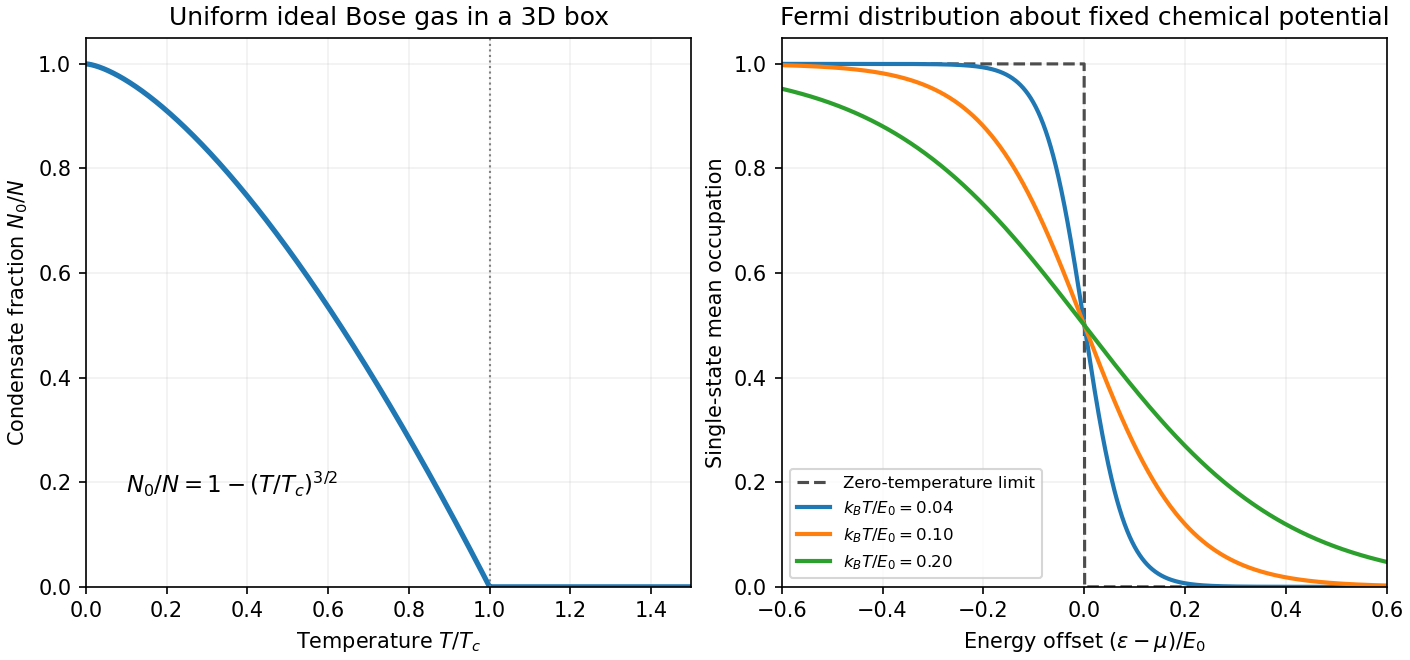
Bose-Einstein condensation is macroscopic occupation of the lowest one-particle state. It is a change in occupation statistics, not ordinary liquid formation and not a requirement that all atoms occupy one spatial point. For ideal bosons,Set the lowest one-particle energy to zero. Then , and the population of excited states in a uniform three-dimensional box isHere . As approaches zero, the excited-state population saturates at . Any excess particles occupy the ground state. In the thermodynamic limit,Thus the onset occurs when the thermal de Broglie wavelength is comparable to the mean interparticle spacing. At finite , the chemical potential remains slightly below the ground-state energy; setting it equal to zero is a thermodynamic-limit statement.
The 1995 rubidium experiment used magnetic confinement and evaporative cooling of atoms. Absorption images after trap manipulation revealed a narrow, anisotropically expanding component superposed on the broader thermal distribution; the new component grew as cooling proceeded. The thermal component supplied an internal comparison through the same imaging optics. Trap decompression and release geometry mattered, and finite imaging resolution and interactions limited direct comparison with an ideal-gas ground state.[ref]
Observation of Bose-Einstein Condensation in a Dilute Atomic Vapor by M. H. Anderson and others. Science 269, pp. 198–201, experimental preparation and velocity distributions
A narrow cloud alone is not sufficient evidence. One should check its emergence across a controlled cooling sequence, atom-number and temperature calibration, the thermal background and the predicted expansion anisotropy. These are tests of an occupation transition rather than a simple focusing artifact. The box formula above is not the exact critical-temperature or condensate-fraction formula for the trapped experiment: the trap changes the density of states, and interactions also matter. Condensation and superfluid response are related but distinct properties; the former definition is ground-state occupation.
The Fermi-Dirac distribution gives the mean occupancy of a single fermion state:Its maximum occupancy of one expresses the Pauli exclusion principle. A spatial orbital with two spin states can hold two electrons because they are different single-particle states. At zero temperature, the occupation is a step at the Fermi energy ; at low nonzero temperature, occupation changes appreciably only in an energy shell of width of order about the chemical potential.
Consequently, most conduction electrons cannot absorb small thermal energies into already occupied states. Only a fraction of order participates, where . For a normal metal with a smooth density of states , including both spin states and using the total-system normalization, the Sommerfeld expansion at fixed particle number givesand thereforeFor a three-dimensional free electron gas, , so . This is much smaller than a classical equipartition estimate at . The chemical potential must adjust with temperature to maintain ; treating it as fixed while differentiating an energy integral gives the wrong fixed- calculation in general.
The lattice adds a Debye contribution at temperatures well below the Debye temperature. HenceA plot of measured against can separate the electronic intercept from the phonon slope. calorimetry must account for the heat capacity of the sample holder, heat leaks, thermal equilibration and thermometer calibration. A magnetic impurity contribution or a superconducting transition can invalidate this two-term fit; the prediction is for the normal metallic state in an appropriate low-temperature interval. Differences from a free-electron coefficient can reveal quasiparticle effective-mass enhancement or nontrivial electronic structure rather than a failure of Fermi statistics.
Ensemble and applications. A grand canonical ensemble describes a system exchanging both energy and particles with a large reservoir. Its fixed control parameters are , while microstates with different have probabilitiesWeak coupling allows the system's energy levels to remain meaningful; equilibrium fixes the reservoir temperature and chemical potential. The grand potential is , with now the mean population. It generates entropy, pressure and mean particle number by differentiation. This ensemble is convenient for gases in contact with particle reservoirs, independently occupied quantum levels and surface adsorption; its particle-number fluctuations are part of the description, not an error in counting.
Classical single-level limit. For the single-level grand partition function in the dilute limit, put . Empty and singly occupied levels contribute and . In the dilute classical limit , higher occupancies contribute only at order or beyond:This truncation does not impose the Pauli principle on a classical gas. A fermion state has exactly , a boson state has , and Maxwell-Boltzmann occupancy weights give ; they all agree to this order. In particular, , with the classical Maxwell-Boltzmann result exactly .
grand potential and chemical potential. With , summing the single-level logarithms and using the stated density of states givesSubstitute , for whichCombining this with the density-of-states prefactor gives . ThusDifferentiating at fixed ,Similarly , so . This is the grand-canonical chemical potential of a classical ideal gas. The condition states the classical regime. The supplied density of states counts one internal state; extra internal degeneracies would have to be included consistently rather than inserted at only one stage.
One adsorption site. Take the free-vapour energy reference as zero and the binding energy as . A site is either empty or singly occupied; the latter has vibrational partition function . Its adsorption-site grand partition function and mean occupation areThe chemical potential of an adsorbed species on equivalent sites follows by inverting the occupation ratioThe factor is the vacant-site probability. The binding reference and the energies included in must be chosen consistently, so that vibrational zero-point energy is not counted twice.
Isotherm. The vibrational factor in a Langmuir equilibrium constant is fixed by adsorption equilibrium, . Neglecting vapour internal degrees of freedom and writing its number density as gives . ThereforeThis is the Langmuir isotherm: initially linear, increasing monotonically and concave down, approaching unit coverage. Half coverage occurs at . The coefficient has inverse-pressure units. It assumes equivalent independent sites, at most one molecule per site and no lateral interaction or multilayer adsorption. The molecular mass appropriate to the vapour determines .
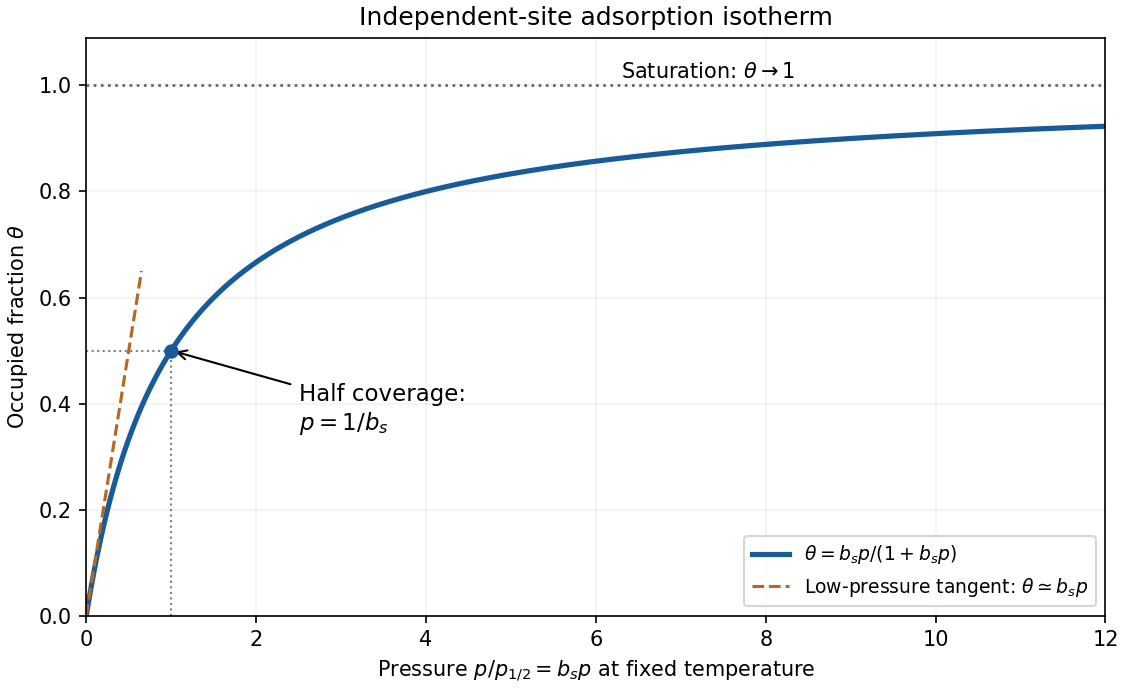
Original dimensionless Langmuir coverage curve with half-coverage and limiting behavior
. Details. A real uptake measurement must separate adsorbed molecules from free gas in the apparatus. Langmuir's original mica experiment compared a mica-containing bulb with a similar blank and inferred uptake from calibrated gas volumes and pressures. His stated blank contribution and bath-temperature drift limited the inferred adsorption; a saturating curve alone does not establish ideal equivalent sites.[ref]
The Adsorption of Gases on Plane Surfaces of Glass, Mica and Platinum by Irving Langmuir. pp. 1376–1378: mica apparatus and blank; p. 1385: limitations
Landau description. Introduce a macroscopic order parameter and expand an appropriate free energy analytically in that parameter, retaining terms permitted by the physical symmetries. Stable equilibrium minimizes this free energy globally; a local minimum with larger free energy is metastable. Coefficient changes with temperature can exchange the preferred minima. A continuous emergence from zero can produce a continuous transition, while competing separated minima can produce a first-order transition. Stability requires a positive highest retained even-power term. This local mean-field description neglects spatial fluctuations and nucleation dynamics unless gradient and dynamical terms are added; near a critical point those omissions can matter.
Local behavior at the origin. To determine constrained order-parameter boundary stability, note that and , the origin is a local minimum for and a local maximum for . At , the quadratic term vanishes, but for small positive . ThereforeThe equality case uses the stipulated domain . On an unrestricted real line, the nonzero cubic term would instead make it a stationary inflection point.
Global stability in both inline cases. For , complete the square in :The quartic coefficient guarantees a bounded global minimum. A negative value exists precisely when the minimum of this quadratic factor is negative. Hence case a, , has a nonzero globally stable phase with for every physical temperature. Case b, , has such a phase exactly forAt , the square's centre is at the boundary, but its negative constant still gives for small positive , so this endpoint is included.
At ,The two global minima have equal free energy, and . The coexistence barrier of a cubic-quartic Landau transition has its maximum at , with barrier height .
For locating the extrema away from coexistence,Retain only real positive roots; when both are positive, is a local maximum and a local minimum. For , only is positive. If , the pair first appears on cooling at ; if , a higher-free-energy nonzero minimum already exists at arbitrarily high temperature. These local-stability limits must not be mistaken for the global coexistence condition. The boundary also favors a nonzero minimum at every finite temperature, but has no finite .
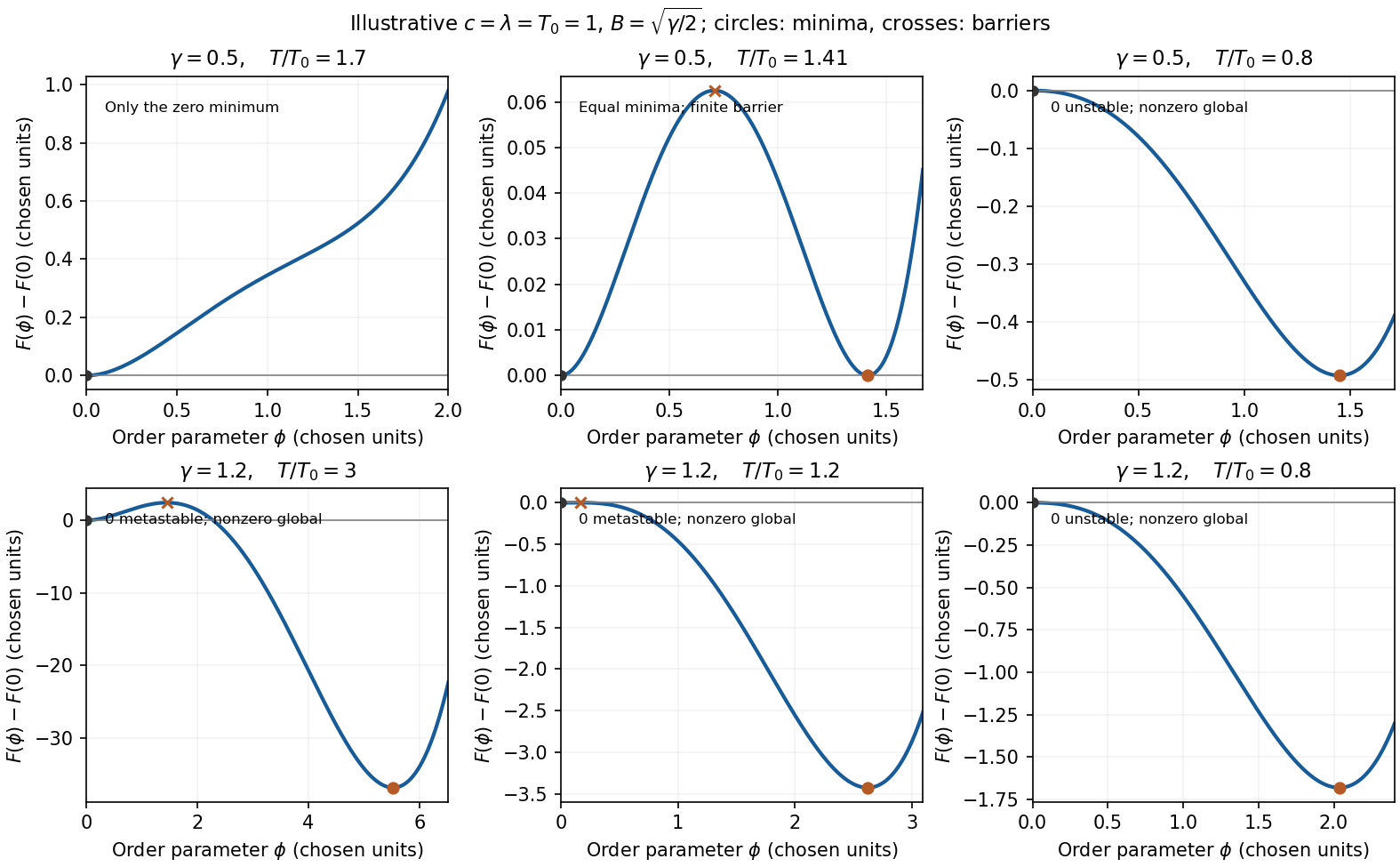


Cooling and transition temperature. For , equilibrium starts at the zero minimum at high temperature and switches to the nonzero minimum at . The jump is finite, , and there is a barrier between the coexisting states. This is a first-order transition. The latent heat of a temperature-dependent cubic-quartic Landau transition follows from differentiating the minimized free energy: the heat released on cooling isIf is an energy density rather than total energy, is likewise a density. An actual system can supercool below before nucleation, so is the equilibrium transition temperature.
For thermal symmetry nonrestoration in a cubic-quartic model, with , the equilibrium global minimum is nonzero already at arbitrarily high temperature. Following it does not force a transition. A system initially prepared in the metastable zero minimum can still leave it by nucleation while ; that minimum loses local stability at . This is the sense in which a change is possible rather than inevitable. There is no equilibrium coexistence temperature for in this model. A kinetic transition can depend on preparation and nucleation dynamics; is the limiting loss of local stability of the zero state, not a second coexistence temperature. Continuing to an imaginary value does not define a physical transition temperature.
Mass window in the specified electroweak phase transition model. For the mass window in a cubic electroweak transition model, put . The supplied ratios implyThe two strict conditions therefore requireSince is increasing for , the finite window isUsing the specified and givesAt u, , but . Thus 134 u lies outside the required window, failing the order-parameter-strength condition. This does not remove the polynomial model's finite first-order jump; it fails the additional requirement . The result is a bound within the specified simplified model, not a model-independent Higgs-mass bound.
Articles by others on the same topic
There are currently no matching articles.