A magnetic field favors alignment of the magnetic moments of a paramagnet, reducing the number of substantially occupied magnetic configurations at fixed temperature. Its magnetic entropy therefore decreases as the field magnitude increases, explaining the negative sign of .
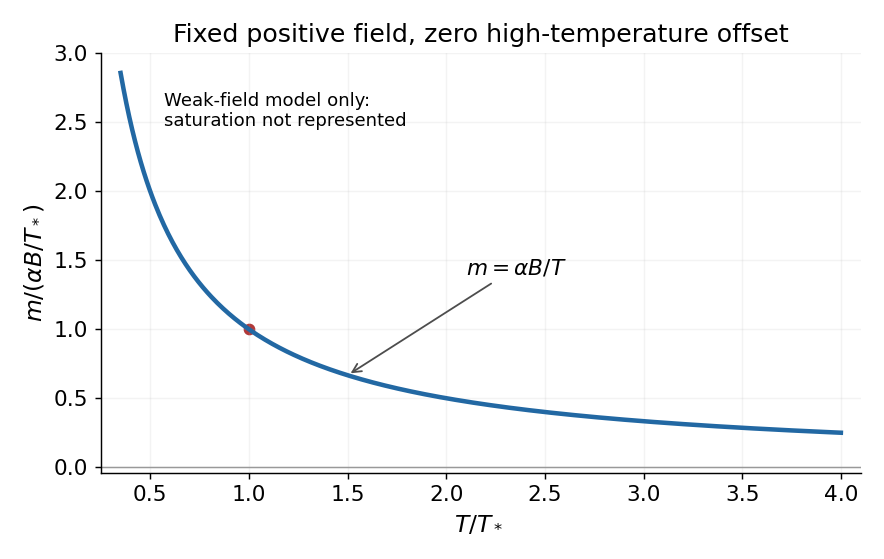
Choose the magnetic Helmholtz free energy convention . Equality of its mixed partial derivatives gives the magnetic Maxwell relationThe magnetic moment inferred from an entropy derivative, integrated at fixed , isThe given entropy derivative alone cannot determine the temperature-independent function . With the usual independent-paramagnet condition as at fixed , , giving Curie's law, . The sketch uses that additional condition. The inverse- expression applies in the weak-field regime; its divergence cannot describe the actual low-temperature saturation of a finite set of magnetic moments.

For reversible quasistatic thermal isolation, . With positive field-dependent heat capacity ,Reducing a positive therefore lowers : this is adiabatic demagnetization. Equivalently, reducing cools for either field sign. Reduced alignment would raise magnetic entropy at fixed ; cooling compensates so total entropy remains constant. Insulation without reversibility would allow additional entropy production and need not follow this adiabat exactly.
Articles by others on the same topic
There are currently no matching articles.