A cooling method that reduces an applied magnetic field while suppressing heat transfer to or from the material. For a suitable material exhibiting paramagnetism, an approximately reversible field reduction can lower its temperature at approximately constant entropy.
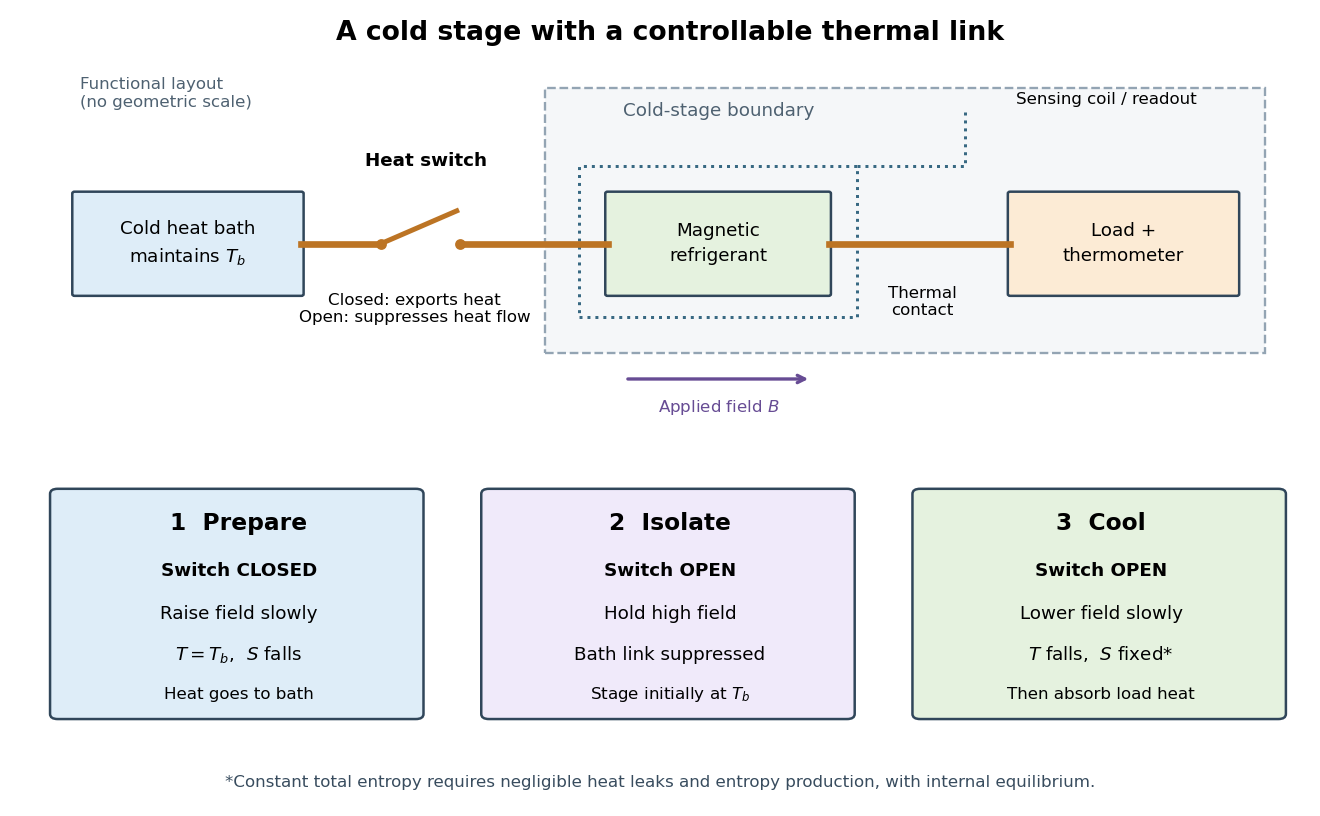
The preparation matters as much as the field reduction. First establish thermal equilibrium with a cold heat bath, then raise the magnetic field while maintaining the bath temperature: this is magnetization in an isothermal process. The bath accepts heat and the material loses magnetic entropy. Next open a heat switch, thermally isolating the working material, and lower the magnetic field. If the sweep maintains internal thermal equilibrium with negligible entropy production, this second leg is an isentropic process. An adiabatic process alone does not guarantee constant entropy.
The attraction is a controllable energy scale: changing the magnetic field changes the separation of magnetic energy levels, even across a thermally insulating gap. This lets an already cold solid become colder without needing a colder contacting heat bath. A practical refrigerator also needs a load, a period of absorbing its heat, and a reset that rejects accumulated entropy to the bath. A single field sweep has finite cooling capacity.

Magnetic entropy counts the uncertainty in the occupied magnetic microstates. For independent localized magnetic moments with one-site probabilities ,where counts sites and is the Boltzmann constant. This is the Gibbs entropy for the magnetic degrees of freedom. Equal occupation of two states gives ; certain occupation of one state gives zero. Calling this disorder is useful only if the relevant states and their probabilities are specified. In an interacting material, correlations generally prevent replacing the many-body Gibbs entropy by this sum of independent one-site contributions.
Increasing the magnetic field at fixed positive temperature favors lower magnetic energy levels, reducing magnetic entropy. During ideal isolated demagnetization, both the level separation and temperature fall together, leaving the occupation probabilities unchanged. Thus the independent-spin idealization cools without increasing spin disorder along the isolated leg. When a real crystal's vibrating lattice also cools, its lost entropy can instead be taken up by the magnetic degrees of freedom. The conserved quantity is the total entropy of the thermally isolated stage, including any attached load in thermal equilibrium.
Use the independent spin-one-half two-level system with fixed distinguishable sites and Hamiltonian levels , where is the magnitude of the field-axis magnetic moment and is a uniform externally controlled magnetic field. Assume positive temperature, no interactions between sites, and no appreciable lattice or load entropy. The two levels differ by . With inverse temperature , the canonical ensemble gives the one-site and total partition functionsHere the minus subscript denotes the lower energy . Factorization of the partition function requires additive energy and independent sites; there is no particle-exchange factor for these fixed distinguishable sites.
Differentiate the partition function, holding fixed when differentiating with respect to . The internal energy, Helmholtz free energy, total field-axis magnetic moment , and magnetic entropy areThe extensive moment is distinct from magnetization, the moment per unit volume. Direct substitution of into the Gibbs entropy gives the same independently of the free-energy derivative.
At fixed , the magnetic heat capacity isStrict decrease makes invertible on . Constant magnetic entropy therefore fixes , not or separately:The partition function may be used to label these equilibrium states even though the isolated cooling leg has no external heat bath. Actual thermalization of the lattice and load additionally requires a sufficiently fast spin-lattice relaxation; perfectly uncoupled spins by themselves cannot refrigerate an attached object.
The limiting cases are instructive. For , , , and . The moment response reproduces Curie's law. For , and the upper-state occupation is exponentially small. Taking at fixed gives ; taking at fixed gives . The origin has a path-dependent limit. Extrapolating a line of constant to does not construct a usable zero-temperature state or prove that a real material retains independent degenerate spins there.
Choose a fictional two-level refrigerant with , where the upright denotes tesla. This chosen moment is a convenient model parameter, not a fitted property of the historical salt. At bath temperature , raise from to . Then increases from to , soThe last equality assumes a reversible isothermal process of magnetization; negative means the refrigerant rejects heat. The bath gains of entropy, balancing the stage's loss in this reversible limit. An appreciable temperature difference during real heat transfer adds entropy production.
Now open the heat switch and reduce from to . Constant gives . Throughout this ideal cooling leg, , , and . Neither state becomes more probable. Field reduction shrinks the energy gap by ten while preserving the Boltzmann distribution's dimensionless ratio of gap to temperature.
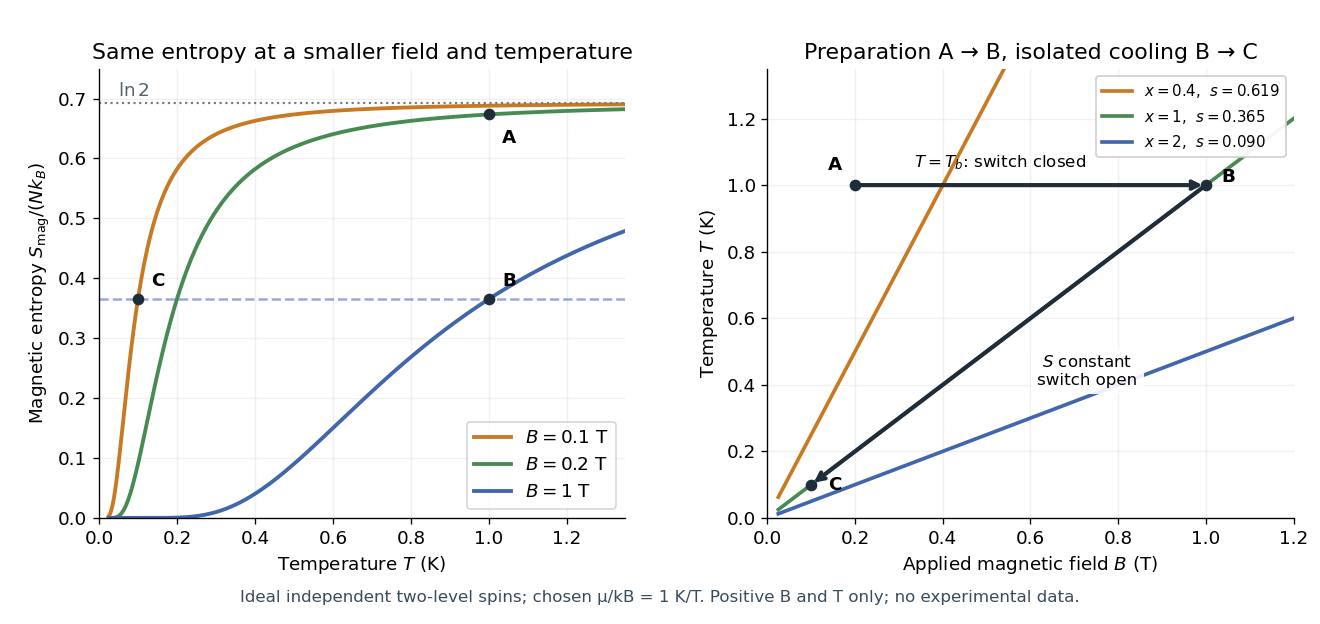

There is a subtle energy check. For the spin Hamiltonian convention used here, external-field interaction energy belongs to , so reversible work done on the spin subsystem is andOn the isolated leg, but increases from to , becoming less negative as the gap shrinks. Integrating at constant supplies exactly . Cooling therefore need not decrease this chosen spin internal energy. An account of work exchanged with a magnet circuit must specify where field interaction energy is assigned before comparing signs. The occupation ratio and temperature prediction do not depend on that bookkeeping choice.
For the isothermal preparation, direct integration gives . The endpoint internal energy difference is , equal to . This independently checks both the rejected heat and the magnetic-work sign in the chosen convention.
William Francis Giauque's 1949 lecture, Some Consequences of Low Temperature Research in Chemical Thermodynamics, credits Peter Debye with an independent proposal. It describes gadolinium sulfate octahydrate in a jacket immersed in liquid helium, with an external solenoid. Exchange gas conducts away heat during magnetization; evacuation isolates the sample before field reduction. A liquid-nitrogen shield reduces radiative heat transfer. Its photograph identifies the 1933 apparatus operated with Duncan Peck MacDougall. An inductance bridge reads the sample's magnetic susceptibility; measuring coils remain outside the evacuated jacket in liquid helium. Increasing magnetic susceptibility indicates cooling, but converting it to temperature using Curie's law becomes approximate as that law fails.[ref]
Some Consequences of Low Temperature Research in Chemical Thermodynamics by William Francis Giauque. Giauque, Nobel lecture, pp. 237–245, Figs. 16–20 and 23–25
The measurement logic deserves a separate check. A changed inductance alone is not an absolute temperature calibration: the sample geometry, applied measuring magnetic field, and constitutive response enter the inference. A modern control would compare the susceptibility-based thermometer with an independently calibrated thermometer over their common range, check recovery after repeated sweeps, and measure subsequent warming to bound incoming heat. These are proposed controls derived from the readout principle, rather than additional procedures attributed to the 1933 experiment. The historical working salt has a richer magnetic level structure than the illustrative two-level paramagnetic cooling model.
Three distinct effects spoil indefinite cooling: extra entropy outside the spin subsystem, additional magnetic energy scales, and irreversible heat or work input. They can be distinguished with a thermodynamic derivative. For a smooth equilibrium Helmholtz free energy obeying , a Maxwell relation givesHere is the total heat capacity participating in the stage's thermal equilibrium. The ideal model has . If its spins share temperature with a field-independent lattice and load of combined heat capacity , thenThe positive slope still means cooling when , but its smaller magnitude gives less cooling per fractional field reduction. For example, a low-temperature Debye model gives a lattice entropy proportional to . As that lattice entropy falls, the spins take up the released entropy; can no longer remain constant. A weak enough coupling to neglect its equilibrium interaction energy can still be strong enough to exchange heat on the sweep timescale.
Interactions between magnetic moments, including exchange interaction and the fields of neighboring magnetic dipole moments, introduce energy scales that do not vanish with the applied . Once they compete with or , the independent-site partition function fails. Correlations and possible magnetic ordering alter the available magnetic entropy and the cooling curve. Simply setting the external magnetic field to zero does not eliminate those interactions. Different refrigerants therefore need their own measured equilibrium properties; there is no universal final temperature from the applied-field ratio alone.
Finally, a real open heat switch has residual thermal conductance; supports, wires and radiation carry incoming heat. Field changes may also dissipate energy. Locally near thermal equilibrium, with incoming heat rate and internal entropy production rate , the stage balance becomesThis uses a common stage temperature; a non-equilibrated load requires separate balances. The sweep must allow spin-lattice relaxation while remaining fast enough to limit accumulated parasitic heat. At fixed , the same balance explains warming and finite hold time. Useful refrigeration is the controlled absorption of a load's heat during that finite interval, followed by a renewed isothermal process of magnetization to export its entropy.
Articles by others on the same topic
There are currently no matching articles.