For a single-particle state of energy , put . The equilibrium mean occupancies areThe Maxwell-Boltzmann distribution is the dilute classical limit. The Fermi-Dirac distribution applies to identical fermions with at most one particle in each complete single-particle state by the Pauli exclusion principle. The Bose-Einstein distribution applies to identical bosons with no such upper occupation bound. The chemical potential fixes total particle number; these are mean state occupancies, not three separately normalized single-particle probability densities. For a number-conserving ideal Bose gas, cannot exceed the lowest single-particle energy.
Take to be a wavevector and count periodic-box states with cell volume in momentum space, parameterized by . Write for internal degeneracy. The number of states in a spherical shell is . Since ,Thus the one-particle canonical partition function isHere , for one nondegenerate branch, and for the spin-half case below. The integral uses . For classical indistinguishable particles, , givingThe factor three in the energy arises from the linear dispersion relation and three-dimensional state counting; the usual nonrelativistic quadratic-dispersion value does not apply.
For spin-half fermions at , all states up to the Fermi energy are occupied. With ,Integrating the occupied energy states givesThese are the corresponding ultrarelativistic ideal Fermi gas formulae with general slope . The nonzero ground-state internal energy and degeneracy pressure reflect the Pauli exclusion principle: particles cannot all occupy the lowest-momentum state. Formally extrapolating the classical equations gives , but Maxwell–Boltzmann statistics is not valid at fixed positive as .
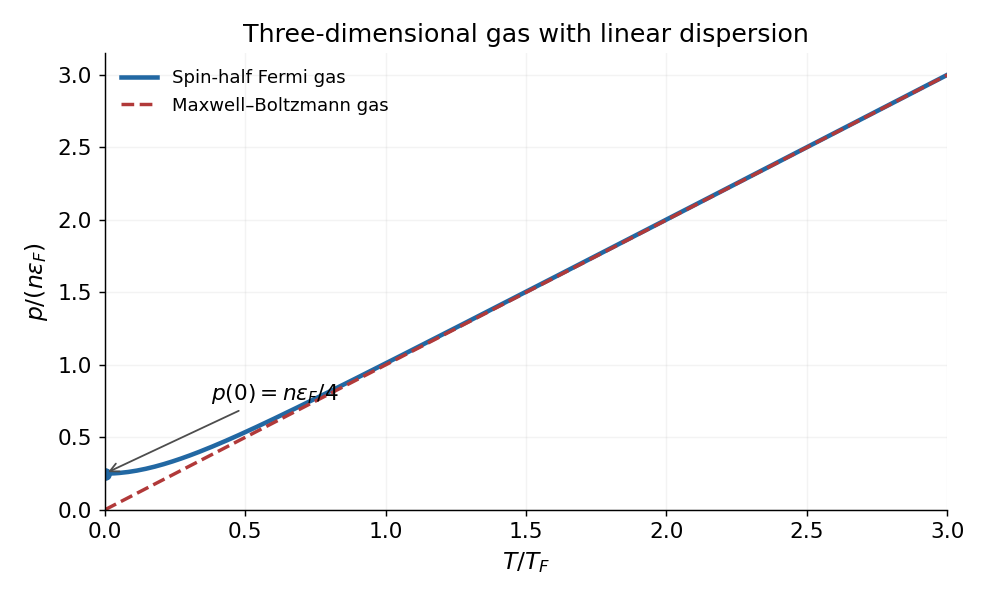
At large , the number equation gives , so expanding the Fermi-Dirac distribution recovers the Maxwell-Boltzmann distribution. A convenient crossover scale is the Fermi temperature,For , both gases have . At fixed , the Fermi curve begins at , has zero initial slope, lies above the classical line, and approaches it at high temperature. For example its low-temperature expansion is . The plot evaluates the finite-temperature occupation integrals at fixed number density.

If the source's symbol is interpreted literally as momentum rather than a wavevector, the state-space cell is . In that convention replace in the wavevector-based coefficients and energy scales above by . The dimensionless thermodynamics and the relation are unchanged.
Articles by others on the same topic
There are currently no matching articles.