A saddle-node bifurcation creates or destroys two equilibria when a real eigenvalue passes through zero with a nonzero quadratic normal-form term. With a parameter orientation chosen so the pair appears for , useThere are no equilibria for , a double nonhyperbolic equilibrium at zero, and equilibria for . The positive branch is stable and the negative branch unstable in the active direction; additional hyperbolic directions can make them a node and a saddle equilibrium. “Supercritical” for a fold depends on this chosen parameter orientation; unlike the pitchfork and Hopf cases it is not an intrinsic distinction between the stability of two possible cubic branches.
The supercritical pitchfork normal form of a dynamical system isThe symmetric equilibrium is stable for and unstable for . Two new stable equilibria emerge on the unstable side of the original branch. Reflection symmetry preserves the pair. The new equilibria approach zero continuously as the parameter reaches the threshold.
A Hopf bifurcation occurs when a simple pair of complex conjugate eigenvalues crosses the imaginary axis at nonzero frequency. A supercritical normal form of a dynamical system isWriting gives and . A stable periodic orbit of radius is born for as the equilibrium loses stability. In contrast, a subcritical Hopf has an unstable small periodic orbit on the side where the equilibrium is still stable.
The Lorenz equilibria satisfy , and . ThusAt the origin the third eigenvalue is and the other two solve . Hence the origin is stable for , has one zero eigenvalue at , and becomes a saddle equilibrium with one unstable direction for . The symmetry interchanges the new branches.
The nonzero-equilibrium characteristic polynomial isNear its Routh-Hurwitz inequalities are strict, so both new branches are stable. More explicitly, center-manifold projection at givesThe linear coefficient crosses positively and the cubic coefficient is negative. Therefore the equilibrium bifurcation is a supercritical pitchfork at , not a saddle equilibrium-node.
For completeness, the later stability boundary satisfiesIf , the nonzero branches remain linearly stable for all . If , they lose stability atAt that point andThis establishes a genuine transverse Hopf crossing. It is subcritical for these positive parameters, so it is not the supercritical Hopf normal form of a dynamical system from (c). One way to check its nonlinear sign is the cubic Hopf formula. At write andFor right and adjoint eigenvectors , , , the cubic coefficient has the sign ofSubstitution and clearing positive factors reduces its sign to that of the following polynomial in :Every term is positive. The radial cubic is therefore positive, giving the unstable small cycle on the stable-equilibrium side. There is no saddle equilibrium-node among the equilibrium branches for : the only zero-eigenvalue branch intersection is the symmetry-forced pitchfork. This does not rule out separate global bifurcations of periodic orbits.
The equilibria are . The Jacobian is . At the origin it has eigenvalues and tangent eigenvectors and , so the origin is a saddle equilibrium. At either nonzero point the eigenvalues are , giving stable foci.
The energy-like function has . It is coercive at large distance, so trajectories remain bounded; there are no periodic orbits because their energy could not return to its starting value unless . The stable manifold of the saddle equilibrium separates the two attracting basins. Its unstable branches leave the origin and approach the right and left foci, respectively. Their negative energy near the origin prevents crossing back through .
For either invariant manifold write . Odd symmetry rules out even powers. Tangency to the vector field requires . Matching coefficients yields and . HenceThese are local graphs, not globally exact cubic curves.
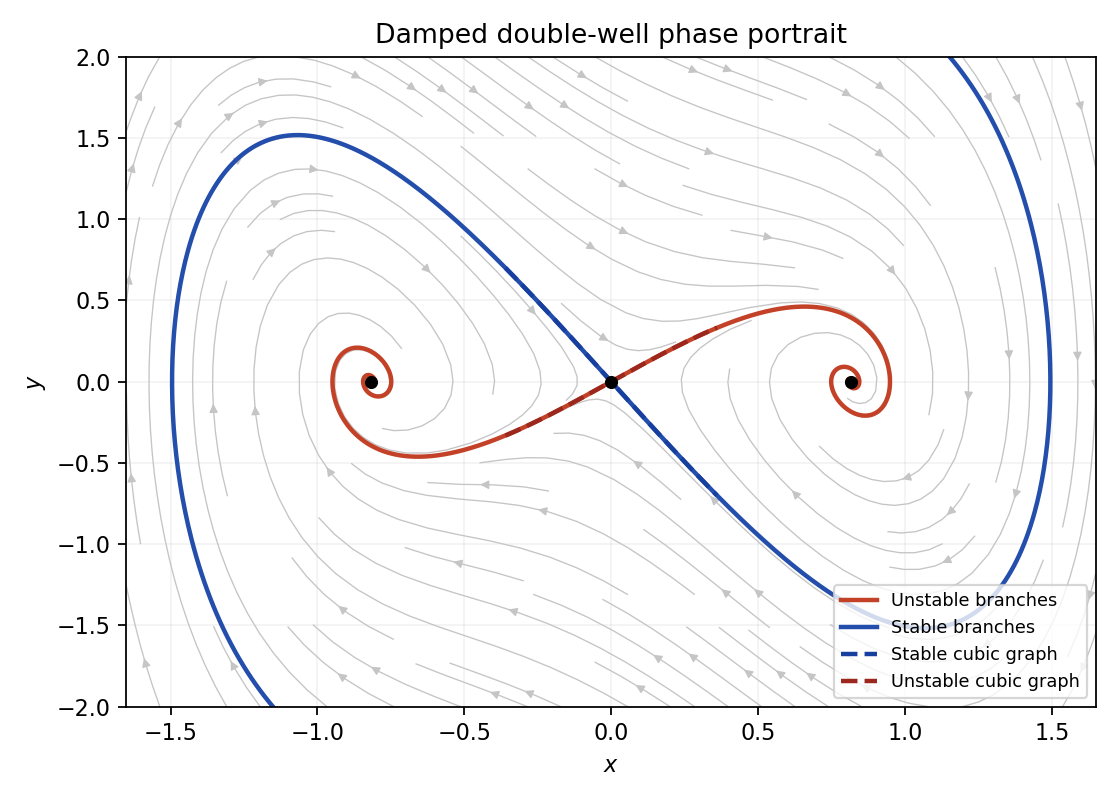
Damped double-well phase portrait: a saddle separates two stable foci, with cubic local invariant manifolds
. Details. At a differentiable fixed point, linear perturbations advance by the Jacobian matrix. A hyperbolic source fixed point of a map has both eigenvalues of modulus greater than one, so nearby perturbations expand under forward iteration of a map. Real signs can cause alternating directions and a complex pair can cause spiral expansion. Eigenvalues on the unit circle are excluded from this linear classification.
A hyperbolic sink fixed point of a map has both Jacobian eigenvalues strictly inside the unit circle. Its iterates locally attract nearby initial states; complex fixed-point multipliers can make the approach spiral. Zero fixed-point multipliers are strongly contracting and can occur for noninvertible maps. A fixed-point multiplier of modulus one requires nonlinear or exact analysis.
A hyperbolic saddle fixed point of a map has one eigenvalue of modulus less than one and one greater than one. The corresponding stable and unstable directions persist locally as invariant sets or manifolds under the usual smoothness and invertibility assumptions. For a noninvertible map a zero stable fixed-point multiplier is possible, and the word saddle fixed point of a map describes forward contraction in one direction and expansion in the other; backward dynamics may not be unique.
A fixed point satisfies . The Jacobian matrix is ; its eigenvalues are the linear fixed-point multipliers used in (i)–(iii).
For the Lozi map, and . At a positive point this gives , and at a negative point . ThereforeThere is no fixed point at , because then and the first component would be one. On an equality boundary the corresponding scalar equation is , so that branch is absent, not a line of fixed points.
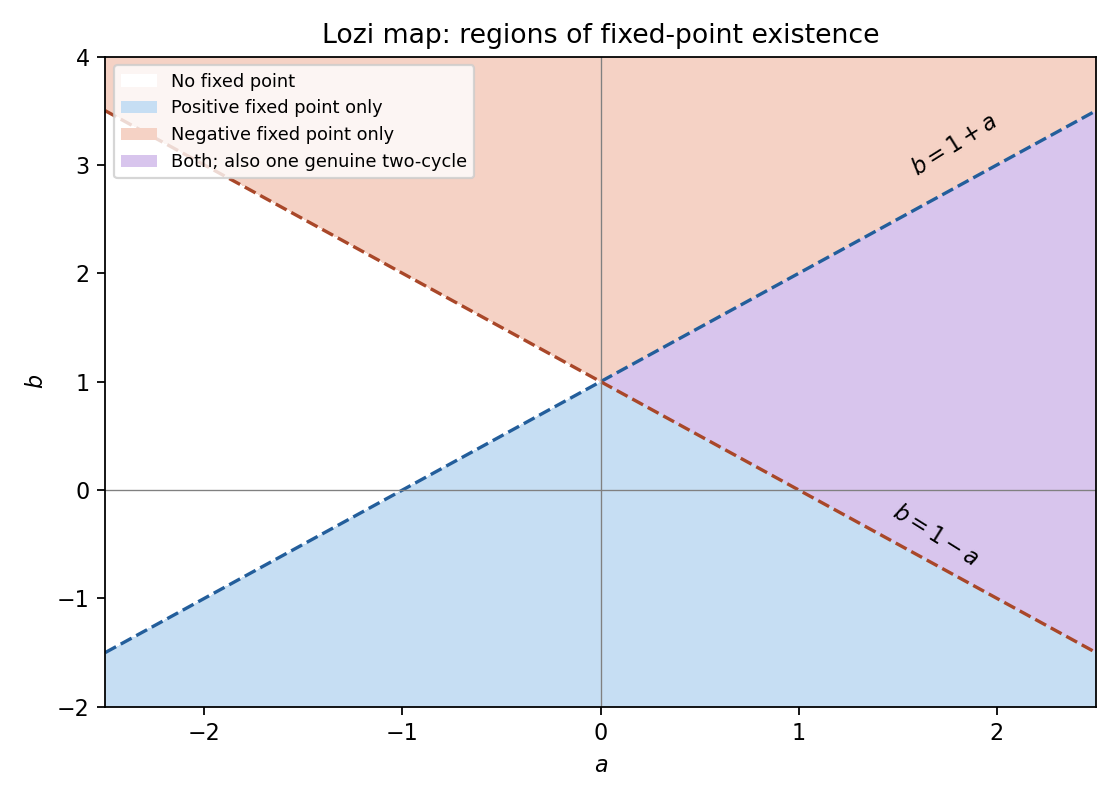
Lozi fixed-point existence regions: positive and negative branches lie in distinct half-planes that can overlap
. Details. For , . If , there is exactly one fixed point unless , when there is none. Its eigenvalues satisfy . It is a sink fixed point of a map for and a source fixed point of a map for . At , the affine map about its fixed point is a quarter turn, and , so it is neutral, not attracting. At no fixed point exists. The positive/negative branch labels follow the sign of .
If , exists for with fixed-point multipliers . It is a sink fixed point of a map for and a forward saddle fixed point of a map for . At the fixed-point multiplier is neutral; on the invariant axis the interval is mapped by , giving two-cycles and the fixed midpoint. The negative point exists only for and has fixed-point multipliers , again a forward saddle fixed point of a map. For there is no fixed point. At , both fixed-point multipliers vanish and two iterates send all initial points to the fixed point.
For a genuine two-cycle let the first coordinates be and put . The two equations are , . If both first coordinates had the same sign , subtracting would give . Since distinct cycle points must have different first coordinates, this contradicts . If one coordinate were zero, the remaining equations would instead force , also excluded. Hence .
Choose . Solving , givesThe required signs hold exactly when . This is the unique two-cycle up to interchanging its two points, under the stipulated nondegeneracy. Borderline parameter lines can carry different degenerate families and were explicitly excluded. These are Lozi fixed points and the alternating-sign two-cycle.
On the invariant biological population interval , the fixed points are and when meaningful. The zero fixed-point multiplier is : extinction attracts for . At , the nonzero branch crosses the origin in the full real-line family, giving a transcritical bifurcation. The nonzero point lies in the biological population interval for and has fixed-point multiplier , so it is stable for and loses stability through at .
Factoring and removing the fixed points gives the two-cycleIts two-step fixed-point multiplier isIt lies between and exactly for . At the upper endpoint it crosses , creating the next period doubling. The two-cycle amplitude tends to zero like at its birth, so the first flip is supercritical. At the equality endpoints linear fixed-point multipliers alone do not establish asymptotic stability.
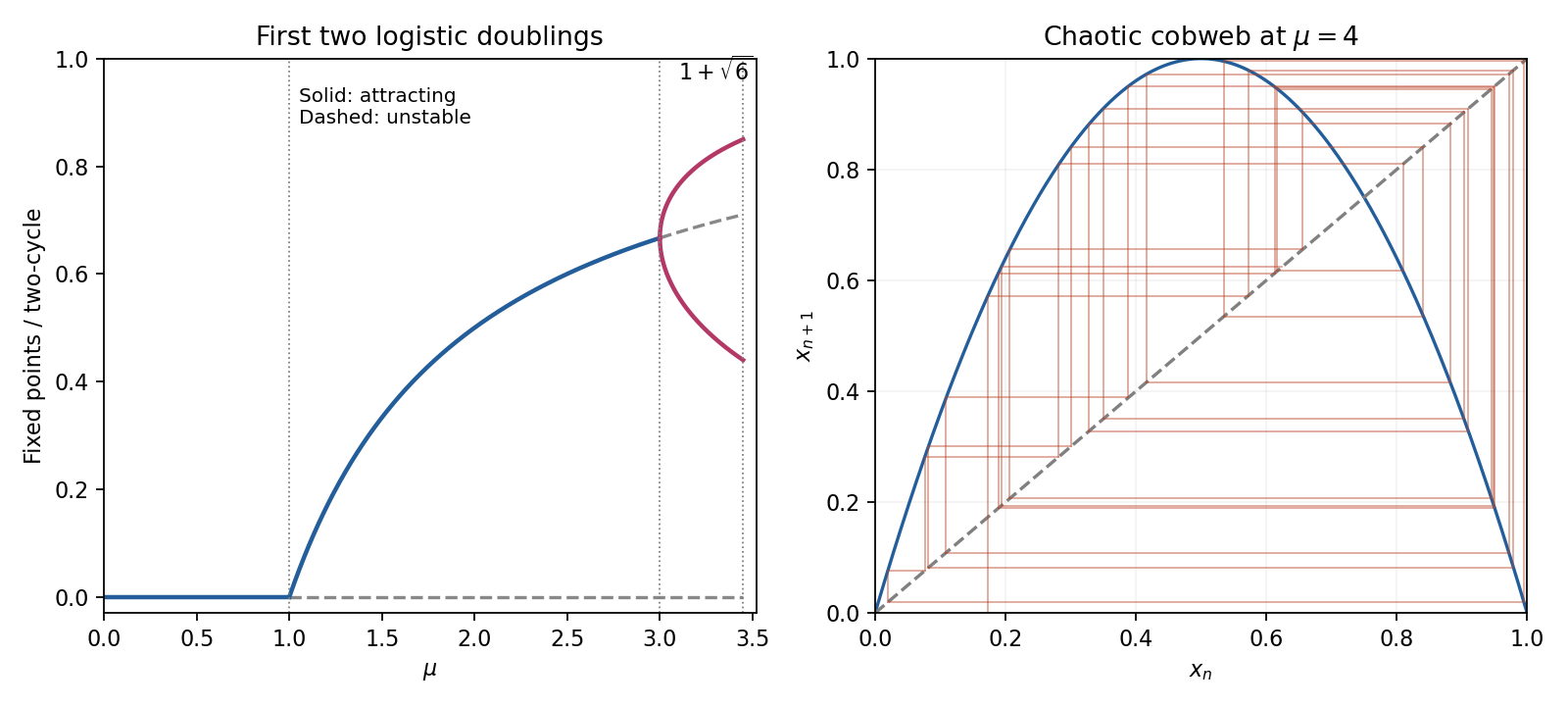


Period-doubling cascade universality concerns the continuation of this period-doubling cascade in smooth unimodal maps with a quadratic maximum. After suitable rescalings their repeated two-step maps approach the same limiting shape; successive parameter spacings have the Feigenbaum ratio approximately and the spatial rescaling has magnitude approximately . These are asymptotic statements involving later doublings, not numbers that can be established from the first two thresholds alone. The accumulation near is outside the first interval considered here. One should not claim chaos throughout the stable two-cycle interval.
Four useful dynamical properties to distinguish are sensitivity to initial conditions, topological transitivity or mixing, dense periodic points, and aperiodic orbits with persistent complex evolution. They concern the invariant set, not an assertion that every orbit must be aperiodic. A positive Lyapunov exponent for typical initial data is an additional quantitative diagnostic.
At , set . The double-angle identity gives the exact solutionFor a direct topological proof use the homeomorphism of . Then , where the full tent map isEvery branch doubles interval length until it crosses a fold; the finite binary cylinders have length and map onto the whole interval after steps. Thus every open interval eventually has an iterate covering the full interval: the map is topologically mixing and sensitive. Repeating a finite left/right branch word gives a periodic itinerary; arbitrarily long prescribed prefixes locate such periodic points in arbitrarily small cylinders, proving density. Nonperiodic binary itineraries yield uncountably many aperiodic orbits. Conjugacy transfers these properties to , proving chaotic behaviour while retaining its dense special periodic orbits.
As a metric check, its invariant measure has density and its typical Lyapunov exponent is . This is a typical-orbit assertion, not a claim about the derivative along every exceptional critical or preperiodic orbit. The explicit trigonometric solution and tent-map conjugacy explain why deterministic iteration of a map can nevertheless amplify uncertainty.
Articles by others on the same topic
There are currently no matching articles.