An equilibrium is asymptotically stable when it is Lyapunov stable and attracts every initial state in some neighbourhood. Lyapunov stability means that sufficiently small initial displacement stays small for all future times; attraction additionally requires convergence to the equilibrium. A Lyapunov function is a differentiable positive-definite scalar function near the equilibrium whose derivative along solutions is nonpositive. Strict negativity, or an appropriate invariant-set argument for a non-strict derivative, gives asymptotic stability.
For , equilibria satisfy and , so only is real. Its Jacobian matrix is , with eigenvalues for every . It is a linear centre equilibrium, so linearization alone cannot decide nonlinear attraction.
Use the positive proper energyFor , energy sublevel sets are compact and invariant. The zero-derivative set is the union of the axes, but its only invariant subset is the origin: on one immediately leaves that axis, and on one has . LaSalle's invariance principle therefore proves global asymptotic stability. At the conserved energy levels are closed periodic orbits, giving a nonlinear centre equilibrium. For , time reversal together with converts the system to the attracting negative- case, so the origin is a nonlinear repeller and is unstable. Nonzero forward trajectories cannot remain bounded; this does not assert existence for all time if finite-time escape occurs.
At either nonzero point the Jacobian matrix is , with eigenvaluesBoth points are attracting for and repelling for . For they are stable foci; for stable nodes. For they are unstable foci; for unstable nodes. At the two repeated-root boundaries they are degenerate nodes. At , linearization has purely imaginary eigenvalues; the conserved energy in the next part shows that they are actual nonlinear centres. Thus the zero-real-part case is resolved by an additional first integral, rather than by the linear test alone.
For , the first integral isIts minimum occurs at the two centres. Levels between and give a periodic orbit around each centre equilibrium; positive levels give larger periodic orbits surrounding both wells. The zero level is the figure-eight separatrix through the saddle, with two homoclinic loops.
On , . The printed parametrization , , taking matching signs, satisfies this identity because . It also has and , so its parameter is physical reversed time, , rather than . It is nonetheless exactly a parametrization of the requested trajectory. In physical forward time one can use , on the right loop.
Approach to the origin requires , hence infinite physical time. Equivalently near the right-loop endpoint, so the elapsed time contains the divergent integral . The point at is reached in finite time from any interior point; it is the asymptotic saddle endpoints, not that turning point, that cause the infinite total traversal time.
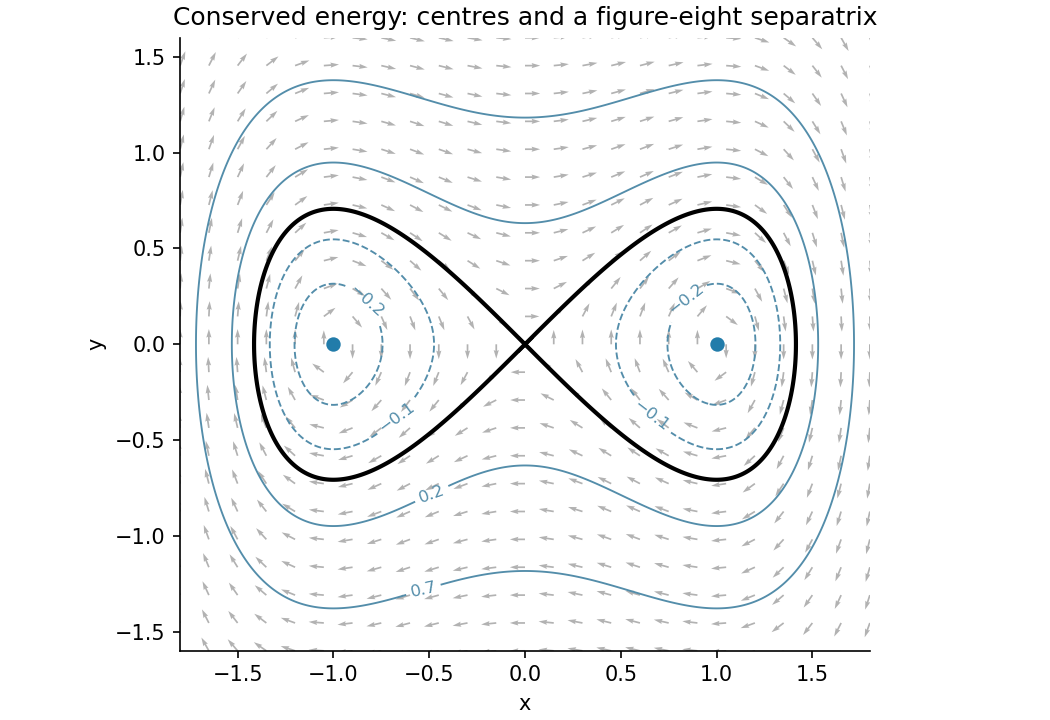
Double-well energy levels and the two homoclinic loops through the saddle
. Details. 
Articles by others on the same topic
There are currently no matching articles.