An equilibrium is asymptotically stable when it is Lyapunov stable and attracts every initial state in some neighbourhood. Lyapunov stability means that sufficiently small initial displacement stays small for all future times; attraction additionally requires convergence to the equilibrium. A Lyapunov function is a differentiable positive-definite scalar function near the equilibrium whose derivative along solutions is nonpositive. Strict negativity, or an appropriate invariant-set argument for a non-strict derivative, gives asymptotic stability.
For , equilibria satisfy and , so only is real. Its Jacobian matrix is , with eigenvalues for every . It is a linear centre equilibrium, so linearization alone cannot decide nonlinear attraction.
Use the positive proper energyFor , energy sublevel sets are compact and invariant. The zero-derivative set is the union of the axes, but its only invariant subset is the origin: on one immediately leaves that axis, and on one has . LaSalle's invariance principle therefore proves global asymptotic stability. At the conserved energy levels are closed periodic orbits, giving a nonlinear centre equilibrium. For , time reversal together with converts the system to the attracting negative- case, so the origin is a nonlinear repeller and is unstable. Nonzero forward trajectories cannot remain bounded; this does not assert existence for all time if finite-time escape occurs.
At either nonzero point the Jacobian matrix is , with eigenvaluesBoth points are attracting for and repelling for . For they are stable foci; for stable nodes. For they are unstable foci; for unstable nodes. At the two repeated-root boundaries they are degenerate nodes. At , linearization has purely imaginary eigenvalues; the conserved energy in the next part shows that they are actual nonlinear centres. Thus the zero-real-part case is resolved by an additional first integral, rather than by the linear test alone.
For , the first integral isIts minimum occurs at the two centres. Levels between and give a periodic orbit around each centre equilibrium; positive levels give larger periodic orbits surrounding both wells. The zero level is the figure-eight separatrix through the saddle, with two homoclinic loops.
On , . The printed parametrization , , taking matching signs, satisfies this identity because . It also has and , so its parameter is physical reversed time, , rather than . It is nonetheless exactly a parametrization of the requested trajectory. In physical forward time one can use , on the right loop.
Approach to the origin requires , hence infinite physical time. Equivalently near the right-loop endpoint, so the elapsed time contains the divergent integral . The point at is reached in finite time from any interior point; it is the asymptotic saddle endpoints, not that turning point, that cause the infinite total traversal time.
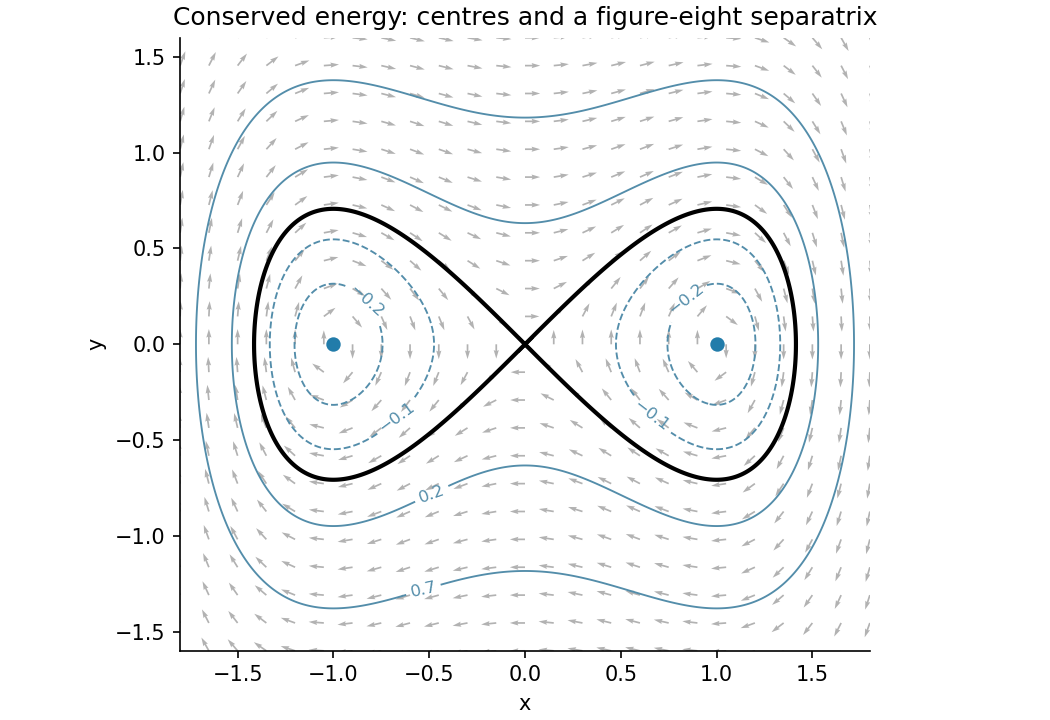
Double-well energy levels and the two homoclinic loops through the saddle
. Details. The cubic terms vanish in the linearization, leaving . Its eigenvalues are , so the origin is a repelling focus equilibrium. The nonzero imaginary part gives rotation, while the positive real part makes small amplitudes grow. In particular it cannot be the forward limit of nearby nonzero trajectories, which motivates looking for an attracting periodic orbit away from the origin.
Use , with . Dotting the vector field with the radial direction and taking its angular cross-product givesThe angular factor ranges from one to three. Hence every radial component is outward for , and every radial component is inward for . The limiting radii areThere is a minor strictness point in the wording. At the outward inequality is non-strict, with tangencies where ; at the inward inequality is non-strict, with tangencies where . Thus these are the supremum and infimum for strict crossing at all angles. The weak inequalities at the endpoints are exactly what is needed for the closed trapping annulus in the next part.
The closed annulus is positively invariant by the radial signs, and excludes equilibria there. Poincaré-Bendixson therefore yields a periodic orbit. Its stability can be established explicitly rather than inferred merely from trapping.
For the exact anisotropic radial limit cycle, set . Then , or . Its unique periodic solution isIt is positive and stays within the trapping annulus. Any other solution at the same phase has , proving radial attraction and uniqueness of the positive periodic orbit. The full planar period is , since a full angular revolution takes that time; the half-turn symmetry of the radius does not halve the period of the position vector. The nontrivial return periodic-orbit multiplier is . Thus the periodic orbit is asymptotically stable, and all nonzero forward trajectories approach it up to phase.
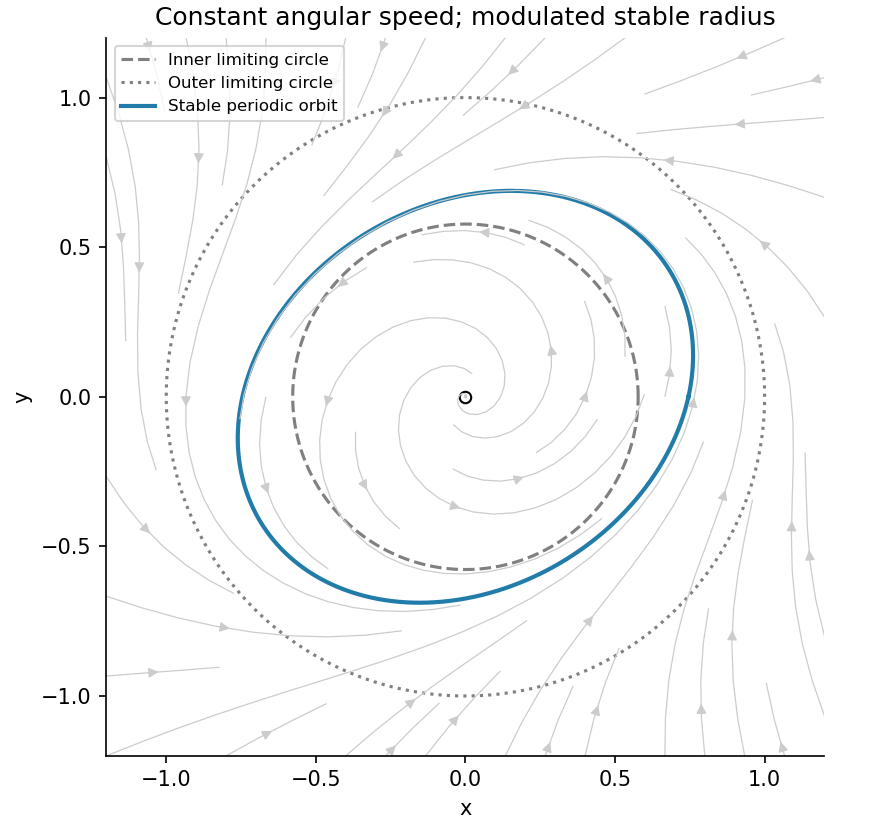
The trapping annulus and the explicitly attracting angularly modulated limit cycle
. Details. A fixed point of a map satisfies . Its linear perturbations evolve by the Jacobian matrix : both eigenvalues must lie strictly inside the unit disk for linear asymptotic stability. One inside and one outside gives a saddle; both outside give a repeller. Unit-modulus eigenvalues require nonlinear analysis, unlike the continuous-time test using signs of real parts.
Here a fixed point has and . ThereforeAt zero the characteristic equation is . Its negative root is less than for every , while its positive root crosses at . Thus zero is a saddle for and a real repeller for , with a pitchfork of fixed-point branches at .
At either nonzero point the characteristic equation is , whose discriminant is . For the fixed points are saddles. At their periodic-orbit multipliers are , giving a flip threshold. For they are attracting real nodes; at repeated-eigenvalue degenerate nodes; and for attracting foci. The Jury stability criterion conditions reduce to and , confirming the full stable interval.
At the periodic-orbit multipliers are . For larger they form a repelling focus equilibrium. This is a unit-circle crossing at a strong resonance of a planar map with ratio ; linearization alone does not justify asserting a generic nonresonant Neimark-Sacker bifurcation. The period-two branch at the flip threshold is derived next, including an additional family absent from the source's proposed quadratic.
A genuine two-cycle must have the form with . Hence . Subtracting givesLet and . Using in either original equation gives . The cubic swap-map two-cycle factorization exhibits two cases, so cancellation of would lose an actual branch.
If , then and . Thus the source's quadratic holds for this family, withThere are two reflected genuine cycles for , coalescing with the fixed points at . For their two-step Jacobian matrix, and . The unit-disk necessary inequality fails, since it is . Therefore these quadratic-family cycles are unstable for every . For these unstable asymmetric cycles of a cubic swap map, their periodic-orbit multipliers are real: one exceeds , while the other crosses at . They are saddles before that secondary threshold and repelling beyond it. Their presence on the stable side of the fixed-point flip identifies the unstable branch of a subcritical flip.
If , then and the preceding quadratic identity gives . Hence there is also the exact cycleThis antipodal cycle of a cubic swap map does not satisfy the printed condition: its product is . Along it the one-step Jacobian matrix is the same matrix at both points, so the cycle periodic-orbit multipliers are the squares of the roots of . The Jury stability criterion conditions giveAt its periodic-orbit multipliers are on the unit circle and linearization is inconclusive. Its real-to-complex transition occurs at . Thus the printed assertion about all period-two components is incomplete: it describes only , whereas the omitted antipodal cycle supplies the actual stable period-two interval.
The fixed-point branches are and beginning at . Zero is a saddle before that threshold and repelling afterwards. The nonzero branches are saddles until , attracting for , and repelling beyond their resonant unit-circle crossing. Solid portions in the diagram mark attracting states; dashed portions mark saddles or repellers.
At , the two asymmetric two-cycles split from with components , pairing the two values with the same first sign. These branches are always unstable. In addition, the antipodal two-cycle occupies the constant component levels for every , attracting only below . It must be included for the actual printed map, even though the quadratic proposed in the previous part misses it. At a given parameter the two component levels represent one cycle, rather than two independent fixed points.
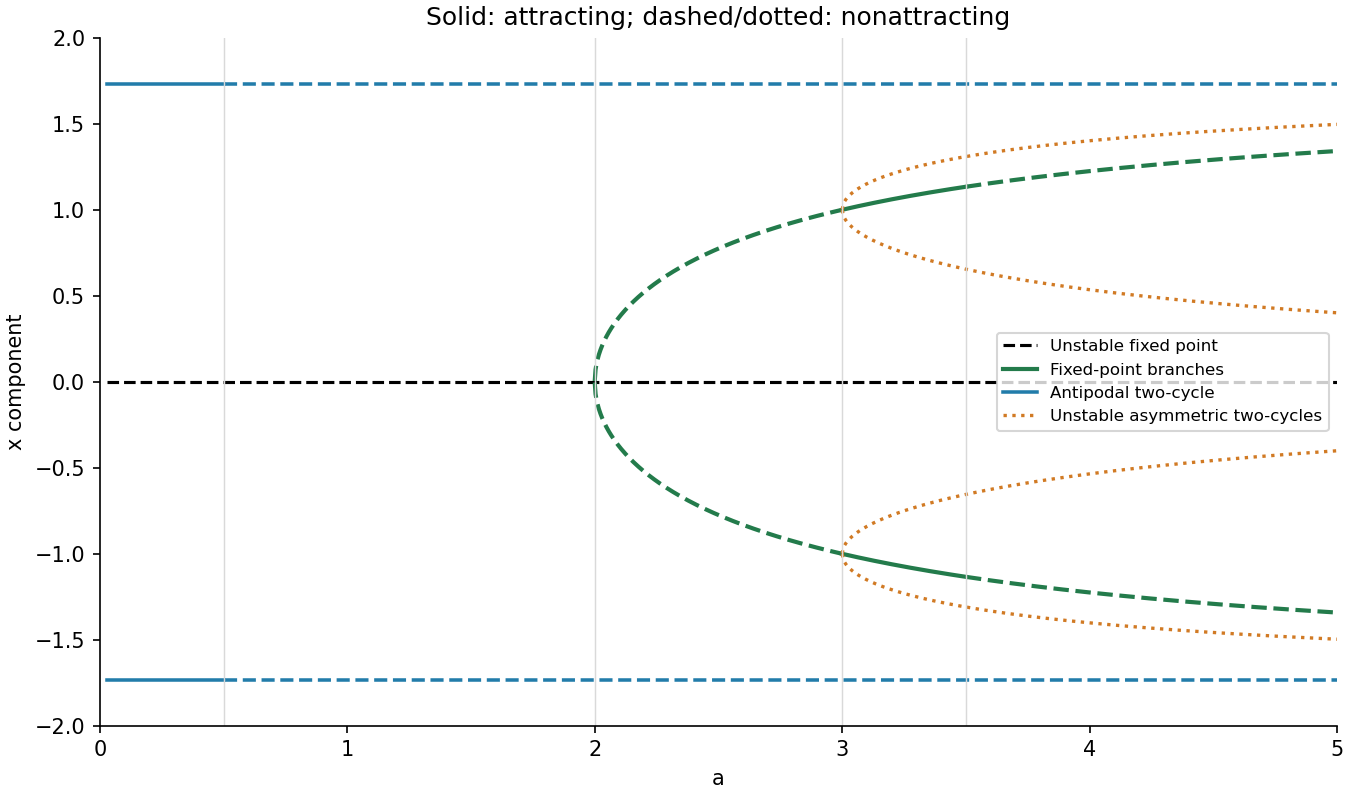
Fixed-point branches and both families of period-two cycles for the printed two-dimensional map
. Details. For an equilibrium at zero, the local stable manifold consists of nearby points whose forward trajectories remain nearby and tend to zero; the local unstable manifold is defined by backward trajectories with the analogous property. For a smooth system with , and no zero-real-part eigenvalues, the stable-manifold theorem gives manifolds tangent to the negative- and positive-real-part eigenspaces. Their dimensions are the corresponding eigenvalue counts. Real distinct eigenvalues alone are insufficient if one is zero; then a centre equilibrium direction requires additional analysis. In the saddle case each manifold is a curve, found by imposing invariance on a power-series graph through the relevant eigenvector.
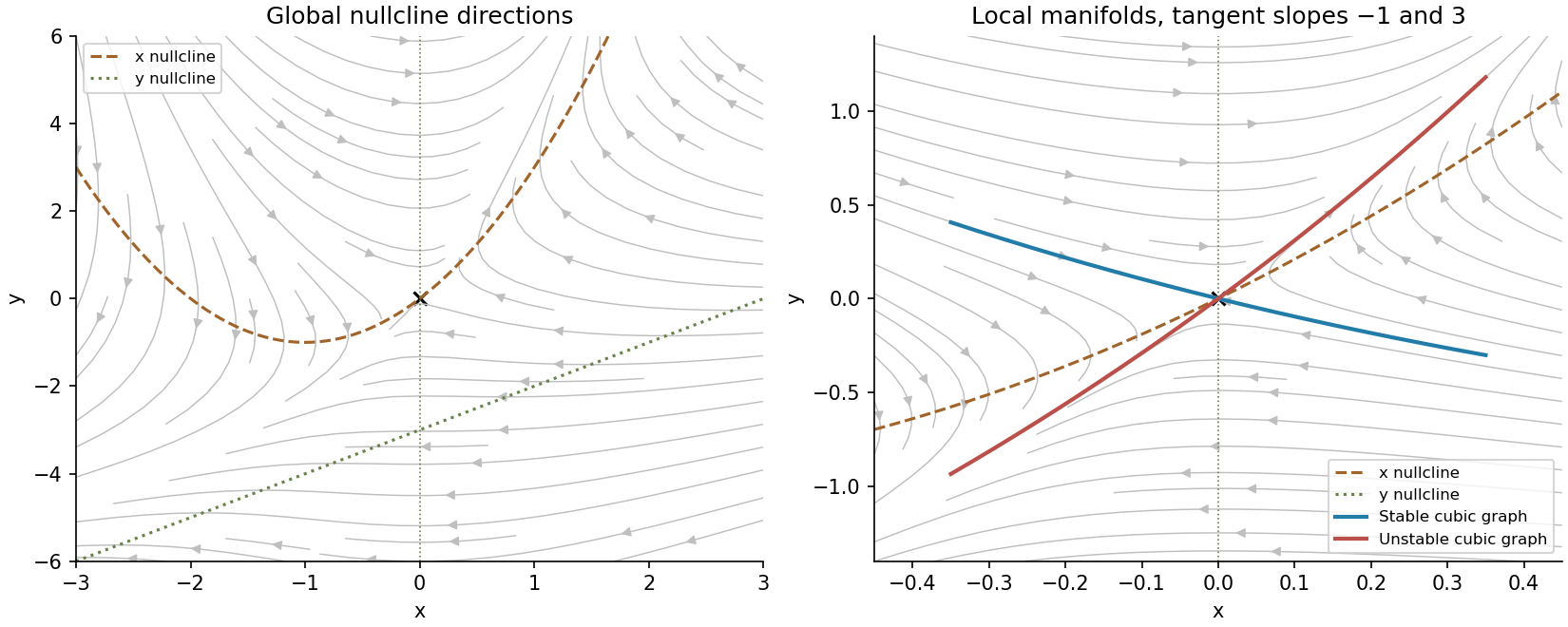
In this system, the nullcline is and the nullclines are and . Substituting the first into the second gives . Since the quadratic has discriminant , the origin is the only real equilibrium. Its Jacobian matrix has eigenvalues , with eigenvectors and . It is therefore a hyperbolic saddle.
Set for either manifold. Invariance requiresFor , matching the linear coefficient gives or . The quadratic and cubic coefficients respectively satisfyFor the stable slope , this yields , ; for the unstable slope , it gives , . ThusSubstituting back into gives the reduced dynamicsThe signs of the linear terms confirm attraction and repulsion along the respective curves.
In the phase portrait, is positive above its parabolic nullcline and negative below it; has sign . The stable branches approach the saddle and the unstable branches leave it in opposite directions. There can be no periodic orbit, since such an orbit would require total enclosed equilibrium index , while the only equilibrium has index . There is no homoclinic excursion either: eliminating gives , so a positive turning point is a strict local minimum and a negative one a strict local maximum. A loop returning to zero would require the opposite extremum somewhere. Hence bounded forward trajectories lie on the stable manifold and approach zero; other trajectories eventually leave compact regions, without a claimed universal rate or infinite-time existence at infinity. The figure shows the global nullclines and the local cubic manifold approximations; the latter are used only near zero.


Articles by others on the same topic
There are currently no matching articles.