A fixed point of a map satisfies . Its linear perturbations evolve by the Jacobian matrix : both eigenvalues must lie strictly inside the unit disk for linear asymptotic stability. One inside and one outside gives a saddle; both outside give a repeller. Unit-modulus eigenvalues require nonlinear analysis, unlike the continuous-time test using signs of real parts.
Here a fixed point has and . ThereforeAt zero the characteristic equation is . Its negative root is less than for every , while its positive root crosses at . Thus zero is a saddle for and a real repeller for , with a pitchfork of fixed-point branches at .
At either nonzero point the characteristic equation is , whose discriminant is . For the fixed points are saddles. At their periodic-orbit multipliers are , giving a flip threshold. For they are attracting real nodes; at repeated-eigenvalue degenerate nodes; and for attracting foci. The Jury stability criterion conditions reduce to and , confirming the full stable interval.
At the periodic-orbit multipliers are . For larger they form a repelling focus equilibrium. This is a unit-circle crossing at a strong resonance of a planar map with ratio ; linearization alone does not justify asserting a generic nonresonant Neimark-Sacker bifurcation. The period-two branch at the flip threshold is derived next, including an additional family absent from the source's proposed quadratic.
A genuine two-cycle must have the form with . Hence . Subtracting givesLet and . Using in either original equation gives . The cubic swap-map two-cycle factorization exhibits two cases, so cancellation of would lose an actual branch.
If , then and . Thus the source's quadratic holds for this family, withThere are two reflected genuine cycles for , coalescing with the fixed points at . For their two-step Jacobian matrix, and . The unit-disk necessary inequality fails, since it is . Therefore these quadratic-family cycles are unstable for every . For these unstable asymmetric cycles of a cubic swap map, their periodic-orbit multipliers are real: one exceeds , while the other crosses at . They are saddles before that secondary threshold and repelling beyond it. Their presence on the stable side of the fixed-point flip identifies the unstable branch of a subcritical flip.
If , then and the preceding quadratic identity gives . Hence there is also the exact cycleThis antipodal cycle of a cubic swap map does not satisfy the printed condition: its product is . Along it the one-step Jacobian matrix is the same matrix at both points, so the cycle periodic-orbit multipliers are the squares of the roots of . The Jury stability criterion conditions giveAt its periodic-orbit multipliers are on the unit circle and linearization is inconclusive. Its real-to-complex transition occurs at . Thus the printed assertion about all period-two components is incomplete: it describes only , whereas the omitted antipodal cycle supplies the actual stable period-two interval.
The fixed-point branches are and beginning at . Zero is a saddle before that threshold and repelling afterwards. The nonzero branches are saddles until , attracting for , and repelling beyond their resonant unit-circle crossing. Solid portions in the diagram mark attracting states; dashed portions mark saddles or repellers.
At , the two asymmetric two-cycles split from with components , pairing the two values with the same first sign. These branches are always unstable. In addition, the antipodal two-cycle occupies the constant component levels for every , attracting only below . It must be included for the actual printed map, even though the quadratic proposed in the previous part misses it. At a given parameter the two component levels represent one cycle, rather than two independent fixed points.
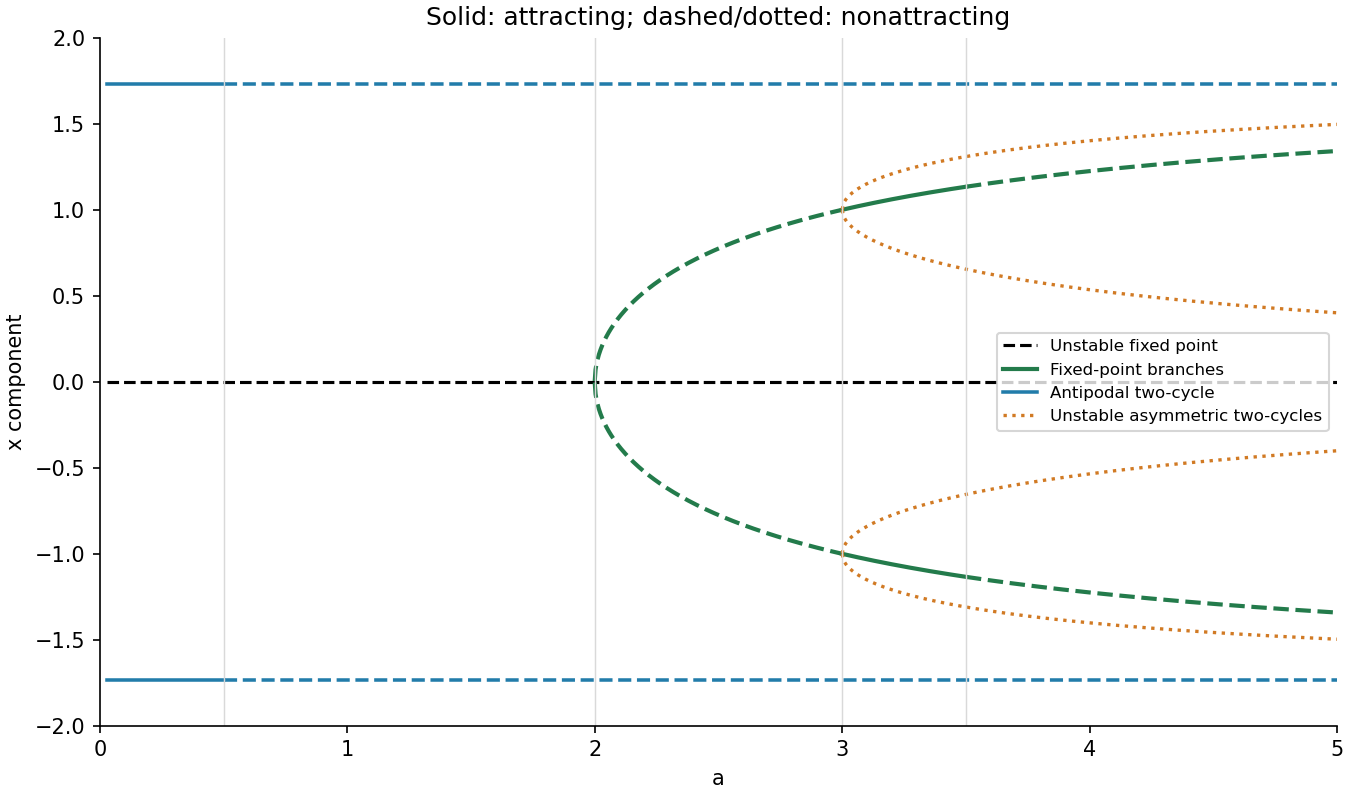
Fixed-point branches and both families of period-two cycles for the printed two-dimensional map
. Details. 
Articles by others on the same topic
There are currently no matching articles.