A lift of is a continuous map satisfying . The covering homotopy theorem says that a homotopy has a unique lift once a continuous lift of its initial map is prescribed. No additional local connectivity assumption on is needed for this homotopy-lifting statement.
To prove injectivity on fundamental groups, let a loop based at project to a based null-homotopic loop. Lift its null-homotopy, starting with . The two endpoint tracks lift constant paths at starting at , so remain at by uniqueness of path lifting. The final path lies in the discrete fibre over and starts at , so it is constant. Thus the lifted homotopy contracts relative its basepoint, provingIn the following constructions, take around the circle factor and around the projective-plane factor. Above each sheet point, the circle has one incoming and one outgoing lifted edge. A fixed sheet for carries an identity cover of ; a transposed pair of sheets is joined as the antipodal fibre of a sphere covering . These pieces give genuine covering neighbourhoods at the wedge point as well as away from it.
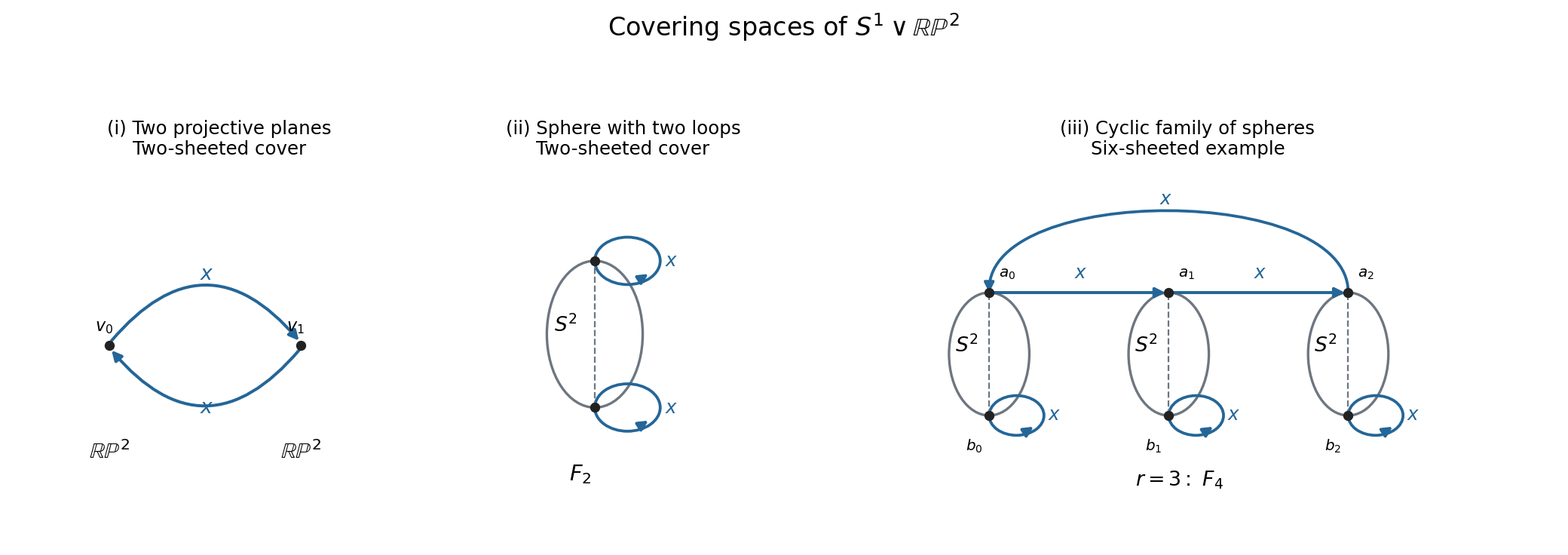
Use two sheet points . Attach a copy of at each, each mapping identically onto the projective-plane summand. Put an oriented edge from to and another from to , each mapping once along the cut-open circle. This is a connected two-sheeted cover.
Its underlying two-edge circle contributes one infinite cyclic free factor, and its two attached projective planes contribute two factors of order two. Collapsing one of the connecting edges, or applying Seifert-van Kampen theorem, givesChoose the first edge as a tree path to . The circle loop projects to , and the two projective-plane generators project to and . By injectivity from the preceding proof,The order-two relations come from the respective projective planes; there are no additional relations between these free factors.
Take the sphere double cover and denote the two points above the wedge point by . Attach one circle at each point, mapping identically onto the circle summand. At both points there is one incoming and one outgoing branch, so this is a connected two-sheeted cover of the wedge.
The sphere is simply connected, while each attached circle supplies one generator. Join the two attachment points by an arc in the sphere and collapse that contractible arc; the fundamental group is the free product of the two circle groups, hence free of rank two. A lift of joins to . The two loop generators therefore project toInjectivity of the covering map identifies their subgroup with the free group on these two generators.
Put . Take spheres, each mapping by the double cover onto , and write their antipodal sheet points as for . Add an oriented edge from to , with indices modulo , and add an loop at each . Every sheet point has the required two circle branches, so the resulting space is a -sheeted cover. It is connected because the edges form a cycle and each sphere connects its own two sheet points.
Choose a connecting arc from to in each sphere. Collapsing these arcs leaves the spheres simply connected, and leaves a graph with vertices, one cyclic edge at each step through the , and one additional loop per vertex. This graph has edges and rank . The sphere summands add no fundamental-group generators. Thus the cover has free fundamental group of rank .
Based at , choose the first cyclic edges as a spanning tree. The closing cycle projects to . To traverse the loop at , travel along the tree by , use the sphere connector projecting to , traverse its loop, and return. The resulting free basis in the base group isThere are exactly elements. For this is the previous pair . Again injectivity of a covering's induced map makes these actual subgroups with the claimed free bases, rather than just quotient presentations.

Articles by others on the same topic
There are currently no matching articles.