Topology and Groups and Algebraic Topology, Trinity Term; Wednesday 3 June 2009, 2.30pm–5.30pm. The intact cover lists Mathematics Part B, Mathematics Part C, and Mathematics and Philosophy Part C under the same module code. Both sections and all six questions are covered here. The full five-page source is retained in a private editable transcription. It was supplied through the past-papers disclosure, in original Part C bundle pages 222–226. No exact worked-answer advertisement was found in the bounded check.
An edge loop is a finite sequence of vertices , starting and ending at , in which consecutive distinct vertices span an edge. Two such sequences are equivalent when related by finitely many elementary edge homotopies, with endpoints fixed: insert or delete a repeated vertex, cancel or insert a spur , and replace by or conversely when the vertices lie in one simplex. Repetitions are allowed in this last convention; a nondegenerate move uses a triangle.
The edge-loop group consists of these equivalence classes, with product given by concatenating the sequences at . Elementary moves remain valid inside a longer concatenation, so this product is well defined. Concatenation is associative after the harmless repeated base vertex is removed; the constant edge loop is the identity. Reversing a sequence gives its inverse, because a sequence followed by its reverse cancels by successive spurs. Thus these operations do form a group.
Realize an edge loop as a piecewise linear path in the geometric realization . A spur contracts in an edge, and a triangle move is a homotopy across that triangle, always fixing endpoints. Hence realization gives a well-defined map to the fundamental group. Realization respects concatenation up to endpoint-preserving reparametrization, so is a homomorphism.
The relative Simplicial approximation theorem says that a continuous map from a finite complex to a geometric realization is homotopic, after sufficiently fine subdivision of its domain, to a simplicial map, with a chosen already simplicial subcomplex kept fixed. Apply its based-circle version to a loop, keeping its marked vertex at . The resulting subdivided simplicial circle traverses edges, so every based homotopy class has an edge-loop representative. Thus is surjective.
For the full two-skeleton, use the triangles through to replace each edge of a loop by . Degenerate cases use repeated-vertex or spur moves. The resulting path contracts by spurs, so its edge-loop group, and therefore its fundamental group, is trivial. This also covers one or two vertices, when only repeated vertices and spurs are needed.
If the deleted triangle has vertices , choose a fourth vertex . Its boundary is filled by the three present triangles , and : their union is the cone from on that boundary. Every elementary homotopy that formerly crossed the missing triangle can therefore be replaced by a homotopy through these three triangles, staying in . Since the one-skeleton has not changed, the same contraction of any edge loop is available in . Surjectivity of its realization map gives
A canonical presentation of a group uses a symbol for each and relations for every pair. Evaluation to is surjective, and is its inverse homomorphism; the relation with implies . Thus this presentation recovers any group.
The pushout of the two homomorphisms isHere is the free product, and the denominator is the normal closure. Its canonical maps satisfy . The universal property says that maps agreeing on factor uniquely as for one homomorphism . The free-product universal property first gives the map before quotienting, and agreement makes it kill precisely the imposed relations, proving this property.
Suppose is generated by , and are finite presentations with disjoint generator sets. Choose words representing . ThenAgreement on these generators implies agreement on every word in , so these finitely many extra relations suffice by the universal property. No finite presentation for is required.
The Seifert-van Kampen theorem states that for a space covered by path-connected open sets with path-connected nonempty intersection and basepoint in that intersection, is the pushout of .
To see the two bands in the Klein bottle model, take one region to be and the other to be the outer strips , , joined along the top-bottom identification. Each is an interval bundle over the horizontal circle, and going once around reverses its transverse coordinate. For the middle band use the coordinate ; for the outer band use the signed coordinate about zero modulo one. Both are therefore Möbius bands. Their common boundary is the one circle represented by the lines , joined at the identified vertical sides. They cover the whole bottle and are glued along that circle.
A Möbius band deformation retracts onto its core circle, so its fundamental group is infinite cyclic. Going once around its boundary traverses the core twice: one pass along one boundary edge changes sides, and the second pass returns. After choosing core generators and consistent boundary orientation, the two inclusion maps from the common circle send its generator to and . Thicken the bands slightly so their overlap is an annular neighbourhood of their common boundary. Seifert-van Kampen theorem then givesReversing a chosen generator absorbs an opposite boundary parametrization, so the presentation is independent of that sign choice.
A lift of is a continuous map satisfying . The covering homotopy theorem says that a homotopy has a unique lift once a continuous lift of its initial map is prescribed. No additional local connectivity assumption on is needed for this homotopy-lifting statement.
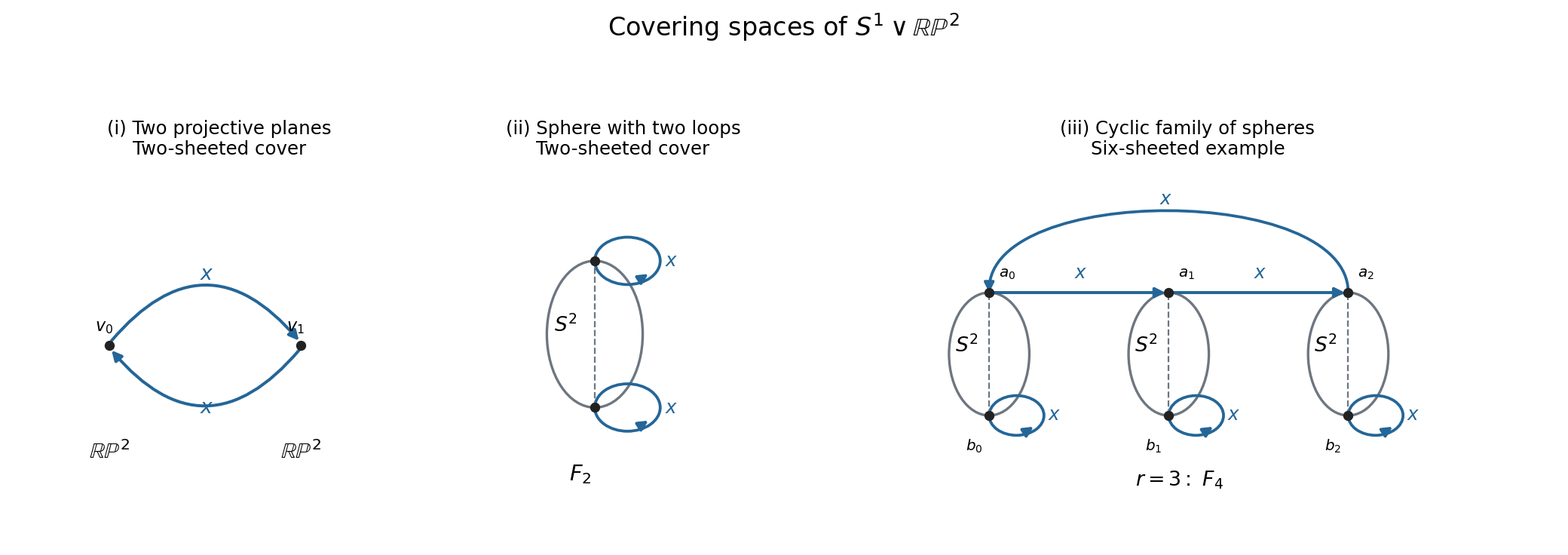
To prove injectivity on fundamental groups, let a loop based at project to a based null-homotopic loop. Lift its null-homotopy, starting with . The two endpoint tracks lift constant paths at starting at , so remain at by uniqueness of path lifting. The final path lies in the discrete fibre over and starts at , so it is constant. Thus the lifted homotopy contracts relative its basepoint, provingIn the following constructions, take around the circle factor and around the projective-plane factor. Above each sheet point, the circle has one incoming and one outgoing lifted edge. A fixed sheet for carries an identity cover of ; a transposed pair of sheets is joined as the antipodal fibre of a sphere covering . These pieces give genuine covering neighbourhoods at the wedge point as well as away from it.
Use two sheet points . Attach a copy of at each, each mapping identically onto the projective-plane summand. Put an oriented edge from to and another from to , each mapping once along the cut-open circle. This is a connected two-sheeted cover.
Its underlying two-edge circle contributes one infinite cyclic free factor, and its two attached projective planes contribute two factors of order two. Collapsing one of the connecting edges, or applying Seifert-van Kampen theorem, givesChoose the first edge as a tree path to . The circle loop projects to , and the two projective-plane generators project to and . By injectivity from the preceding proof,The order-two relations come from the respective projective planes; there are no additional relations between these free factors.
Take the sphere double cover and denote the two points above the wedge point by . Attach one circle at each point, mapping identically onto the circle summand. At both points there is one incoming and one outgoing branch, so this is a connected two-sheeted cover of the wedge.
The sphere is simply connected, while each attached circle supplies one generator. Join the two attachment points by an arc in the sphere and collapse that contractible arc; the fundamental group is the free product of the two circle groups, hence free of rank two. A lift of joins to . The two loop generators therefore project toInjectivity of the covering map identifies their subgroup with the free group on these two generators.
Put . Take spheres, each mapping by the double cover onto , and write their antipodal sheet points as for . Add an oriented edge from to , with indices modulo , and add an loop at each . Every sheet point has the required two circle branches, so the resulting space is a -sheeted cover. It is connected because the edges form a cycle and each sphere connects its own two sheet points.
Choose a connecting arc from to in each sphere. Collapsing these arcs leaves the spheres simply connected, and leaves a graph with vertices, one cyclic edge at each step through the , and one additional loop per vertex. This graph has edges and rank . The sphere summands add no fundamental-group generators. Thus the cover has free fundamental group of rank .
Based at , choose the first cyclic edges as a spanning tree. The closing cycle projects to . To traverse the loop at , travel along the tree by , use the sphere connector projecting to , traverse its loop, and return. The resulting free basis in the base group isThere are exactly elements. For this is the previous pair . Again injectivity of a covering's induced map makes these actual subgroups with the claimed free bases, rather than just quotient presentations.

For , the integral singular homology of the sphere is , , and zero in other degrees. For there are two components, so . Choose an orientation generator for positive dimension. The degree of a map is the integer satisfyingTo define a local degree of a continuous map at over , require to be isolated in that fibre. A small neighbourhood contains no other preimage of , so maps to . By excision their local top homology groups are both , with generators fixed by the orientations. Multiplication by an integer in this induced map defines . Without fibre isolation, this particular local-degree definition is not in general available.
If is finite, the local-degree formula isIndeed excision identifies with the direct sum of the local groups at the . The global fundamental class maps to the vector of their local orientation generators, namely . Naturality of the map of pairs sends that vector to in the local group at . The other route through the naturality diagram sends the global class by first and therefore gives . The map from the target sphere's top homology to its local homology is an isomorphism, so the two integers agree. Empty fibres give degree zero by the same argument. Standard approximation by a homotopic smooth map permits the formula to be used with regular values when an original continuous map has no convenient finite fibre.
Identify with the unit complex numbers and put for any integer , including the constant map for . A lift of its angular coordinate to the real line is , so it sends the oriented circle's fundamental class to times itself. Thus .
The natural suspension isomorphism in reduced homology identifies with and intertwines a map with its suspension. This isomorphism follows from Mayer-Vietoris sequence for the two contractible suspension cones, and its naturality gives the intertwining. Since , suspending a sphere self-map preserves degree. Repeating this construction givesThe positive-dimension convention is necessary for the arbitrary-degree assertion; self-maps of the two-point space do not realize arbitrary integers on reduced homology.
Let be the antipodal map, whose degree is . The invariance condition is . Multiplicativity of degree gives , so if is even,For odd , factor the invariant map uniquely through the quotient , writing . The standard orientability and homology facts for Real projective space are that is orientable in odd dimension and has top integral homology . With compatible orientation the double cover has degree two: both local sheets preserve orientation because the antipodal map does. Thus is multiplication by an integer and .
Every such integer occurs. In the oriented projective space, choose a small oriented closed ball and collapse its exterior to a point. The resulting map has degree one, because a point in the interior image has one orientation-preserving preimage. Composing it with a degree- sphere map from part (b) givesHere denotes the dimension- map constructed by suspension. The factorization through makes the resulting map antipodally invariant.
A CW complex is built from a discrete set of zero-cells by attaching -discs along maps of their boundary spheres into the previous skeleton. Its topology is the weak topology determined by the characteristic maps, and each cell closure meets only finitely many cells. The k-skeleton is the union of cells of dimension at most , with .
Set . This is the free abelian group on the -cells. The cellular boundary map is with the maps in the question. In the long exact sequence of the pair , the consecutive maps areExactness gives . HenceAt the lowest indices put negative chain groups equal to zero.
The cellular homology is . For a field , use , the vector space with basis the -cells, with the same connecting-and-quotient construction. Its homology is . Equivalently tensor the integral free cellular chain complex with . The cellular homology theorem identifies these with singular homology using the same coefficients.
The identifications yield one vertex, one-cells and one two-cell, whose boundary word is . Thus the integral cellular chain complex, in degrees two, one and zero, hasFor the first map is injective. The vector is primitive and extends to an integral basis, so quotienting by twice that vector givesWith , every boundary map vanishes. HenceFor cohomology, dualize the free cellular complex. The only nonzero possible coboundary over is , . Its kernel is free of rank and its image is . ThusOver the cochain maps are zero too, giving , , and zero higher groups. In particular the integral top homology and top cohomology differ, as their explicit complexes show. Finally the cell count gives
A closed manifold is a compact manifold without boundary. Here is Hausdorff and every point has a neighbourhood homeomorphic to an open subset of ; the usual countability condition is included in the manifold convention. Compactness also gives a finite atlas and hence second countability.
A local orientation at is a choice of generator of . An orientation of a manifold is a compatible choice of these generators as varies: locally they are induced by the same coordinate-ball orientation, or equivalently by a local relative homology class. For an oriented closed manifold, the fundamental class is the unique class mapping to the chosen generator at every point. On disconnected closed manifolds this is the sum of the fundamental classes of their finitely many components.
For a triangulated or Delta complex description, orient the top-dimensional simplices compatibly with the local orientation and sum them with their corresponding signs. Each codimension-one face appears twice with opposite induced orientations, so the sum is a cycle. At a point inside any top simplex its image is the prescribed local generator, so this cycle represents . In the connected case generated by this class.
The homology conclusions below use the opening closed-manifold hypothesis for . That hypothesis is necessary if their later description is read independently: removing a ball from for creates a nonzero st homology group, so the claimed isomorphism would fail without closedness.
Remove the ball interiors. Each remaining piece inherits an orientation of a manifold and hence a boundary orientation. Choose the orientation on the second piece, reversing its original choice if necessary, so that the gluing map identifies these boundary orientations oppositely. Its two possible orientation signs are accommodated by this choice.
Near a glued point, the two half-space collar charts combine to give a full Euclidean chart. The opposite induced boundary orientations make the two interior orientations agree in this chart. Away from the seam, keep the orientations already chosen on the two pieces. These fit together globally, so the connected sum is orientable. This does not require that an arbitrarily chosen gluing preserve both initially specified orientations unchanged.
Write for either connected closed oriented manifold and for its embedded closed ball. A precise relative form of Poincare duality for a compact locally contractible subset isThis is Poincaré-Alexander duality. It applies to the printed closed-ball complement without replacing by its interior. Since is contractible, the relative group is at and zero otherwise. Naturality identifies with restriction , which is an isomorphism because both spaces are connected. Equivalently, the fundamental class restricts to the relative orientation generator on the ball.
In the long exact sequence of a pair, the only potentially exceptional part is thereforeExactness gives and the desired isomorphism in degree . In every lower degree both adjacent relative terms are zero, so the same exact sequence gives the remaining isomorphisms. ThusFor the pieces used in the gluing, the same conclusion follows from excision and the pair , or from the radial deformation of a punctured ball to its boundary. These pieces also have zero top homology, and the image of their boundary sphere's fundamental class is zero: it is the boundary of their relative oriented fundamental chain.
Let and . Use open thickenings of the two pieces, whose intersection deformation retracts onto . The Mayer-Vietoris sequence then has terms from and .
For , the pieces and intersection are connected. The map on from the intersection is and is injective; it gives and contributes no extra degree-one class. In intermediate degrees the sphere has no homology, except potentially at . At that degree its map to is zero because each oriented boundary sphere bounds the punctured piece's relative fundamental chain. Using , the top part of the sequence therefore gives and . The injection just noted handles the adjacent term when .
Together with part (ii), the answer isFor , each connected closed manifold is a circle and each punctured piece is an interval. The intersection is with two components: its map to the two interval components has rank one and kernel . Mayer-Vietoris gives , so the same displayed formula holds, with no intermediate degrees. The usual connected-sum construction here uses positive dimension.
Articles by others on the same topic
There are currently no matching articles.