The product topology has basisOpen subsets of the product are arbitrary unions of these rectangles. The rectangles cover the product and their finite intersections are rectangles, so they satisfy the basis axioms. Equivalently, this is the smallest topology making both coordinate projections continuous.
First assume both factors are nonempty. If the product is compact, its continuous coordinate projections are onto, so each factor is compact by the continuous image of a compact space theorem.
For the converse, let be compact and let be an open cover of their product. Fix . For every , choose a basis rectangle containing and lying in a cover member . Compactness of gives finitely many covering . Thenis an open neighbourhood of , and is covered by the corresponding finitely many .
The sets cover . Compactness gives finitely many of them covering , and the finitely many cover members associated to these choices now cover . Hence the product is compact. This is the finite-product Tychonoff theorem proof, with the finite intersection creating a uniform neighbourhood along each fibre.
As printed, the assertion omits the nonempty hypothesis. If and , the product is compact while is not. The fully correct version without any nonemptiness assumption is
The interval is compact by the Heine-Borel theorem, so its square is compact by part (a). The half-open interval is not compact because it is not closed in the real line.
Each of the other two products has a continuous surjective coordinate projection onto . If either product were compact, that image would be compact, a contradiction. Compactness is preserved by homeomorphisms, so neither product is homeomorphic to the closed square.
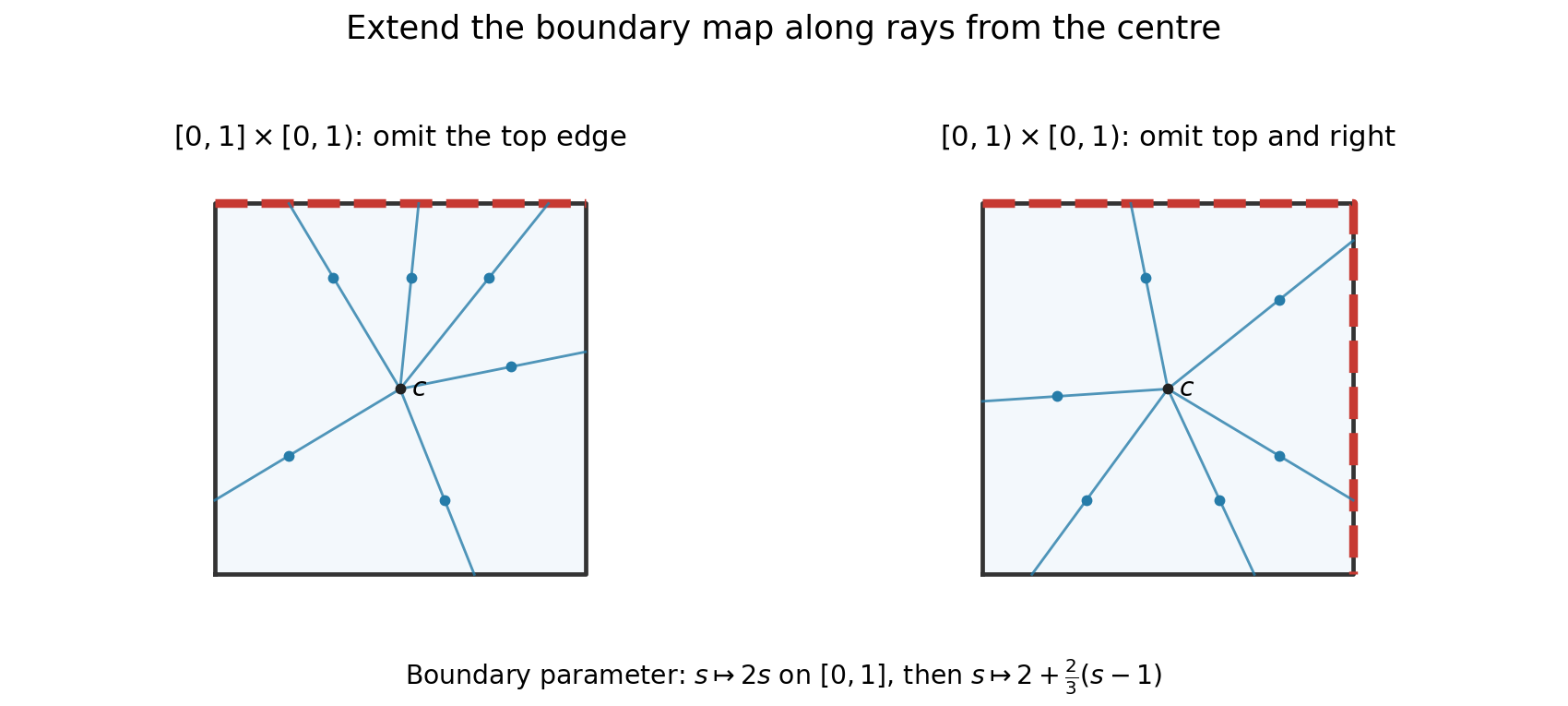
A boundary reparameterization gives an explicit homeomorphism. Let , with centre , and parametrize its boundary once byHere . The omitted top edge of is . The omitted top and right edges of are .
Use the increasing boundary parameter mapIt takes bijectively onto itself, respects the identified endpoints, and maps the first omitted arc exactly onto the second. Extend it radially:Every noncentral point has a unique boundary ray and a unique radial parameter ; the only duplicate boundary parameters are zero and four, whose images agree. The inverse uses by the same construction. Both maps are continuous off the centre, and at the centre their radial distances tend to zero. Thus is a homeomorphism of the whole closed square.
It carries the first omitted edge precisely onto the second omitted pair of edges, so restriction givesThis is the radial extension of a square boundary homeomorphism; it avoids any need to treat corners as topologically distinguished points.

Articles by others on the same topic
There are currently no matching articles.