A Fourier sine series automatically meets the zero-temperature boundary conditions because . Equivalently, extend oddly from to and then periodically with period . Its Fourier series has only sine terms, withThe coefficient formula follows from the orthogonality identityFor piecewise smooth initial data the series equals at interior continuity points and the average of its one-sided values at interior jumps. More general square-integrable data have convergence in L2 norm convergence. A classical solution continuous at the initial corners additionally requires , in agreement with the prescribed boundary conditions.
Substitute the proposed Fourier sine series into the heat equation:Projecting onto each sine using orthogonality gives for every mode with . The initial condition fixes , since already describes the initial amplitude. HenceFor a mode with , the value of is immaterial and the same convention is convenient. The positive thermal diffusivity damps every mode, with higher frequencies decaying faster. For square-integrable initial data the damping justifies termwise differentiation for and recovery of the initial data in L2 norm convergence as .
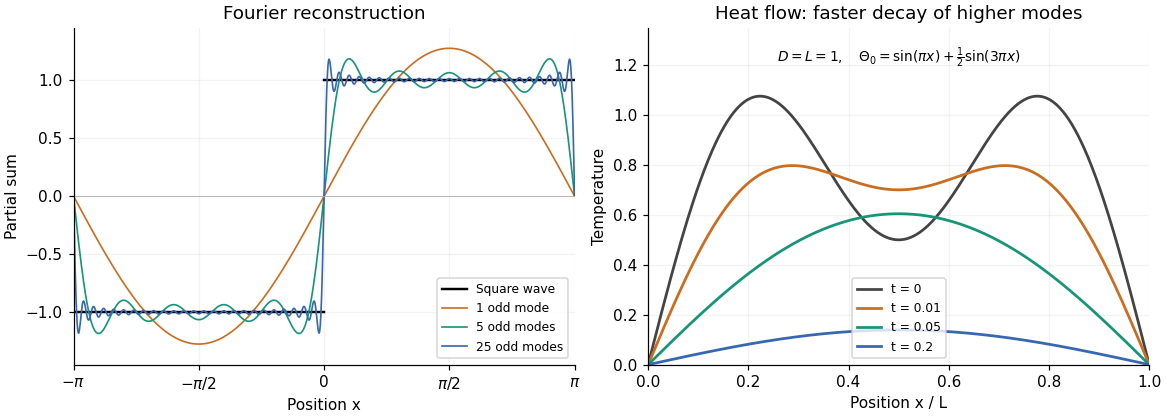

The left panel illustrates the Fourier series in part (b). The right panel is a self-generated example with and , showing the two normal modes decaying at rates and .
Articles by others on the same topic
There are currently no matching articles.