For nonzero , let be its angle to the unit vector . The scalar projection on the oriented axis is . Since , the dot product identity gives . Multiplying that signed scalar by places the foot at .
The residual is perpendicular to the axis, because . An obtuse angle gives a negative scalar and a foot on the negative side of the line; has projection zero without needing an angle.
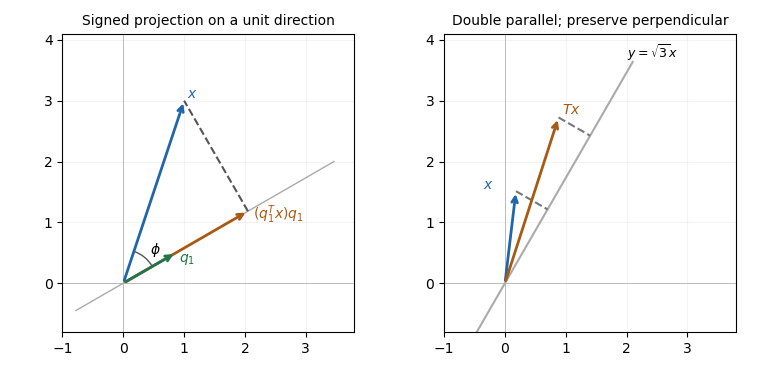
Projection drops a perpendicular to a unit direction; directional stretching doubles only the parallel component
. Details. 
The first panel is a constructed geometric illustration. The second illustrates the directional stretch used later in Question 6.
Consequently for every . Taking successively as the standard basis vectors shows that every column of this difference is zero. Hence . Equality on one selected vector would not suffice; here it holds on all vectors.
Using the unit length of ,Then ordinary matrix expansion gives . Both and its complementary matrix are projectors. The second calculation in fact holds for every idempotent matrix, without requiring the matrix to equal its transpose.
Take . It has exactly two nonzero entries, both one, but . Thus it is not an idempotent matrix. Its being an orthogonal matrix does not make it an orthogonal projector.
Conversely, if , then , which explicitly writes as an image of a linear map under . Hence . The two inclusions prove . No orthogonality assumption was used.
Set . Since , the previous result applies to this projector and gives . Substituting proves . These are the kernel-image identities for complementary projectors.
For a sum of mutually orthogonal projectors, orthonormality gives for and one for . Therefore equals zero for different indices and for equal indices. Expanding the finite sum yieldsThus every stated partial sum is a projector. Its image of a linear map is the span of the first orthonormal set of vectors; arbitrary sums of idempotent matrices would not have this conclusion.
The image of a linear map of is exactly the one-dimensional span of : its formula always returns a multiple of , and . Hence .
The rank-nullity theorem gives . Since by (e)(i), . This includes the case , where the complementary projector is zero.
Articles by others on the same topic
There are currently no matching articles.