False. Set . For ,Iteration gives a growing geometric sequence as a lower bound for . Hence and no eventual constant can bound , as Big O notation would require.
True. Rationalizing the square root gives, for ,The uniform bound is exactly the assertion in Big O notation.
True. The logarithm identity givesFor , , so . By monotonicity of the natural logarithm, the expression lies between and . It is therefore in Big O notation.
False. On every odd positive integer , . Given any proposed Big O notation constant and threshold , choose an odd . Then , contradicting the required bound. The behavior on even integers cannot repair this failure on an unbounded subsequence.
The prime numbers form the lower antichain; the nonprime elements form the upper antichain. In particular, is not a prime number. Each lower element is below each upper element, and no third element can lie strictly between them. Therefore the six cover relations are , represented by the following Hasse diagram. Upward movement represents increasing order; crossing lines do not add elements.
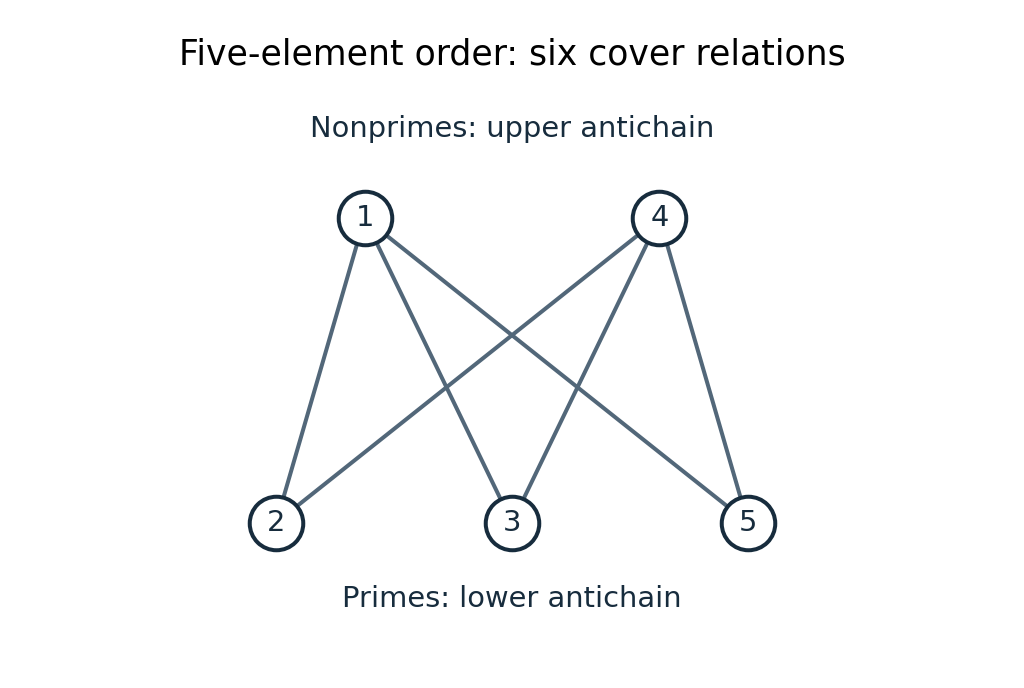

Write for the prime numbers in and for its nonprime elements. Since , both antichains have at least two elements: and . Every element of is below every element of . We can classify a subset by its intersection with these two levels of the two-level partial order.
- If , every element of is an upper bound. There is no maximum, because has no elements, and no least upper bound, because the distinct elements are incomparable minimal elements of .
- If with , its upper bounds are ; its maximum and least upper bound are both .
- If has at least two elements, its upper bounds are exactly . There is no maximum in and no least upper bound, because has at least two incomparable elements.
- If , its only upper bound is : no different element is above this nonprime element. Since every remaining element of is a prime number, belongs to and dominates all of it. Thus is both its maximum and its least upper bound.
- If contains at least two elements of , these distinct nonprime elements have no common upper bound, and has neither a maximum nor a least upper bound.
Consequently an upper bound exists exactly when ; a maximum or least upper bound exists exactly when or is a singleton subset of . The exhaustive cases also justify why the last two existence criteria coincide here.
Articles by others on the same topic
There are currently no matching articles.