Use base-ten logarithms and dimensionless thermodynamic activities at the stated temperature and pressure. Define and . The concentration notation is an ideal dilute-solution approximation with a consistent concentration reference.
With pure solids and unit water activity, the two reaction quotients are and . Equating them to the corresponding equilibrium constants givesThe slopes on the mineral activity diagram are and . The lines meet at , within the negative silica-logarithm range.
Subtract the nepheline–corundum reaction from the albite–corundum reaction and divide by two. In the albite-to-nepheline direction the resulting net reaction isAdditivity of the standard Gibbs energy of reaction makes the logarithms of the equilibrium constants combine with the same coefficients:This normalization is per one albite formula unit. The doubled reaction has , and reversing the reaction changes its sign.
The net reaction quotient is when the solid and water activities equal one. Therefore its equilibrium line isa vertical line through the intersection of the other two. There is no dependence on , because the net reaction contains neither hydrogen ions nor sodium ions.
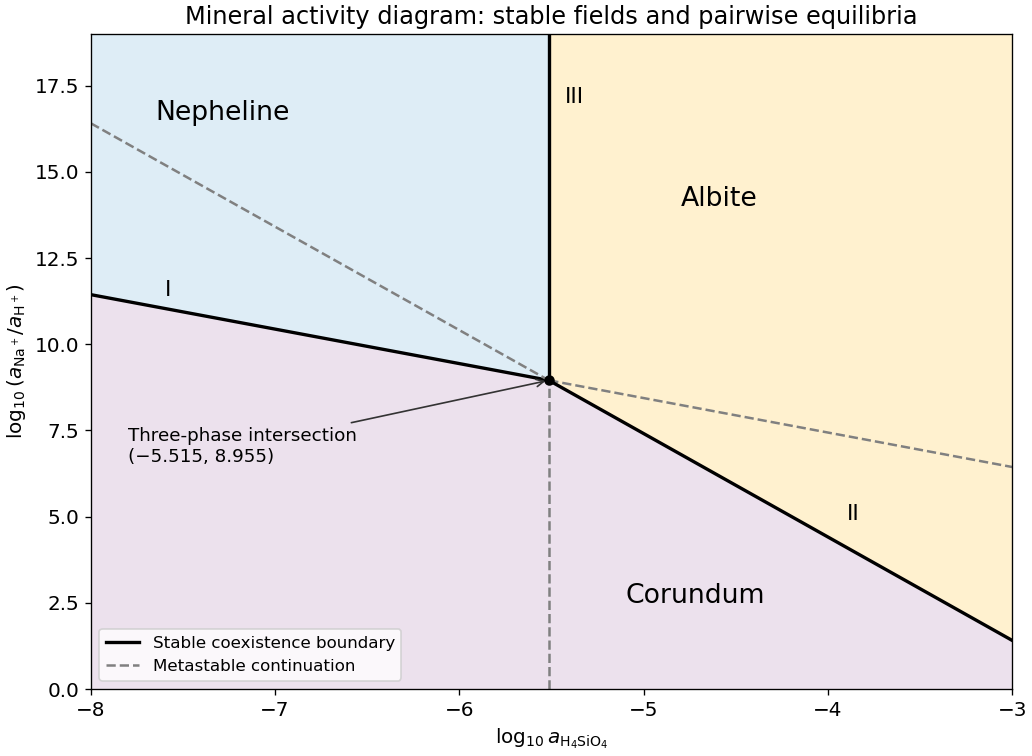
Stable and metastable mineral boundaries for the common albite-nepheline-corundum equilibrium example
. Original diagram computed from the supplied equilibrium constants. Solid lines show stable coexistence; dashed continuations are metastable. Logarithms are base ten. Details.
A stability boundary in a mineral activity diagram must also be stable against the third mineral. Use the common-potential test for a three-mineral activity diagram. For the two corundum-producing directions,Negative values favour corundum. For the albite-to-nepheline conversion, , so low silica activity favours nepheline and high silica activity favours albite. These comparisons give:
All three coexist at the intersection. Pairwise mass-action equations alone do not distinguish the stable segments from their metastable extensions.
Articles by others on the same topic
There are currently no matching articles.