The geomorphology of active normal faulting records a competition between accumulated tectonic displacement and the ability of erosion, transport and deposition to modify it. A hanging wall moves down relative to a footwall, producing a fault scarp, mountain-front relief, and accommodation space for a sedimentary basin. Repeated earthquakes can build a large front even though each individual surface break is much smaller.[ref]
Normal-fault geomorphic features by United States Geological Survey. The primary mapping report's table of geomorphic features lists scarps, faceted spurs, oversteepened mountain fronts and rejuvenated valley floors as common normal-slip indicators.
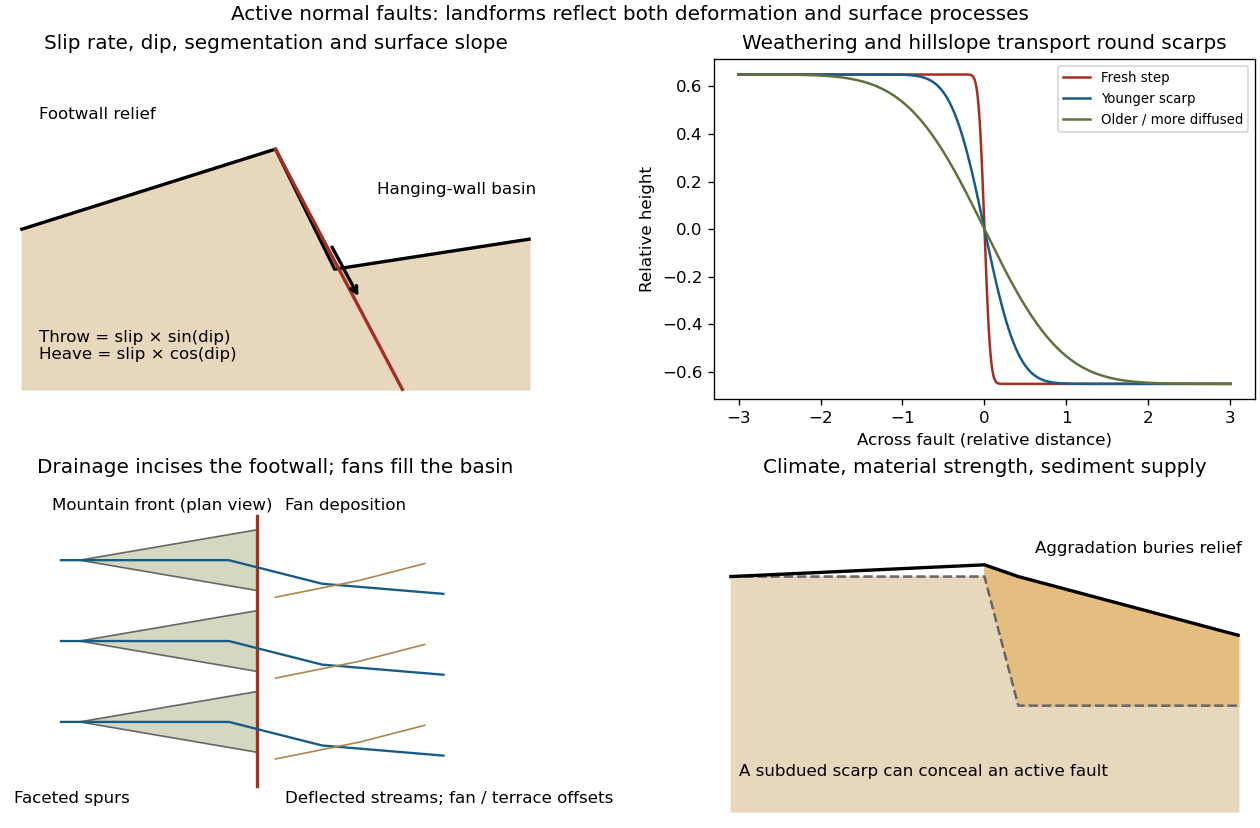
Original sketches of tectonic, erosional and depositional controls on normal-fault landforms
. The panels distinguish cumulative block displacement, progressive scarp rounding, drainage and faceted mountain fronts, and burial of a scarp by sediment. Geometries and relative scales are illustrative. Details.
The principal controls and their observable effects are:
- Displacement, rate and timing. Larger single-event fault slip creates a higher fresh scarp; repeated slip builds cumulative offsets of fans and river terraces. The interval since the latest rupture controls degradation. For pure dip-slip faulting on a plane dipping , vertical fault throw is and horizontal fault heave is . Scarp height on an inclined eroded surface need not equal either the slip or the original vertical throw.
- Geometry and structural history. Fault dip, strike, curvature, segmentation, splays and along-strike variations in fault slip control scarp orientation and continuity. Linked faults can create a stepped front; synthetic and antithetic faults can create a graben. Cumulative deformation includes broad footwall uplift and hanging-wall tilting as well as a sharp break.
- Lithology and cover. Strong exposed bedrock can preserve steep scarps and fresh fault surfaces. Weak fractured rock, thick regolith and loose alluvium weather and slump more rapidly, spread deformation, and produce debris at the scarp base. Differential erosion can make a lithological front without recent tectonic movement, so a straight cliff alone is not sufficient evidence of activity.
- Climate and surface transport. Rainfall, runoff, frost action, vegetation and slope processes control scarp rounding and colluvium production. Steep new faces collapse towards stable slopes; later hillslope transport rounds the crest and fills the toe. A simple scarp diffusion model broadens a step over a length proportional to , but only if a suitable transport law and comparable material and climate apply.
- Drainage and sediment supply. Footwall uplift can incise channels and produce river terraces, knickpoints and triangular faceted spurs. Hanging-wall subsidence can pond drainage, deflect streams and promote alluvial fans and basin filling. Rapid aggradation can bury an active scarp, while stream incision can remove or exaggerate local relief.
- Preservation and initial landscape. Pre-existing slopes, relief, surface ages, glacial modification and human disturbance determine where offsets can be recognized. A fan abandoned long before the latest earthquake can accumulate more offset than a younger nearby surface. Compare like-age markers across a fault, and distinguish a mountain front's long history from a single event.
Useful observations therefore include scarp profiles, repeated offsets of dated surfaces, drainage organization, and continuity along strike. A high rugged front is not by itself evidence of a high present fault slip rate; conversely, a muted or buried scarp need not mark an inactive fault.
A surface-reaching normal fault earthquake commonly produces a down-facing step towards the hanging wall, accompanied by extension across the break. A fresh free face can expose bedrock, polish or striations, roots or offset soil. The actual rupture is usually irregular: fault slip changes along strike, separate strands overlap or step, and tension fissures, small grabens and secondary cracks distribute part of the extension.
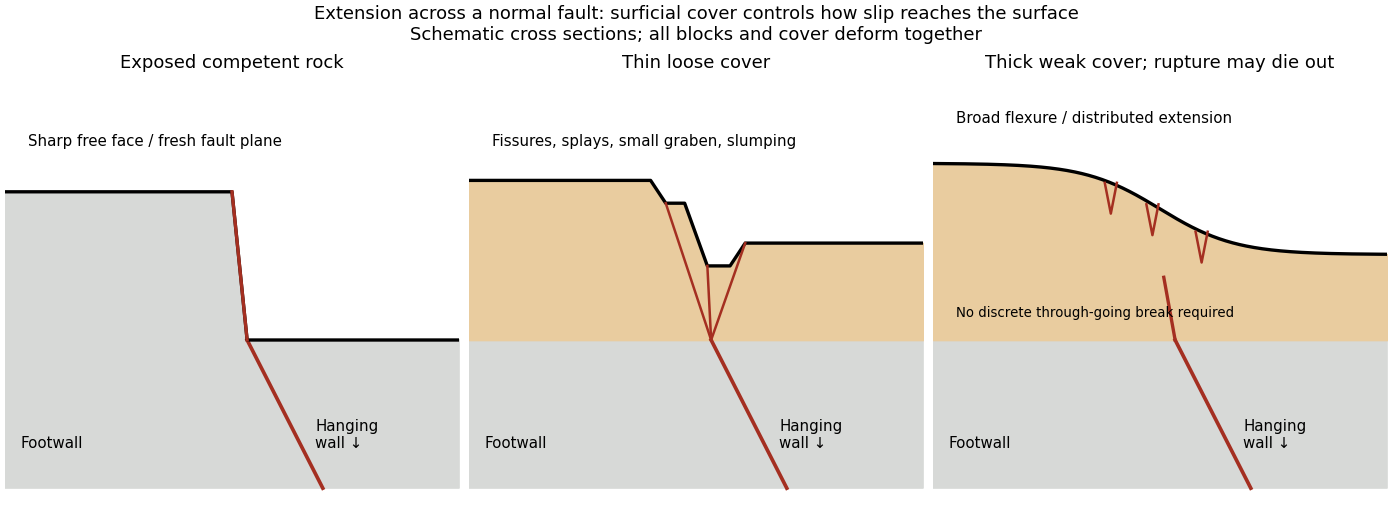
Original cross sections showing how surficial cover changes normal-fault surface rupture
. Competent exposed rock localizes a sharp free face; thin loose cover permits splays and a small graben; thick weak cover can accommodate a buried fault tip by broad flexure and distributed extension. Details.
Exposed competent rock or very thin cover: a relatively narrow, sharp break can closely follow the principal fault plane. A steep free face can be recognizable immediately, then weather and shed debris. The face need not be vertical or maintain the same height along strike.
Loose granular or poorly consolidated cover: the main shear can splay upwards through alluvium or regolith. Open fissures, step-like scarps, rotated blocks, synthetic and antithetic normal faults, and a small intervening graben can form across a wider zone. Collapse and raveling quickly build colluvium at the toe. A single rupture event can therefore create several parallel breaks; counting them does not count earthquakes.
Thick weak or cohesive cover: deeper fault slip can be transferred into distributed shear strain, tilted beds, broad warping or monoclines, with tension cracks above a propagating tip. A discrete break may be attenuated or absent if the fault remains blind. Cover thickness alone is not enough to predict the response: cohesion, grain size, layering, saturation, rupture displacement and fault depth also matter. Saturated loose sediment can additionally develop soil liquefaction, sand blows or lateral spreading; these are secondary shaking effects and do not independently locate the tectonic rupture.
The observed vertical step, crack aperture and total width of disturbed ground should be measured separately. Reconstruct the total displacement across all strands and account for the original ground slope. Landslides or gravitational spreading can imitate normal-fault scarps, so map connections to the main fault and displaced markers rather than assuming every open crack is primary tectonic slip.
Excavate across the mapped fault scarp, approximately perpendicular to its strike, at a site where young sediments record and preserve deformation. On cleaned trench walls log bedding, soil horizons, shear zones, fissure fills, buried surfaces and colluvial wedges. Correlate the same marker beds across the fault before reconstructing individual displacements.
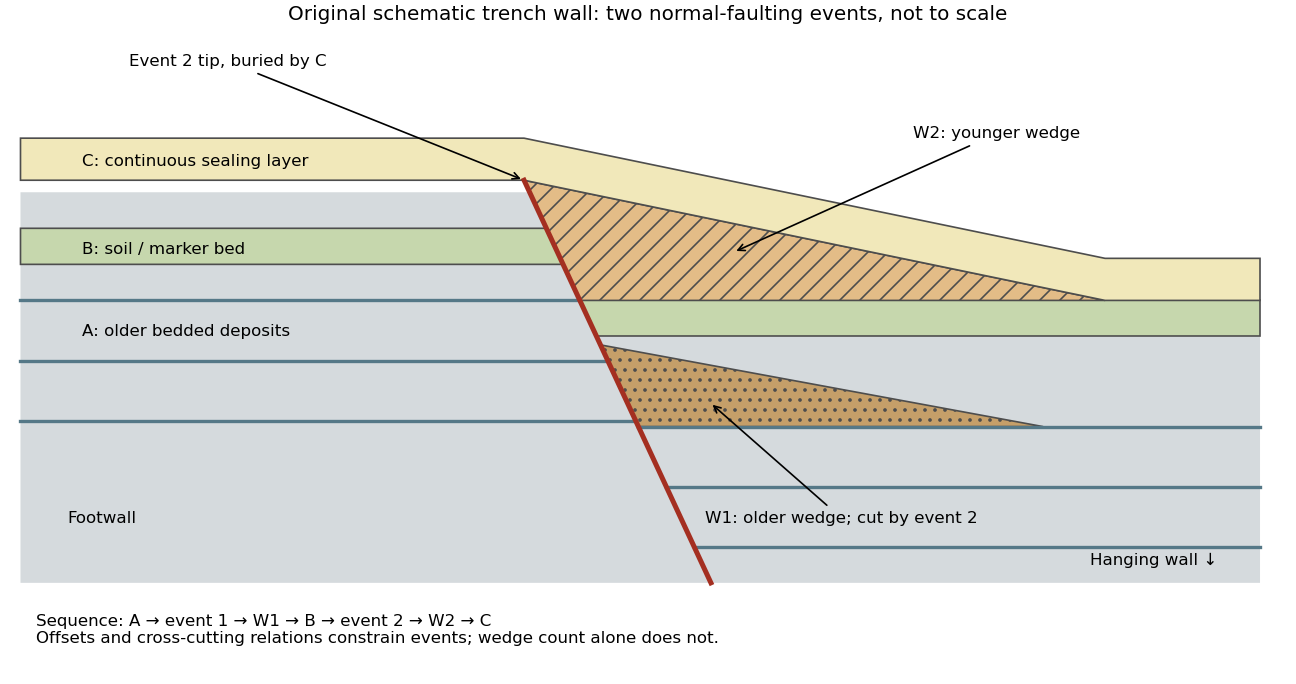

- A fault or fissure cuts older layers but terminates below an undeformed sealing deposit. The event occurred after deposition of the youngest demonstrably displaced material and before deposition of the oldest demonstrably sealing material.
- A fresh free face sheds coarse angular debris, often thickest against the scarp and thinning into the hanging wall; later finer slopewash can overlie it. A buried soil horizon between successive colluvial wedges can indicate a period of stability separating events. Fissures filled from above can preserve collapsed soil blocks or distinctive younger sediment.
- Older markers may have larger offsets than younger markers. A lower wedge or soil cut and displaced by a younger shear, then overlain by a new wedge and an intact seal, gives a cross-cutting basis for at least two events. Changes in displacement should be reconstructed across all fault strands.
- Rapid tilting, growth of accommodation space, abrupt changes in deposit thickness, and locally ponded beds can corroborate the structural evidence. Soil liquefaction structures or shaking-induced landslides may support a chronology, but do not alone prove surface rupture on the trenched fault.
In the drawing, A was faulted in event 1; W1 accumulated; B buried and stabilized that surface. Event 2 displaced A, W1 and B, after which W2 accumulated and C sealed the fault tip. Thus A records two events, B one and C none. This combination of offset and sealing relationships is stronger evidence than identifying two wedge-shaped units alone.
Bracket event ages with multiple samples just below and above the event horizons. Suitable short-lived organic material can be dated by radiocarbon dating; optically stimulated luminescence dating can constrain deposition of appropriate mineral grains. Reworked old charcoal, younger roots, incomplete bleaching, erosional gaps and time elapsed between rupture and wedge deposition must enter the age interpretation. For calendar dates, only when those deposits genuinely bracket the rupture; a radiocarbon age in years before present reverses the numerical ordering.[ref]
Introduction to paleoseismology by United States Geological Survey. “Finding Paleoearthquakes” explains disrupted layers followed by unbroken cover; “Determining the Age of a Paleoearthquake” explains dating deposits above and below the event horizon.
One earthquake can generate several debris pulses and wedges; repeated earthquakes may reuse one strand without leaving separable deposits. Erosion, bioturbation, nondeposition, lateral facies changes and upward-dying splays can hide events or mimic terminations. Confirm relationships on both trench walls and, when possible, in adjacent exposures. The result is a minimum supported event sequence with age intervals, not an assumption of perfectly periodic recurrence or one earthquake per wedge.
Articles by others on the same topic
There are currently no matching articles.