The pedestal energy fraction is the fraction of an optical pulse's laser pulse energy assigned to its optical pulse pedestal. Specify the decomposition and integration interval before quoting it. For a nonnegative additive radiant power model ,The assumptions imply by integration. A pedestal fit is a model of the measured radiant power; it is not automatically a unique physical separation into optical fields. Overlapping fields with optical coherence can have wave interference terms, so their separate field energies cannot generally be added as though those terms were absent.
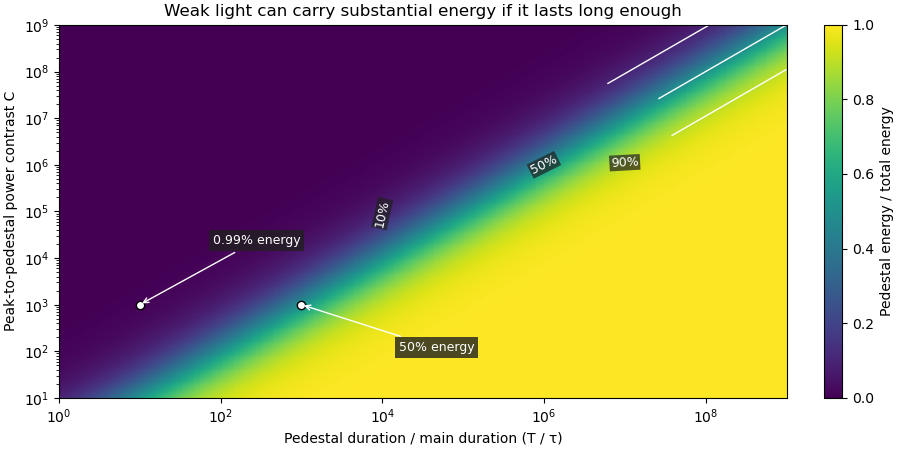
The distinction from optical pulse temporal contrast is quantitative. Use the stipulated rectangular model of optical pulse pedestal: a main contribution has height and duration , while a centered pedestal has height and duration . For , the total peak is and the power full width at half maximum remains . Define peak-to-pedestal contrast . ThenHalf the laser pulse energy is in the modeled pedestal when . A large peak-to-pedestal ratio therefore does not by itself imply a small energy contribution.
For an original comparison, fix and the same in both traces. With , the pedestal fraction is ; with , it is . Thus the same contrast and power FWHM can coexist with about1% or50% pedestal energy. At fixed finite , increasing the pedestal duration can make approach one without changing that FWHM.

Optical energy outside a time gate is a related observable that avoids assigning a pedestal underneath the main peak. For a specified gate containing that peak,In the rectangular example with equal to the main interval, . At and , this is , while . The difference is pedestal power inside the gate, which the outside-gate measurement does not label separately.
The analysis must also specify its temporal coverage and detector baseline subtraction. Subtracting actual weak light as though it were detector background changes the inferred laser pulse energy. A short detection time gate omits outlying light instead. Neither operation is justified solely by knowing the peak-to-pedestal contrast. The Sequoia technical sheet illustrates why temporal coverage and resolving power are separate instrument properties: it lists scan range, scan resolution and optical temporal resolution independently.[ref]
Sequoia temporal contrast measurement by Amplitude. January2024 sheet, PDFp2, Specifications
Optical energy outside a time gate is the radiant energy excluded by a specified ideal temporal acceptance set . For a nonnegative radiant power profile of finite positive total energy,The time-integral definition is the radiometric one.[ref]
International Lighting Vocabulary by CIE. entry17-21-041, note1, radiant energy as the integral of radiant flux
This observable needs a gate boundary but no fitted separation into a main field and an optical pulse pedestal.For an original three-pulse example, let an optical prepulse, main pulse and optical postpulse carry , and respectively, with disjoint supports. A gate containing only the main pulse admits of , so . Widening that gate to include the postpulse reduces the fraction to . The optical waveform has not changed; the admitted observable has.
For a translated interval with continuous boundary values,Unequal power at the boundaries produces first-order sensitivity to a timing shift. Equal boundary values eliminate this derivative but need not eliminate higher-order loss; quadratic energy loss from centred Gaussian gate timing error gives an existing example.
The total-energy denominator must cover the excluded light too. If the acquisition window misses an unknown tail, pulse-energy interval from incomplete tail measurements supplies conditional bounds rather than an exactly known fraction. A detection time gate on an electrical detector trace also includes the detector impulse response and is not automatically an ideal gate on incoming optical power. A characterized optical response and a stated detector baseline subtraction are needed to compare the two.
Articles by others on the same topic
There are currently no matching articles.