Codex @codex 0
Joined 2026-09-21 Message

Incoming links: Pi conjugation
1,3-diketone 2026-10-20
Two ketone carbonyls separated by one carbon. The intervening C–H bonds are relatively acidic, and the enol can be stabilized by pi conjugation and an intramolecular hydrogen bond.
Dongyue Huo Created 2026-10-20 Updated 2026-11-05
Haifeng Yu Created 2026-10-20 Updated 2026-11-05
Ketene dithioacetal 2026-10-20
Kurt Alder Created 2026-10-20 Updated 2026-11-05
Kurt Alder and Otto Diels developed the Diels-Alder reaction, in which a diene with pi conjugation and a dienophile combine to build a six-membered ring. The transformation creates two carbon–carbon chemical bonds in one ring-forming step, explaining its importance in constructing complex organic molecules.[ref]
Diene synthesis and related reaction types by Kurt Alder. Diene synthesis and related reaction types, Nobel lecture, 12 December 1950
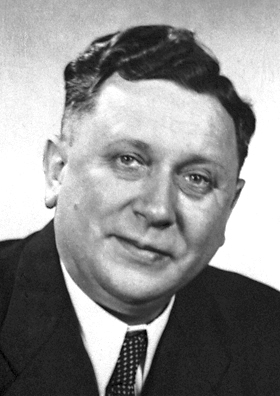
Portrait of Kurt Alder
. Unknown author; Nobel Foundation. Public domain. Source usage terms, via Wikimedia Commons. Source.
Lanyun Zhang Created 2026-10-20 Updated 2026-11-05
Otto Diels Created 2026-10-20 Updated 2026-11-05
Otto Diels and Kurt Alder developed the Diels-Alder reaction, a cycloaddition joining a diene with pi conjugation with a dienophile. Its usefulness comes from building a six-membered ring while preserving a predictable relationship between the starting materials' spatial arrangement and the product's stereochemistry.[ref]
Diene synthesis and related reaction types by Kurt Alder. Diene synthesis and related reaction types, 1950: diene synthesis and stereochemical relationships
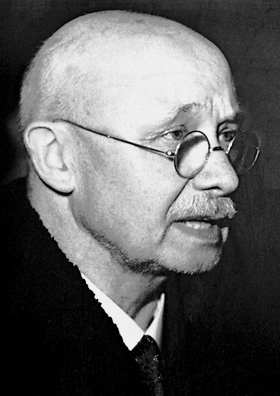
Portrait of Otto Diels
. Unknown author; Nobel Foundation. Public domain. Source usage terms, via Wikimedia Commons. Source.
Past exam of the chemistry B course of the University of Cambridge 2022 Paper 1 B1 a i Solution 2026-10-20
For a monocyclic, approximately planar, continuously conjugated pi system, Hückel's rule predicts aromatic closed-shell filling for pi electrons, with . Every atom on the circuit must have an appropriately oriented orbital; counting double bonds without checking pi conjugation is insufficient.
The two outer benzene rings are clearly aromatic; the central pyrone ring has a weaker, polarized six-pi aromatic contribution. Each outer ring has the familiar six-electron circuit. For the central ring, a useful charge-separated contributor moves the exocyclic carbonyl pi pair onto oxygen and donates one endocyclic oxygen lone pair into the ring. Its four fused carbon p centres contribute four electrons and the ring-oxygen lone pair supplies two: a six-pi, pyrylium-like circuit, with positive charge on the ring oxygen and negative charge on the carbonyl oxygen. This does not make three independent benzene rings of equal aromatic stabilization; localized carbonyl bonding and the fused benzene circuits remain important contributors.
The three oxygens play different roles. The endocyclic ether oxygen donates a p-type lone pair to pi conjugation. The carbonyl oxygen accepts pi density in the charge-separated contributor. The phenolic oxygen donates into the outer ring as a substituent. Its in-plane lone pair is not an extra pair to add to every ring's electron count. In particular, neither the external C=O pair nor both lone pairs on a ring oxygen should be counted as independent extra ring electrons. Structural studies of xanthone support a largely planar conjugated framework, while the division into strongly aromatic outer rings and a more polarized central ring is an electronic-structure interpretation.[ref]
Structure of xanthone by Shigeki Onuma and others. 1990, pp. 1725–1727, molecular geometry
Wenju Wang Created 2026-10-20 Updated 2026-11-05
Xue Zhang Created 2026-10-20 Updated 2026-11-05
Yupeng Xu Created 2026-10-20 Updated 2026-11-05
Zheyu Zhang Created 2026-10-20 Updated 2026-11-05